

Month: January 2018
Colombia Birding Trip Report: Endemics in Putumayo & Huila
26 - 01 - 2018
Triumph in the Andes: Chasing Colombia’s Rarest Endemics in Putumayo & Huila
Trip Report: Private ‘Southeastern Regions’ Tour (Jan 14 – 24, 2018) with Hans Jornvall
This specialized, tailor-made journey through the rugged southeastern regions of Putumayo and Huila was a tremendous success. Designed specifically for Hans Jornvall from Sweden , the trip saw him add nine new species to his impressive life list, which already boasted over 9,200 species. More than just a birding tour, this expedition was a rewarding immersion into Colombia’s rich Andean and Amazonian foothills, yielding unforgettable experiences and stunning views of highly sought-after avifauna.
Trip Summary
| Tour | Private ‘Putumayo & Huila Expedition’ |
| Duration | 11 Days / 10 Nights (Jan 14 – 24, 2018) |
| Guide | Brayan Coral Jaramillo (BTC Lead Guide) |
| Lifer Count | 9 New Species seen, plus 2 ‘heard only’ |
| Key Endemics | Upper Magdalena Tapaculo, Dusky-headed Brush-Finch |
| Key Highlight | Excellent views of Chestnut-bellied Cotinga |

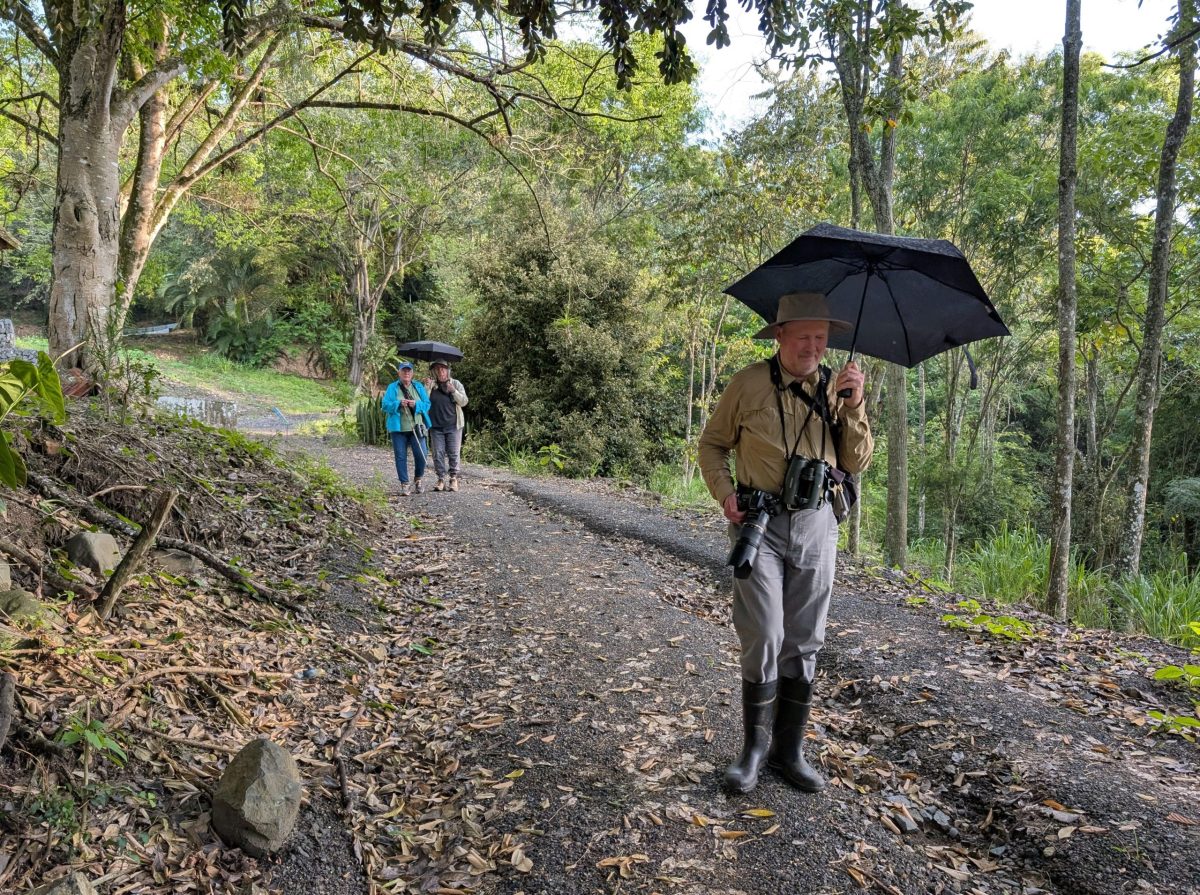
Hans Jornvall after returning from the mid-Magdalena Valley. We stopped at a typical restaurant entering Bogota.
Trip Highlights
The challenging terrain and focused effort paid off with spectacular sightings:
- Andean Endemics: Obtaining great views of the magnificent Chestnut-bellied Cotinga (Doliornis remseni) and Masked Mountain-Tanager (Buthraupis wetmorei) while visiting Paramo de Bordoncillo was a thrilling start.
- The Sicklebill Prize: A major highlight was successfully seeing the Buff-tailed Sicklebill (Eutoxeres condamini) at the beautiful Isla Escondida private nature reserve.
- Tinamous & Tapaculos: A true stroke of luck was finding a Highland Tinamou (Nothocercus bonapartei) sitting on a nest after a challenging ascent by horse near Pitalito. Near this same location, in dense Chusquea bamboo, the group enjoyed excellent views of the endemic Upper Magdalena Tapaculo (Scytalopus rodriguezi).
- Brush-Finches & Antbirds: The group was excited to find both the stunning White-rimmed Brush-Finch (Atlapetes leucopis) at El Trampolín de Las Aves and the endemic Dusky-headed Brush-Finch (Atlapetes fuscoolivaceus) along the road from Mocoa to Pitalito. The gorgeous pair of East Andean Antbird (Drymophila caudata) seen in the bamboo stands was another memorable sighting.

The picturesque poirt at Laguna de La Cocha.
Key Species Observed
Here is a selection of the most notable species sighted (or heard) during the expedition, demonstrating the region’s incredible biodiversity:
| Species Name | Location/Context | Status/Observation |
| Chestnut-bellied Cotinga (Doliornis remseni) | Paramo de Bordoncillo | Great views |
| Masked Mountain-Tanager (Buthraupis wetmorei) | Paramo de Bordoncillo | Great views |
| White-rimmed Brush-Finch (Atlapetes leucopis) | El Trampolín de Las Aves | Splendid views |
| White-streaked Antvireo (Dysithamnus leucostictus) | Campucana Trail (near Mocoa) | Successful sighting |
| Buff-tailed Sicklebill (Eutoxeres condamini) | Isla Escondida | Seen well; highly wanted |
| Highland Tinamou (Nothocercus bonapartei) | Steep mountain near Pitalito | Found sitting on a nest |
| Upper Magdalena Tapaculo (Scytalopus rodriguezi) | Dense bamboo near Pitalito | Endemic; seen well |
| East Andean Antbird (Drymophila caudata) | Dense bamboo near Pitalito | Gorgeous pair seen |
| Dusky-headed Brush-Finch (Atlapetes fuscoolivaceus) | Mocoa to Pitalito road | Endemic; found roadside |
| Chestnut-headed Crake (Anurolimnas castaneiceps) | Isla Escondida | Heard only, a few meters away |
| Black Tinamou (Tinamus osgoodi) | Campucana Trail (near Mocoa) | Heard but not seen |

A second view of El Puerto, at Laguna de La Cocha.
The Andean Foothills: Pasto, Bordoncillo & Mocoa
The journey began with a flight into Pasto, followed by a picturesque overnight stay at Laguna de La Cocha. The real climbing started the following day at Paramo de Bordoncillo, a stunning high-altitude ecosystem, or páramo, where the air is crisp and the species are magnificent. We obtained great views of the magnificent Chestnut-bellied Cotinga (Doliornis remseni) and the Masked Mountain-Tanager (Buthraupis wetmorei).
On our descent towards Mocoa, we birded El Trampolín de Las Aves, where the group enjoyed splendid views of the White-rimmed Brush-Finch (Atlapetes leucopis). Near Mocoa, along the Campucana Trail, we were successful with the White-streaked Antvireo (Dysithamnus leucostictus) but only heard the elusive Black Tinamou (Tinamus osgoodi).
Isla Escondida & the Amazonian Transition
The mid-point of the tour was spent at Isla Escondida, a private nature reserve set by co-author of Birdwatching in Colombia, Jurgen Beckers. Here, the team found a major success by seeing well the highly wanted Buff-tailed Sicklebill (Eutoxeres condamini). The dense cover also revealed the very shy Chestnut-headed Crake (Anurolimnas castaneiceps), heard only a few meters away from us.
The Pitalito Highlands: Tapaculos and Tinamous
The most challenging section of the itinerary proved the most rewarding for endemics. Near Pitalito, we had essential support from local guides Jorge Peña and Roso Ortiz. A strenuous, yet successful, ascent by horse to a steep mountain near the town led to an incredible discovery: a Highland Tinamou (Nothocercus bonapartei) sitting on a nest.
Targeted birding in the dense bamboo stands (Chusquea spp.) yielded excellent views of the endemic Upper Magdalena Tapaculo (Scytalopus rodriguezi). This habitat was equally fruitful for another spectacle: a gorgeous pair of the East Andean Antbird (Drymophila caudata). Finally, along the road from Mocoa back toward Pitalito, we located the endemic Dusky-headed Brush-Finch (Atlapetes fuscoolivaceus).
The group flew out of Pitalito back to Bogotá on Avianca, concluding an extremely focused and successful expedition.
We extend our deep gratitude to our local support team:
- Brayan Coral Jaramillo: Provided excellent logistical organization and additional guidance throughout the main trip.
- Jorge Peña and Roso Ortiz: Gave crucial support near Pitalito, ensuring success in a challenging area.
This adventure stands as a testament to the incredible, untouched birding opportunities found across Colombia’s interior regions. From high-altitude paramo to dense bamboo stands, the landscapes were as rewarding as the birds themselves, especially when a lifer is waiting!
If you’re inspired by Hans Jornvall’s success and are ready to tackle the elusive tapaculos, antbirds, and unique endemics of Putumayo and Huila, let Birding Tours Colombia design your next tailor-made expedition. Come find your next nine lifers with us!
In the previous week (January 7 – 13), we birded the Rio Claro canyon & Bellavista Forest in mid-Magdalena Valley for White-bearded Manakin (Corapipo leucorrhoa) & Saffron-headed Parrot (Pyrilia pyrilia) (having seen the manakin, but missing the parrot), and Hato La Aurora in the Orinoco region of Colombia for Crestless Curassow (Mitu tuberosum) & Masked Cardinal (Paroaria nigrogenis) (having seen both).
YOU MAY ALSO LIKE
Putumayo & Huila Birding Trip Report: A Private Colombia Birding Tour (Oct 2025) with Judy Harackiewicz & Cliff Thurber from Madison
SEE MORE

Birding & photographing birds along the Central & Western Andes with Doug & Gail Cheeseman (April 22 – May 8, 2019).
SEE MORE
Birding the Central & Western Andes with Anthony Kaduck & Ken Edwards from Canada (March 20 – April 5, 2019).
SEE MORE


Birding Mitú, Inírida & the Perijá Mountains for key species with Hans Jornvall from Sweden (January 5 - 23, 2019).
SEE MORE

Second birding trip to Colombia for Ernest Bradley & Dale Brinker (November 19 – December 03, 2018).
SEE MORE


Birding Hato La Aurora in the Eastern Llanos with Todd Pepper & Mark Eaton (December 1 – 4, 2017).
SEE MORE
Birding the Central & Western Andes of Colombia with Anthony Collerton (July 14 – 23, 2017).
SEE MORE
Andean Endemics tour with British crew: from the Eastern Andes to the mid-Magdalena Valley & Central Andes of Colombia (March 1 – 14, 2017).
SEE MORE
Another challenging & productive trip for Hans Jörnvall from Sweden (January 2 – 15, 2017).
SEE MORE
The Eastern Andes from Bogota to Soata: birding trip for recordist Terry Morgan & Karen Walz (November 18-30, 2016).
SEE MORE
Second birding trip for Katy Krigbaum & Birgit Felser: the Western & Central Andes of Colombia (September 1-20, 2016).
SEE MORE
Birding for much desired targets with Keith Betton, Andrew Herbert (UK) and Rainer Kopa (Germany) (April 17-May 7, 2016).
SEE MORE
Birding the Western & Central Andes with Richard & Jennifer Kershaw from UK (March 10-31, 2016).
SEE MORE
Second birding trip for Steve Huggins & Glenn Giacinto from Chicago, Illinois (January 23 – February 2, 2016).
SEE MORE
Birding along the Western & Central Andes of Colombia with Bob & Katie Self from the UK (November 9 – 26, 2015).
SEE MORE
Birding in Colombia from the Western Andes to the Santa Marta Mountains & Guajira peninsula, with a recapitulation.
SEE MORE
The Eastern Andes, mid-Magdalena Valley, Santa Marta Mountains & La Guajira peninsula with Katy Krigbaum & Birgit Felser (Sept. 2 – 21, 2015).
SEE MORE
Bird photo tour for photographers from Taiwan & China: The Western & Central Andes of Colombia (July 18 – August 8, 2015).
SEE MORE
Second birding trip for Debby Reynolds & David Copas (UK), and Jane Andrews (USA) (January 20 – February 6, 2015).
SEE MORE
Short but productive bird photo trip for family group from Canada and Colombia (December 16-20, 2014).
SEE MORE

Medium length birding trip through the Western & Central Andes of Colombia with Bruce Webb, Jeanne Conry & Peter Gent from USA (May 18 - 27, 2014).
SEE MORE
Short birding escapade for James Taylor & Christine Forster from Victoria, British Columbia (Canada) (May 8-11, 2014).
SEE MORE
Bird photography trip for Japanese photographers – Hisao komori & Yasunobu Shiga (April 26-May 4, 2014).
SEE MORE

Birding the Eastern, Central & Western Andes with Andy & Gill Swash, Debby Reynolds & David Copas from UK (January 15 – February 5, 2014).
SEE MORE
Birding the Central Andes of Colombia with Steven Huggins & Glenn Giacinto from Chicago, Illinois (January 3 – 13, 2014).
SEE MORE


Bird photography trip to the Eastern Andes of Colombia for Juan José Arango & Anabel Vanin (July 31 - August 04, 2013).
SEE MORE


Back to Colombia for a second time: Peter Hawrylyshyn & Bob Lewis search for more hummingbird species and bird specialties at new birding sites (February 15 – March 03, 2013).
SEE MORE
Central Andes short tour with Happy Warblers touring company from New York (February 5 – 13, 2013).
SEE MORE
More Andean endemics with magnificent birding crew from USA, UK & Canada (Dec. 28, 2012 to Jan. 5, 2013).
SEE MORE

Touring for Central Andes Endemics: how good birding in Colombia can be (October 6 – 15, 2012).
SEE MORE
Bird photography trip for Peter Hawrylyshyn, Bob & Hanno Lewis with emphasis on hummingbirds (August 22 – September 9, 2012).
SEE MORE

Birding Otún-Quimbaya Wildlife Sanctuary for some bird images with Juan Jose Arango and Anabel Vanin (August 3 – 5, 2012).
SEE MORE
Enjoying the Rio Blanco antpittas and Central Andes endemics with Eugenia Carey from Dauphin Island (July 5 – 12, 2012).
SEE MORE


Promoting Colombia as a travel destination with British presenter & producer Nigel Marven (February 6 – 11, 2012).
SEE MORE
Bogota Sunangel or not? The intriguing hummingbird at Rogitama Private Nature Reserve (2011).
SEE MORE
Birding with Dominic Mitchell – Managing Editor of Birdwatch Magazine (UK) (November 27 – December 4, 2011).
SEE MORE
Guiding and operating for Birding Adventures TV episodes in Colombia (November 27 – December 4, 2011).
SEE MORE


Colombia Birding Tour: Crestless Curassow Quest
15 - 01 - 2018
Quest for the Curassow: A Target-Driven Triumph in Colombia’s Eastern Llanos
Trip Report: Private Eastern Llanos Tour at Hato La Aurora (January 2018) with Hans Jornvall
Our Birding Tours Colombia itineraries are designed to maximize field time, targeting the most sought-after endemics and regional specialties. Whether you join a scheduled departure or one of our custom Colombia birding trips, our expert birding guides Colombia use their deep local knowledge to connect you with the birds you’ve traveled to see. This report showcases the results of that dedication.
The Client’s Quest
This special, short trip was a private birding tour designed for Hans Jornvall. Hans, an exceptionally experienced birder with over 9,200 species on his life list, had traveled with us before. He had already seen nearly every bird at Hato La Aurora, but two species had consistently eluded him. This custom Colombia birding trip had a clear, focused mission: to find his two remaining targets, the Crestless Curassow and the Masked Cardinal.
A Birder’s Paradise: Hato La Aurora
Hato La Aurora is a paradise for birdwatching in Colombia, a vast reserve in the Eastern Llanos harboring a huge collection of species. Some are restricted to the Orinoco region, such as the Pale-headed Jacamar, Orinoco Goose, Purple-throated Euphonia, and White-bearded Flycatcher.
The lowland savannas and gallery forests here are filled with amazing birds, including the Jabiru, Maguari Stork, Horned Screamer, Sunbittern, Scarlet Ibis, Double-striped Thick-Knee, Hoatzin, Dwarf Cuckoo, Great Horned Owl, Black-and-white Owl, Burrowing Owl, Chestnut-fronted Macaw, Russet-throated Puffbird, and Wire-tailed Manakin.
Day 1: January 11 – Arrival and the First Search
We flew from Bogotá to Yopal early on January 11th and met our driver for the four-hour journey to the ranch. Local guides had seen the curassow in previous days, so we immediately headed to the exact location.
The Crestless Curassow is an uncommon and elusive bird. Its seasonal behaviors are dictated by rain, water levels, and food availability, making it highly unpredictable. Despite our best efforts, we had to return to the lodge at nightfall without a sighting.
Even so, the day provided fantastic highlights, including two Brazilian Teals, two Speckled Chachalacas, four Lesser Yellow-headed Vultures, a Crane Hawk, a Pied Lapwing, two Double-striped Thick-knees, eight Nacunda Nighthawks, and two Pale-headed Jacamars. We also found a White-bearded Hermit, Blue-tailed Emeralds, a Chestnut-eared Aracari, two White-bearded Flycatchers, a Black-faced Tanager, an Orange-crowned Oriole, and two Purple-throated Euphonias.
Day 2: January 12 – Success with the Curassow
The next day, we shifted strategy and visited a second site where the curassow had been seen visiting a plantain crop, likely attracted by fallen fruit. The site was promising: a small stream ran nearby, edged by a thin but dense gallery forest.
We waited silently for about an hour. Suddenly, a beautiful male Crestless Curassow emerged, walking slowly and almost leisurely between the forest and the plantation. It was a tense and thrilling 30 minutes. The bird would stand still, nervously looking around, then calmly preen its tail feathers. We had ample time for magnificent scope views—a fantastic reward for a difficult-to-find target.
With our main target secured, we used the rest of the day to find the Masked Cardinal, which quickly showed up near the lodge.

The day was filled with other wetland and forest specialties, including five Horned Screamers, three Orinoco Geese, two Rufous-vented Chachalacas, a Rufescent Tiger-Heron, four Whistling Herons, six Scarlet Ibises, two Sharp-tailed Ibises, and three Jabirus. We also recorded an Aplomado Falcon, a Sunbittern, ten Chestnut-fronted Macaws, four Hoatzins, a Glittering-throated Emerald, two more Pale-headed Jacamars, and two Crimson-crested Woodpeckers.
In just this short, focused visit, we registered 131 species, with 127 species seen and 4 heard-only.
This focused, target-driven itinerary highlights the value of our private birding tours in Colombia. If you have a specific “nemesis bird” or a list of targets, contact Birding Tours Colombia. We can design a custom Colombia birding trip to help you find it. Explore our scheduled tours for 2026 and 2027 to see what adventures are waiting.
YOU MAY ALSO LIKE
Putumayo & Huila Birding Trip Report: A Private Colombia Birding Tour (Oct 2025) with Judy Harackiewicz & Cliff Thurber from Madison
SEE MORE
Birding & photographing birds along the Central & Western Andes with Doug & Gail Cheeseman (April 22 – May 8, 2019).
SEE MORE
Birding the Central & Western Andes with Anthony Kaduck & Ken Edwards from Canada (March 20 – April 5, 2019).
SEE MORE
Birding Mitú, Inírida & the Perijá Mountains for key species with Hans Jornvall from Sweden (January 5 - 23, 2019).
SEE MORE
Second birding trip to Colombia for Ernest Bradley & Dale Brinker (November 19 – December 03, 2018).
SEE MORE
Birding Hato La Aurora in the Eastern Llanos with Todd Pepper & Mark Eaton (December 1 – 4, 2017).
SEE MORE
Birding the Central & Western Andes of Colombia with Anthony Collerton (July 14 – 23, 2017).
SEE MORE
Andean Endemics tour with British crew: from the Eastern Andes to the mid-Magdalena Valley & Central Andes of Colombia (March 1 – 14, 2017).
SEE MORE
Another challenging & productive trip for Hans Jörnvall from Sweden (January 2 – 15, 2017).
SEE MORE
The Eastern Andes from Bogota to Soata: birding trip for recordist Terry Morgan & Karen Walz (November 18-30, 2016).
SEE MORE
Second birding trip for Katy Krigbaum & Birgit Felser: the Western & Central Andes of Colombia (September 1-20, 2016).
SEE MORE
Birding for much desired targets with Keith Betton, Andrew Herbert (UK) and Rainer Kopa (Germany) (April 17-May 7, 2016).
SEE MORE
Birding the Western & Central Andes with Richard & Jennifer Kershaw from UK (March 10-31, 2016).
SEE MORE
Second birding trip for Steve Huggins & Glenn Giacinto from Chicago, Illinois (January 23 – February 2, 2016).
SEE MORE
Birding along the Western & Central Andes of Colombia with Bob & Katie Self from the UK (November 9 – 26, 2015).
SEE MORE
Birding in Colombia from the Western Andes to the Santa Marta Mountains & Guajira peninsula, with a recapitulation.
SEE MORE
The Eastern Andes, mid-Magdalena Valley, Santa Marta Mountains & La Guajira peninsula with Katy Krigbaum & Birgit Felser (Sept. 2 – 21, 2015).
SEE MORE
Bird photo tour for photographers from Taiwan & China: The Western & Central Andes of Colombia (July 18 – August 8, 2015).
SEE MORE
Second birding trip for Debby Reynolds & David Copas (UK), and Jane Andrews (USA) (January 20 – February 6, 2015).
SEE MORE
Short but productive bird photo trip for family group from Canada and Colombia (December 16-20, 2014).
SEE MORE
Medium length birding trip through the Western & Central Andes of Colombia with Bruce Webb, Jeanne Conry & Peter Gent from USA (May 18 - 27, 2014).
SEE MORE
Short birding escapade for James Taylor & Christine Forster from Victoria, British Columbia (Canada) (May 8-11, 2014).
SEE MORE
Bird photography trip for Japanese photographers – Hisao komori & Yasunobu Shiga (April 26-May 4, 2014).
SEE MORE
Birding the Eastern, Central & Western Andes with Andy & Gill Swash, Debby Reynolds & David Copas from UK (January 15 – February 5, 2014).
SEE MORE
Birding the Central Andes of Colombia with Steven Huggins & Glenn Giacinto from Chicago, Illinois (January 3 – 13, 2014).
SEE MORE
Bird photography trip to the Eastern Andes of Colombia for Juan José Arango & Anabel Vanin (July 31 - August 04, 2013).
SEE MORE
Back to Colombia for a second time: Peter Hawrylyshyn & Bob Lewis search for more hummingbird species and bird specialties at new birding sites (February 15 – March 03, 2013).
SEE MORE
Central Andes short tour with Happy Warblers touring company from New York (February 5 – 13, 2013).
SEE MORE
More Andean endemics with magnificent birding crew from USA, UK & Canada (Dec. 28, 2012 to Jan. 5, 2013).
SEE MORE
Touring for Central Andes Endemics: how good birding in Colombia can be (October 6 – 15, 2012).
SEE MORE
Bird photography trip for Peter Hawrylyshyn, Bob & Hanno Lewis with emphasis on hummingbirds (August 22 – September 9, 2012).
SEE MORE
Birding Otún-Quimbaya Wildlife Sanctuary for some bird images with Juan Jose Arango and Anabel Vanin (August 3 – 5, 2012).
SEE MORE
Enjoying the Rio Blanco antpittas and Central Andes endemics with Eugenia Carey from Dauphin Island (July 5 – 12, 2012).
SEE MORE
Promoting Colombia as a travel destination with British presenter & producer Nigel Marven (February 6 – 11, 2012).
SEE MORE
Bogota Sunangel or not? The intriguing hummingbird at Rogitama Private Nature Reserve (2011).
SEE MORE
Birding with Dominic Mitchell – Managing Editor of Birdwatch Magazine (UK) (November 27 – December 4, 2011).
SEE MORE
Guiding and operating for Birding Adventures TV episodes in Colombia (November 27 – December 4, 2011).
SEE MORE