

Author: unpajaroadministradordesitios
Santa Marta & Perijá Birding: Colombia Endemics Tour Report
28 - 10 - 2018
A Quest for Endemics: Triumph in the Santa Marta, Guajira, and Perijá Mountains (October 2018)
Endemics of the Evolutionary Islands
We are thrilled to share the highlights from this spectacular 10-day Colombia birding trip. Our four adventurous clients—Tony, Tom, Dale, and Daniel—joined us for a challenging but rewarding extension, targeting the “Big 3” specialties across Colombia’s northern ranges: the Santa Marta Mountains, the Guajira Peninsula, and the Perijá Mountains. This itinerary is a true showcase of Colombia endemic birds tours. Our team of Expert birding guides Colombia specializes in these unique regions, ensuring our guests from around the world experience the world-class biodiversity that makes us the choice for premier Birding tours Colombia. This Colombia birding itinerary offers an unparalleled neotropical birding tour experience.
Trip Summary: The Northern Endemics Quest
| Tour: | Santa Marta & Perijá Endemics Tour |
| Duration: | 10 Days / 9 Nights |
| Guide: | Daniel Uribe – Tour Leader , local expert – José Luis Pushaina |
| Clients: | Tony, Tom, Dale & Daniel |
| Star Species: | Santa Marta Antpitta, Perijá Thistletail, Santa Marta Screech-Owl |
| Total Species: | A comprehensive list of Northern Colombia specialties (211) |
| Client Goal: | High-altitude endemics in the San Lorenzo Ridge, scrubland specialties in the Guajira, and the endemics of the Perijá Mountains. |
The Sierra Nevada de Santa Marta: An Ascent to Endemism
Our expedition began immediately after landing in Santa Marta. A quick stop at El Vale yielded views of a group of seven Chestnut-winged Chachalacas, an endemic to northern Colombia. We also spotted Crested Bobwhites and Groove-billed Anis.
Our initial stay at Hotel Minca provided a pleasant base for Birding in Minca Colombia. The feeders were buzzing with ten hummingbird species, including White-necked Jacobin, Long-billed Hermit, Lesser Violetear, White-vented Plumeleteer, Steely-vented Hummingbird, and Rufous-tailed Hummingbird. We also enjoyed sightings of Black-chested Jays, Bicolored Wrens, and Streak-headed Woodcreepers.
Day 2: El Dorado Lodge and Roadside Gems
The following morning, we drove up the steep mountain road towards ProAves’s El Dorado Lodge. This climb is a vital part of the Santa Marta birding tour, offering a perfect altitude gradient for endemic species. Stopping along the way, we successfully located the near-endemic Red-billed Emerald. More importantly, we found several key Santa Marta endemics: Santa Marta Foliage-Gleaner, Santa Marta Antbird, and Santa Marta Tapaculo.
At the Baticola stop, we were rewarded with the beautiful Santa Marta Blossomcrown, the Bang’s subspecies of Gray-breasted Wood-Wren, and a gorgeous Keel-billed Toucan. Other sightings included a pair of Crested Guans, a singing pair of Rufous-breasted Wrens, and a duet of Rufous-and-white Wrens.
Guide’s Moment: Recognizing the Mixed Flock
The forest was quiet, but I recognized the faint alarm call of an unseen bird, which often means a mixed flock is nearby. I told the group to get their binoculars ready. Sure enough, we began picking up species like Cocoa Woodcreeper, Whooping Motmot, Rufous-tailed Jacamar, White-bearded Manakin, and several flycatchers, followed by tanagers like the White-lined and Crimson-backed Tanagers.
After a late lunch at the lodge, the feeders provided quality birds: the endemic Sierra Nevada (Colombian) Brush-Finch, endemic Santa Marta Brush-Finch, endemic White-tailed Starfrontlet, and near-endemic Band-tailed Guan. Later, a short hike near the lodge provided views of the endemic White-lored Warbler and, thrillingly, the endemic Santa Marta Screech-Owl at night.
Day 3: Triumph on San Lorenzo Ridge
We had an early start (4:00 AM) to reach the San Lorenzo Ridge birding site. Birding was challenging, but our expertise ensured we gradually found most of our targets.
The trophies for the morning included the endemic Santa Marta Antpitta, Brown-rumped Tapaculo, Streak-capped Spinetail, Rusty-headed Spinetail, Santa Marta Bush-Tyrant, Santa Marta (Hermit) Wood-Wren, Black-cheeked (Santa Marta) Mountain-Tanager, and Santa Marta Warbler. We had close looks at a juvenile Solitary Eagle, and saw Plushcap and Tyrian Metaltail. Back at the lodge, we enjoyed great looks at 15 Band-tailed Guans and found a group of four Black-fronted Wood-Quails.
Day 4: Farewell to the Sierra Nevada
Our descent was highlighted by a spectacular show: four female White-tipped Quetzals being courted by two splendid males, right in the parking lot! We also found the endemic Santa Marta Woodstar and the near-endemic Golden-winged Sparrow.

All happy to be at the top of San Lorenzo ridge with a good day!
La Guajira Peninsula: The Dry Scrub Specialties
We settled in Camarones for a two-night stay, meeting our good friend José Luis Pushaina, an expert guide in this region. Our early start was crucial due to the midday heat.
Day 5: Desert Trophies and Coastal Flocks
We successfully located near-endemics like the Tocuyo Sparrow, Chestnut Piculets, three striking Vermilion Cardinals, and two White-whiskered Spinetails. We also found Buffy Hummingbirds and the Slender-billed Tyrannulet. Raptor highlights included an astounding Hook-billed Kite and a beautiful Crane Hawk.
At Boca de Camarones, the American Flamingos were the stars, with a flock of over 200 individuals. We saw a huge number of waders and aquatics, including Reddish Egrets, White Ibises, and three brilliant Scarlet Ibises.
Day 6: Cari-Cari Road
Birding the Cari-Cari road, we achieved second views of Orinocan Saltators, Vermilion Cardinals, and Glaucous Tanagers. We also added Russet-throated Puffbirds, Buff-breasted Wrens, and Scrub Greenlet. The afternoon was spent driving to Valledupar.

Excitement came with the extraordinary views of the endemic Perijá Thistletail.
The Perijá Mountains: Conquering the Final Frontier
Near midday, we started our ascent to the Perijá Mountains. A stop at Los Besotes private nature reserve secured the highly sought-after Red-legged Tinamou. On the climb, we added the endemic Perijá Tapaculo and near-endemic Gray-throated Warbler. The feeders at the lodge were busy with Speckled Hummingbird, Amethyst-throated Sunangel, and Tyrian Metaltail.
Day 8: Páramo de Sabana Rubia
The challenges were waiting for us up at Páramo de Sabana Rubia, a high-altitude area that provides a true test for Andes birding tours. Initially, we struggled to locate the target, but our patience and expertise were compensated with extraordinary views of the rare Perijá Thistletail. Soon after, we saw our first Perijá Metaltail and the Perijá (Rufous) Antpitta. A splendid Andean Condor soared high above us.
Other birds included Merlin, Red-crested Cotingas, Lacrimose Mountain-Tanagers, Blue-capped Tanagers, and Bluish Flowerpiercer. Before dark, we saw a pair of Golden-headed Quetzals and a Band-winged Nightjar below the lodge.
Day 9: Final Endemic Success
On the final day of the birding portion, we had a close encounter with a pair of the endemic Perijá (Phelp’s) Brush-Finch. We also saw a group of three Black-fronted Wood-Quails, Southern Emerald Toucanets, and several Perijá Tapaculos.

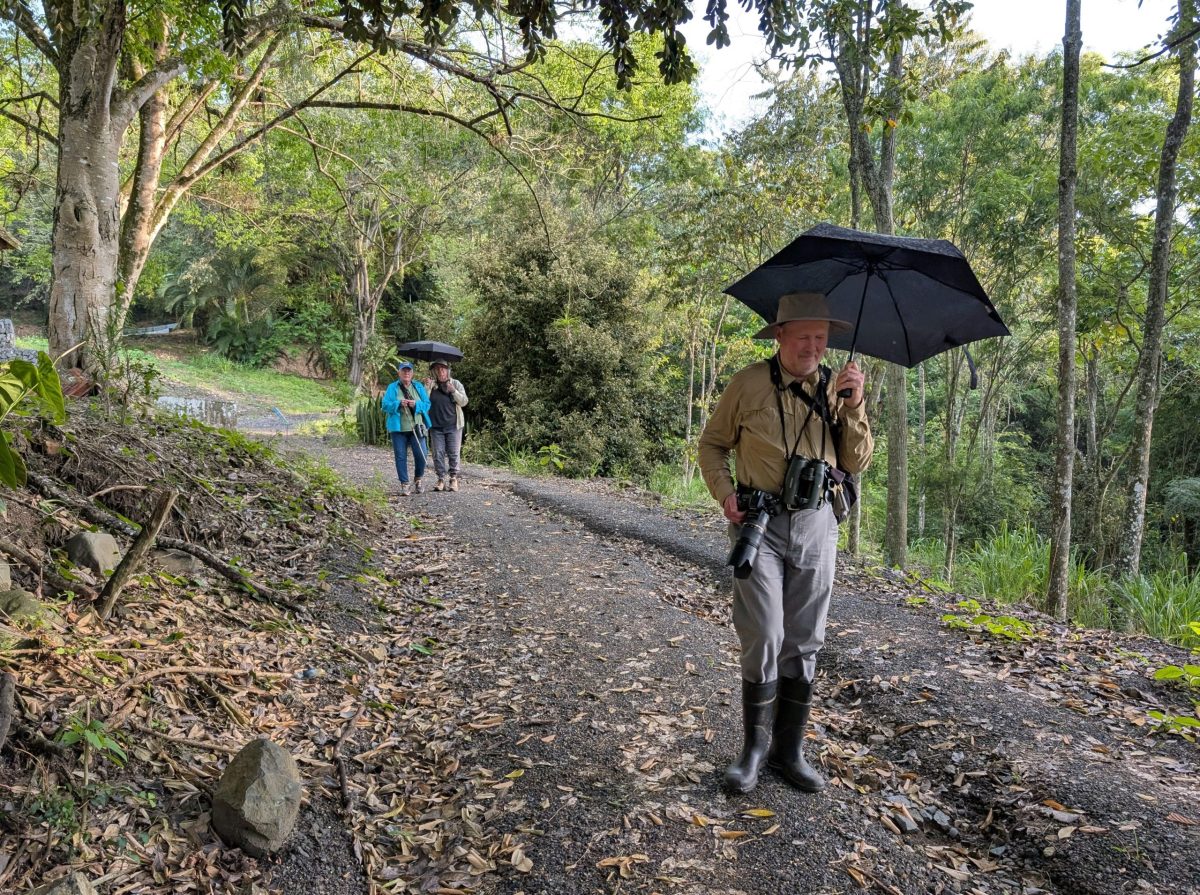
The group at Los Besotes reserve, after seing the Red-legged Tinamou. From left to right: Daniel, Tony, Dale, Tom and José Luis Ropero (local guide). Guess who bought the colorful Guajira bag the day before?
Species recorded across the three regions. Endemic (E) and Near-Endemic (NE) species are highlighted.
| Santa Marta Antpitta (E) | White-tipped Quetzal (NE) |
| Santa Marta Screech-Owl (E) | Red-legged Tinamou |
| Santa Marta Tapaculo (E) | Rufous-tailed Jacamar |
| Santa Marta Foliage-Gleaner (E) | White-necked Jacobin |
| Santa Marta Blossomcrown (E) | Keel-billed Toucan |
| Santa Marta Woodstar (E) | Military Macaw |
| Santa Marta Brush-Finch (E) | Crimson-crested Woodpecker |
| White-tailed Starfrontlet (E) | Masked Trogon |
| Perijá Thistletail (E) | American Flamingo |
| Perijá Metaltail (E) | Scarlet Ibis |
| Perijá (Rufous) Antpitta (E) | Orinocan Saltator |
| Perijá Tapaculo (E) | Hook-billed Kite |
| Perijá (Phelp’s) Brush-Finch (E) | Andean Condor |
| Tocuyo Sparrow (NE) | Golden-headed Quetzal |
| Vermilion Cardinal (NE) | Golden-breasted Fruiteater |
| Golden-winged Sparrow (NE) | Pale-eyed Thrush |
Start Your Colombian Adventure
This 10-day extension was a phenomenal success, securing spectacular sightings of Colombia’s rarest species. If you, like Tony, Tom, Dale, and Daniel, are ready to check off your own list of Colombia endemic birds or secure incredible shots on a Colombia bird photography tour, we invite you to join us.
Explore our scheduled tours and custom birding trips across Colombia’s Andes and Chocó region. Book birding tours Colombia by contacting us today to build your dream private tour.
YOU MAY ALSO LIKE
Putumayo & Huila Birding Trip Report: A Private Colombia Birding Tour (Oct 2025) with Judy Harackiewicz & Cliff Thurber from Madison
SEE MORE

Birding & photographing birds along the Central & Western Andes with Doug & Gail Cheeseman (April 22 – May 8, 2019).
SEE MORE
Birding the Central & Western Andes with Anthony Kaduck & Ken Edwards from Canada (March 20 – April 5, 2019).
SEE MORE


Birding Mitú, Inírida & the Perijá Mountains for key species with Hans Jornvall from Sweden (January 5 - 23, 2019).
SEE MORE

Second birding trip to Colombia for Ernest Bradley & Dale Brinker (November 19 – December 03, 2018).
SEE MORE


Birding Hato La Aurora in the Eastern Llanos with Todd Pepper & Mark Eaton (December 1 – 4, 2017).
SEE MORE
Birding the Central & Western Andes of Colombia with Anthony Collerton (July 14 – 23, 2017).
SEE MORE
Andean Endemics tour with British crew: from the Eastern Andes to the mid-Magdalena Valley & Central Andes of Colombia (March 1 – 14, 2017).
SEE MORE
Another challenging & productive trip for Hans Jörnvall from Sweden (January 2 – 15, 2017).
SEE MORE
The Eastern Andes from Bogota to Soata: birding trip for recordist Terry Morgan & Karen Walz (November 18-30, 2016).
SEE MORE
Second birding trip for Katy Krigbaum & Birgit Felser: the Western & Central Andes of Colombia (September 1-20, 2016).
SEE MORE
Birding for much desired targets with Keith Betton, Andrew Herbert (UK) and Rainer Kopa (Germany) (April 17-May 7, 2016).
SEE MORE
Birding the Western & Central Andes with Richard & Jennifer Kershaw from UK (March 10-31, 2016).
SEE MORE
Second birding trip for Steve Huggins & Glenn Giacinto from Chicago, Illinois (January 23 – February 2, 2016).
SEE MORE
Birding along the Western & Central Andes of Colombia with Bob & Katie Self from the UK (November 9 – 26, 2015).
SEE MORE
Birding in Colombia from the Western Andes to the Santa Marta Mountains & Guajira peninsula, with a recapitulation.
SEE MORE
The Eastern Andes, mid-Magdalena Valley, Santa Marta Mountains & La Guajira peninsula with Katy Krigbaum & Birgit Felser (Sept. 2 – 21, 2015).
SEE MORE
Bird photo tour for photographers from Taiwan & China: The Western & Central Andes of Colombia (July 18 – August 8, 2015).
SEE MORE
Second birding trip for Debby Reynolds & David Copas (UK), and Jane Andrews (USA) (January 20 – February 6, 2015).
SEE MORE
Short but productive bird photo trip for family group from Canada and Colombia (December 16-20, 2014).
SEE MORE

Medium length birding trip through the Western & Central Andes of Colombia with Bruce Webb, Jeanne Conry & Peter Gent from USA (May 18 - 27, 2014).
SEE MORE
Short birding escapade for James Taylor & Christine Forster from Victoria, British Columbia (Canada) (May 8-11, 2014).
SEE MORE
Bird photography trip for Japanese photographers – Hisao komori & Yasunobu Shiga (April 26-May 4, 2014).
SEE MORE

Birding the Eastern, Central & Western Andes with Andy & Gill Swash, Debby Reynolds & David Copas from UK (January 15 – February 5, 2014).
SEE MORE
Birding the Central Andes of Colombia with Steven Huggins & Glenn Giacinto from Chicago, Illinois (January 3 – 13, 2014).
SEE MORE


Bird photography trip to the Eastern Andes of Colombia for Juan José Arango & Anabel Vanin (July 31 - August 04, 2013).
SEE MORE


Back to Colombia for a second time: Peter Hawrylyshyn & Bob Lewis search for more hummingbird species and bird specialties at new birding sites (February 15 – March 03, 2013).
SEE MORE
Central Andes short tour with Happy Warblers touring company from New York (February 5 – 13, 2013).
SEE MORE
More Andean endemics with magnificent birding crew from USA, UK & Canada (Dec. 28, 2012 to Jan. 5, 2013).
SEE MORE

Touring for Central Andes Endemics: how good birding in Colombia can be (October 6 – 15, 2012).
SEE MORE
Bird photography trip for Peter Hawrylyshyn, Bob & Hanno Lewis with emphasis on hummingbirds (August 22 – September 9, 2012).
SEE MORE

Birding Otún-Quimbaya Wildlife Sanctuary for some bird images with Juan Jose Arango and Anabel Vanin (August 3 – 5, 2012).
SEE MORE
Enjoying the Rio Blanco antpittas and Central Andes endemics with Eugenia Carey from Dauphin Island (July 5 – 12, 2012).
SEE MORE


Promoting Colombia as a travel destination with British presenter & producer Nigel Marven (February 6 – 11, 2012).
SEE MORE
Bogota Sunangel or not? The intriguing hummingbird at Rogitama Private Nature Reserve (2011).
SEE MORE
Birding with Dominic Mitchell – Managing Editor of Birdwatch Magazine (UK) (November 27 – December 4, 2011).
SEE MORE
Guiding and operating for Birding Adventures TV episodes in Colombia (November 27 – December 4, 2011).
SEE MORE


Eastern Andes Birding Report: Bogota Rail & 10-Day Triumph
20 - 10 - 2018
A Quest for Eastern Andes Endemics: A Private Tour
Colombia Birding Trip Report: Eastern Andes near Bogota (October 2018)
Welcome to our latest Colombia birding trip report , a series where we share the highlights from our world-class expeditions. As expert birding guides in Colombia , we specialize in connecting passionate birdwatchers with the planet’s highest avian diversity. Our Colombia birding tours are designed to deliver unforgettable experiences, whether you join a scheduled departure or embark on a custom Colombia birding trip. We celebrate the joy of birding and are thrilled to showcase the results of our recent adventures. Explore the possibilities for your own journey with Birding Tours Colombia.
A Custom Tour for Expert Listers
From October 9–18, 2018, we organized a specialized private birding tour for Tony Menart, Thomas Heatley & Dale Manor—three exceptional birders with life lists exceeding 6,500 species each. This marked their second Colombia birding trip with us, so our objective was clear: focus exclusively on their most-wanted target birds
Our custom Colombia birding itinerary was designed to maximize their opportunities, covering the very best birding sites near Bogota and the eastern slope of the Eastern Andes. We explored a diverse range of habitats, from cloud forest and páramo to the foothills near Villavicencio. Sites visited included Laguna de Pedro Palo , Chicaque Park , Bosque Bavaria (Orange-breasted Falcon Reserve) , Monterredondo , and the high-altitude páramos of Chingaza National Park and Sumapaz.
Trip Highlights
The success of this trip lay in securing close views of several of the region’s most sought-after and difficult species:
- Tawny-breasted Tinamou: A ridiculously close, memorable encounter at Monterredondo.
- Bogotá Rail (E): Two individuals were seen very well at the Siecha gravel pits, though more than five others were heard calling from the reedy marsh.
- Brown-breasted (Flame-winged) Parakeet (E): Close views of a group of seven endemic parakeets perched at Monterredondo.
- Crestless Curassow: A surprising and delightful sighting of a male at Lagos de Menegua, a new and productive site.
- Hummingbird Heaven: The feeders at the Observatorio de Colibríes lived up to their legendary reputation, bustling with near-endemics like the Blue-throated Starfrontlet and the spectacular Sword-billed Hummingbird
Key Species Observed by Region
Laguna de Pedro Palo
Our birding at Laguna de Pedro Palo yielded the endemic and vulnerable Black Inca , alongside Spectacled Parrotlet, Gray-rumped Swift, White-tipped Swift, the near-endemic Gorgeted Woodstar, Crowned Woodnymph, Booted Racket-Tail, Andean Emerald, Smoky-brown Woodpecker, Olivaceus Piculet, Streaked Xenops, Ash-browed Spinetail, Brown-capped Vireo, Black-capped Tanager, Scrub Tanager, Beryl-spangled Tanager, Metallic-green Tanager, Flame-faced Tanager, and Yellow-backed Oriole.
Chicaque Park
At Chicaque Park, we were delighted by the gorgeous near-endemic Golden-bellied Starfrontlet, spotting one male and two females. The hummingbird activity was excellent, with Tourmaline Sunangel, Collared Inca, Buff-tailed Coronet, Lesser Violetear, and Sparkling Violetear. We also tracked down a Whiskered Wren in the dense bamboo stands.
Bosque Bavaria (Orange-breasted Falcon Reserve)
Bosque Bavaria proved to be a great forest for birding. Our search produced Gray-chinned Hermit, Golden-tailed Sapphire, Green-backed Trogon, Amazonian Motmot, Yellow-billed Nunbird, Gilded Barbet, Channel-billed Toucan, Lettered Aracari, Scaled Piculet, Northern Slaty-Antshrike, Black-faced Antbird, Spot-winged Antbird, Yellow-browed Tody-Flycatcher, Yellow-breasted Flycatcher, White-necked Thrush, Speckled Tanager, Paradise Tanager, and Pectoral Sparrow
Lagos de Menegua: An Eastern Llanos Detour
Having successfully found our targets at Bosque Bavaria , the group opted to scout Lagos de Menegua, a new site for our company. This area, with its scrubby secondary forest, wetlands, and fishing ponds, proved to be a wonderful location for Eastern Llanos specialties. We were surprised by a male Crestless Curassow. As a bonus, we added Striated Heron, Undulated Tinamou, Horned Screamer, Black-collared Hawk, Snail Kite, Hoatzin, Greater Ani, Sulphury Flycatcher, Pale-eyed Pygmy-Tyrant, Striped-necked Tody-Tyrant, and Red-capped Tanager.
Monterredondo
At Monterredondo, we had a ridiculously close encounter with a Tawny-breasted Tinamou walking along the road’s edge. We also achieved fantastic perched views of a group of seven endemic Brown-breasted (Flame-winged) Parakeets and very close views of the vocal Lined-Quail Dove. The forest was alive with birds, including: Speckled Hummingbird, Bronzy Inca, Green-bellied Hummingbird, Golden-headed Quetzal, Montane Foliage-Gleaner, Pearled Treerunner, Black-capped Tyrannulet, Cliff Flycatcher, Black-collared Jay, Spectacled Thrush, Gray-hooded Bush-Tanager, Hooded Mountain-Tanager, a pair of the uncommon Black-chested Mountain-Tanager, Grass-green Tanager, Blue-capped Tanager, Blue-and-black Tanager, Beryl-spangled Tanager, Capped Conebill, Bluish Flowerpiercer, Chestnut-capped Brush-Finch, Ochre-breasted Brush-Finch, Golden-fronted Whitestart, and Mountain Cacique. We also heard over seven Cundinamarca Antpittas calling, but they remained elusive this time.
Páramo de Sumapaz
In the high-altitude Paramo de Sumapaz , access restrictions meant we only saw the endemic Green-bearded Helmetcrest once, at a great distance. However, we secured close views of two pairs of the endemic Apolinar´s Wren and had good scope views of Andean Teal and Andean Duck on the lake .We also easily found Tawny Antpitta, Andean Tit-Spinetail, and Plumbeous Sierra-Finch.
Chingaza National Park
Birding in Chingaza National Park , we had another brief, distant view of a male Green-bearded Helmetcrest hovering over Espeletia flowers. We were more successful with other high-Andean targets, getting good views of the endemics Pale-bellied Tapaculo and Silvery-throated Spinetail, as well as the near-endemics Bronze-tailed Thornbill and Rufous-browed Conebill. Our checklist here also included Andean Guan, Black-chested Buzzard-Eagle, Amethyst-throated Sunangel, Crimson-mantled Woodpecker, White-chinned Thistletail, Tawny-rumped Tyrannulet, Red-crested Cotinga, Superciliared Hemispingus, Scarlet-bellied Mountain-Tanager, Blue-backed Conebill, Plushcap, Paramo Seedeater, Pale-naped Brush-Finch, Black-backed Grosbeak, Golden-fronted Whitestart, and Andean Siskin.
The Hummingbird Observatory at La Calera
The gardens at the Observatorio de Colibríes (The Hummingbird Observatory) are always beautifully kept by its owner. This stop on our Colombia hummingbird tour did not disappoint. The feeders were as busy as ever, with delightful views of the near-endemic Blue-throated Starfrontlet (male and female), Black-tailed Trainbearer (male and female), Green-tailed Trainbearer, Sword-billed Hummingbird, Great Saphirewing, Tyrian Metaltail, Glowing Puffleg, Sparkling Violetear, and Lesser Violetear.
Páramo Grande and Vereda Concepción
Both Páramo Grande and Vereda Concepción (with the Bioandina & La Guajira private reserves) hold great expanses of well-preserved habitat. We did well, finding the near-endemics Bronze-tailed Thornbill and Rufous-browed Conebill for a second time. We also had good repeat sightings of Blue-throated Starfrontlet, Andean Guan, Tyrian Metaltail, and Glowing Puffleg. Other notable birds included Streaked Tuftedcheek, White-browed Spinetail, Black-capped Tyrannulet, Smoky Bush-Tyrant, White-capped Dipper, Scarlet-bellied Mountain-Tanager, Buff-breasted Mountain-Tanager, Blue-and-black Tanager, and Andean Siskin.
Guasca and Siecha Gravel Pits
At the Siecha gravel pits, we focused on marsh specialties. We successfully saw two individuals of the endemic Bogota Rail and heard at least five others calling from the reeds. We also found Noble Snipe, Spot-flanked Gallinule, Grassland Yellow-Finch, Striated Heron, Black-crowned Night-Heron, and Band-tailed Seedeater.
Enchanted Gardens of San Francisco
As always, the Enchanted Gardens were truly enchanting, with hectic activity at the feeders. This site was key for the endemic Indigo-capped Hummingbird. We also saw two male and one female Gorgeted Woodstar, White-necked Jacobin, White-bellied Woodstar, Andean Emerald, White-vented Plumeleteer, Black-throated Mango, Rufous-tailed Hummingbird, Lesser Violetear, and Sparkling Violetear.
Laguna de Tabacal
We can never overstate how good the birding is at Laguna de Tabacal. This site holds a high number of quality birds, specialties, and skulkers. We found many great species here, including the endemic Velvet-fronted Euphonia and the near-endemics Short-tailed Emerald, Bar-crested Antshrike, and Scrub Tanager. Other highlights included Ruddy Quail-Dove, Striped Hermit, Red-rumped Woodpecker, Jet Antbird, Blue-lored Antbird, White-bellied Antbird, Ruddy Foliage-Gleaner, Ash-browed Spinetail, Stripe-breasted Spinetail, Cinereous Becard, Rufous-naped Greenlet, Black-bellied Wren, Speckle-breasted Wren, Long-billed Gnatwren, Gray-headed Tanager, Blue-necked Tanager, Plain-colored Tanager, Rosy-thrush Tanager, and Black-striped Sparrow. We also enjoyed repeated views of the Rusty-breasted Antpitta and Red-billed Scythebill.

From left to right: Victoria Lizarralde, Dale Manor, Tony Menart and Thomas Heatley, at the Hummingbird Observatory.
This successful journey highlights the incredible birding possibilities in Colombia’s Eastern Andes. We are passionate about crafting unforgettable expeditions for birders and photographers. If this report inspires you, we invite you to explore our scheduled departures or contact us to design your own custom Colombia birding trip. Our expert guides are ready to show you the best of Birding Tours Colombia.
YOU MAY ALSO LIKE
Putumayo & Huila Birding Trip Report: A Private Colombia Birding Tour (Oct 2025) with Judy Harackiewicz & Cliff Thurber from Madison
SEE MORE
Birding & photographing birds along the Central & Western Andes with Doug & Gail Cheeseman (April 22 – May 8, 2019).
SEE MORE
Birding the Central & Western Andes with Anthony Kaduck & Ken Edwards from Canada (March 20 – April 5, 2019).
SEE MORE
Birding Mitú, Inírida & the Perijá Mountains for key species with Hans Jornvall from Sweden (January 5 - 23, 2019).
SEE MORE
Second birding trip to Colombia for Ernest Bradley & Dale Brinker (November 19 – December 03, 2018).
SEE MORE
Birding Hato La Aurora in the Eastern Llanos with Todd Pepper & Mark Eaton (December 1 – 4, 2017).
SEE MORE
Birding the Central & Western Andes of Colombia with Anthony Collerton (July 14 – 23, 2017).
SEE MORE
Andean Endemics tour with British crew: from the Eastern Andes to the mid-Magdalena Valley & Central Andes of Colombia (March 1 – 14, 2017).
SEE MORE
Another challenging & productive trip for Hans Jörnvall from Sweden (January 2 – 15, 2017).
SEE MORE
The Eastern Andes from Bogota to Soata: birding trip for recordist Terry Morgan & Karen Walz (November 18-30, 2016).
SEE MORE
Second birding trip for Katy Krigbaum & Birgit Felser: the Western & Central Andes of Colombia (September 1-20, 2016).
SEE MORE
Birding for much desired targets with Keith Betton, Andrew Herbert (UK) and Rainer Kopa (Germany) (April 17-May 7, 2016).
SEE MORE
Birding the Western & Central Andes with Richard & Jennifer Kershaw from UK (March 10-31, 2016).
SEE MORE
Second birding trip for Steve Huggins & Glenn Giacinto from Chicago, Illinois (January 23 – February 2, 2016).
SEE MORE
Birding along the Western & Central Andes of Colombia with Bob & Katie Self from the UK (November 9 – 26, 2015).
SEE MORE
Birding in Colombia from the Western Andes to the Santa Marta Mountains & Guajira peninsula, with a recapitulation.
SEE MORE
The Eastern Andes, mid-Magdalena Valley, Santa Marta Mountains & La Guajira peninsula with Katy Krigbaum & Birgit Felser (Sept. 2 – 21, 2015).
SEE MORE
Bird photo tour for photographers from Taiwan & China: The Western & Central Andes of Colombia (July 18 – August 8, 2015).
SEE MORE
Second birding trip for Debby Reynolds & David Copas (UK), and Jane Andrews (USA) (January 20 – February 6, 2015).
SEE MORE
Short but productive bird photo trip for family group from Canada and Colombia (December 16-20, 2014).
SEE MORE
Medium length birding trip through the Western & Central Andes of Colombia with Bruce Webb, Jeanne Conry & Peter Gent from USA (May 18 - 27, 2014).
SEE MORE
Short birding escapade for James Taylor & Christine Forster from Victoria, British Columbia (Canada) (May 8-11, 2014).
SEE MORE
Bird photography trip for Japanese photographers – Hisao komori & Yasunobu Shiga (April 26-May 4, 2014).
SEE MORE
Birding the Eastern, Central & Western Andes with Andy & Gill Swash, Debby Reynolds & David Copas from UK (January 15 – February 5, 2014).
SEE MORE
Birding the Central Andes of Colombia with Steven Huggins & Glenn Giacinto from Chicago, Illinois (January 3 – 13, 2014).
SEE MORE
Bird photography trip to the Eastern Andes of Colombia for Juan José Arango & Anabel Vanin (July 31 - August 04, 2013).
SEE MORE
Back to Colombia for a second time: Peter Hawrylyshyn & Bob Lewis search for more hummingbird species and bird specialties at new birding sites (February 15 – March 03, 2013).
SEE MORE
Central Andes short tour with Happy Warblers touring company from New York (February 5 – 13, 2013).
SEE MORE
More Andean endemics with magnificent birding crew from USA, UK & Canada (Dec. 28, 2012 to Jan. 5, 2013).
SEE MORE
Touring for Central Andes Endemics: how good birding in Colombia can be (October 6 – 15, 2012).
SEE MORE
Bird photography trip for Peter Hawrylyshyn, Bob & Hanno Lewis with emphasis on hummingbirds (August 22 – September 9, 2012).
SEE MORE
Birding Otún-Quimbaya Wildlife Sanctuary for some bird images with Juan Jose Arango and Anabel Vanin (August 3 – 5, 2012).
SEE MORE
Enjoying the Rio Blanco antpittas and Central Andes endemics with Eugenia Carey from Dauphin Island (July 5 – 12, 2012).
SEE MORE
Promoting Colombia as a travel destination with British presenter & producer Nigel Marven (February 6 – 11, 2012).
SEE MORE
Bogota Sunangel or not? The intriguing hummingbird at Rogitama Private Nature Reserve (2011).
SEE MORE
Birding with Dominic Mitchell – Managing Editor of Birdwatch Magazine (UK) (November 27 – December 4, 2011).
SEE MORE
Guiding and operating for Birding Adventures TV episodes in Colombia (November 27 – December 4, 2011).
SEE MOREColombia Birding Trip Report: Endemics in Putumayo & Huila
26 - 01 - 2018
Triumph in the Andes: Chasing Colombia’s Rarest Endemics in Putumayo & Huila
Trip Report: Private ‘Southeastern Regions’ Tour (Jan 14 – 24, 2018) with Hans Jornvall
This specialized, tailor-made journey through the rugged southeastern regions of Putumayo and Huila was a tremendous success. Designed specifically for Hans Jornvall from Sweden , the trip saw him add nine new species to his impressive life list, which already boasted over 9,200 species. More than just a birding tour, this expedition was a rewarding immersion into Colombia’s rich Andean and Amazonian foothills, yielding unforgettable experiences and stunning views of highly sought-after avifauna.
Trip Summary
| Tour | Private ‘Putumayo & Huila Expedition’ |
| Duration | 11 Days / 10 Nights (Jan 14 – 24, 2018) |
| Guide | Brayan Coral Jaramillo (BTC Lead Guide) |
| Lifer Count | 9 New Species seen, plus 2 ‘heard only’ |
| Key Endemics | Upper Magdalena Tapaculo, Dusky-headed Brush-Finch |
| Key Highlight | Excellent views of Chestnut-bellied Cotinga |

Hans Jornvall after returning from the mid-Magdalena Valley. We stopped at a typical restaurant entering Bogota.
Trip Highlights
The challenging terrain and focused effort paid off with spectacular sightings:
- Andean Endemics: Obtaining great views of the magnificent Chestnut-bellied Cotinga (Doliornis remseni) and Masked Mountain-Tanager (Buthraupis wetmorei) while visiting Paramo de Bordoncillo was a thrilling start.
- The Sicklebill Prize: A major highlight was successfully seeing the Buff-tailed Sicklebill (Eutoxeres condamini) at the beautiful Isla Escondida private nature reserve.
- Tinamous & Tapaculos: A true stroke of luck was finding a Highland Tinamou (Nothocercus bonapartei) sitting on a nest after a challenging ascent by horse near Pitalito. Near this same location, in dense Chusquea bamboo, the group enjoyed excellent views of the endemic Upper Magdalena Tapaculo (Scytalopus rodriguezi).
- Brush-Finches & Antbirds: The group was excited to find both the stunning White-rimmed Brush-Finch (Atlapetes leucopis) at El Trampolín de Las Aves and the endemic Dusky-headed Brush-Finch (Atlapetes fuscoolivaceus) along the road from Mocoa to Pitalito. The gorgeous pair of East Andean Antbird (Drymophila caudata) seen in the bamboo stands was another memorable sighting.

The picturesque poirt at Laguna de La Cocha.
Key Species Observed
Here is a selection of the most notable species sighted (or heard) during the expedition, demonstrating the region’s incredible biodiversity:
| Species Name | Location/Context | Status/Observation |
| Chestnut-bellied Cotinga (Doliornis remseni) | Paramo de Bordoncillo | Great views |
| Masked Mountain-Tanager (Buthraupis wetmorei) | Paramo de Bordoncillo | Great views |
| White-rimmed Brush-Finch (Atlapetes leucopis) | El Trampolín de Las Aves | Splendid views |
| White-streaked Antvireo (Dysithamnus leucostictus) | Campucana Trail (near Mocoa) | Successful sighting |
| Buff-tailed Sicklebill (Eutoxeres condamini) | Isla Escondida | Seen well; highly wanted |
| Highland Tinamou (Nothocercus bonapartei) | Steep mountain near Pitalito | Found sitting on a nest |
| Upper Magdalena Tapaculo (Scytalopus rodriguezi) | Dense bamboo near Pitalito | Endemic; seen well |
| East Andean Antbird (Drymophila caudata) | Dense bamboo near Pitalito | Gorgeous pair seen |
| Dusky-headed Brush-Finch (Atlapetes fuscoolivaceus) | Mocoa to Pitalito road | Endemic; found roadside |
| Chestnut-headed Crake (Anurolimnas castaneiceps) | Isla Escondida | Heard only, a few meters away |
| Black Tinamou (Tinamus osgoodi) | Campucana Trail (near Mocoa) | Heard but not seen |

A second view of El Puerto, at Laguna de La Cocha.
The Andean Foothills: Pasto, Bordoncillo & Mocoa
The journey began with a flight into Pasto, followed by a picturesque overnight stay at Laguna de La Cocha. The real climbing started the following day at Paramo de Bordoncillo, a stunning high-altitude ecosystem, or páramo, where the air is crisp and the species are magnificent. We obtained great views of the magnificent Chestnut-bellied Cotinga (Doliornis remseni) and the Masked Mountain-Tanager (Buthraupis wetmorei).
On our descent towards Mocoa, we birded El Trampolín de Las Aves, where the group enjoyed splendid views of the White-rimmed Brush-Finch (Atlapetes leucopis). Near Mocoa, along the Campucana Trail, we were successful with the White-streaked Antvireo (Dysithamnus leucostictus) but only heard the elusive Black Tinamou (Tinamus osgoodi).
Isla Escondida & the Amazonian Transition
The mid-point of the tour was spent at Isla Escondida, a private nature reserve set by co-author of Birdwatching in Colombia, Jurgen Beckers. Here, the team found a major success by seeing well the highly wanted Buff-tailed Sicklebill (Eutoxeres condamini). The dense cover also revealed the very shy Chestnut-headed Crake (Anurolimnas castaneiceps), heard only a few meters away from us.
The Pitalito Highlands: Tapaculos and Tinamous
The most challenging section of the itinerary proved the most rewarding for endemics. Near Pitalito, we had essential support from local guides Jorge Peña and Roso Ortiz. A strenuous, yet successful, ascent by horse to a steep mountain near the town led to an incredible discovery: a Highland Tinamou (Nothocercus bonapartei) sitting on a nest.
Targeted birding in the dense bamboo stands (Chusquea spp.) yielded excellent views of the endemic Upper Magdalena Tapaculo (Scytalopus rodriguezi). This habitat was equally fruitful for another spectacle: a gorgeous pair of the East Andean Antbird (Drymophila caudata). Finally, along the road from Mocoa back toward Pitalito, we located the endemic Dusky-headed Brush-Finch (Atlapetes fuscoolivaceus).
The group flew out of Pitalito back to Bogotá on Avianca, concluding an extremely focused and successful expedition.
We extend our deep gratitude to our local support team:
- Brayan Coral Jaramillo: Provided excellent logistical organization and additional guidance throughout the main trip.
- Jorge Peña and Roso Ortiz: Gave crucial support near Pitalito, ensuring success in a challenging area.
This adventure stands as a testament to the incredible, untouched birding opportunities found across Colombia’s interior regions. From high-altitude paramo to dense bamboo stands, the landscapes were as rewarding as the birds themselves, especially when a lifer is waiting!
If you’re inspired by Hans Jornvall’s success and are ready to tackle the elusive tapaculos, antbirds, and unique endemics of Putumayo and Huila, let Birding Tours Colombia design your next tailor-made expedition. Come find your next nine lifers with us!
In the previous week (January 7 – 13), we birded the Rio Claro canyon & Bellavista Forest in mid-Magdalena Valley for White-bearded Manakin (Corapipo leucorrhoa) & Saffron-headed Parrot (Pyrilia pyrilia) (having seen the manakin, but missing the parrot), and Hato La Aurora in the Orinoco region of Colombia for Crestless Curassow (Mitu tuberosum) & Masked Cardinal (Paroaria nigrogenis) (having seen both).
YOU MAY ALSO LIKE
Putumayo & Huila Birding Trip Report: A Private Colombia Birding Tour (Oct 2025) with Judy Harackiewicz & Cliff Thurber from Madison
SEE MORE
Birding & photographing birds along the Central & Western Andes with Doug & Gail Cheeseman (April 22 – May 8, 2019).
SEE MORE
Birding the Central & Western Andes with Anthony Kaduck & Ken Edwards from Canada (March 20 – April 5, 2019).
SEE MORE
Birding Mitú, Inírida & the Perijá Mountains for key species with Hans Jornvall from Sweden (January 5 - 23, 2019).
SEE MORE
Second birding trip to Colombia for Ernest Bradley & Dale Brinker (November 19 – December 03, 2018).
SEE MORE
Birding Hato La Aurora in the Eastern Llanos with Todd Pepper & Mark Eaton (December 1 – 4, 2017).
SEE MORE
Birding the Central & Western Andes of Colombia with Anthony Collerton (July 14 – 23, 2017).
SEE MORE
Andean Endemics tour with British crew: from the Eastern Andes to the mid-Magdalena Valley & Central Andes of Colombia (March 1 – 14, 2017).
SEE MORE
Another challenging & productive trip for Hans Jörnvall from Sweden (January 2 – 15, 2017).
SEE MORE
The Eastern Andes from Bogota to Soata: birding trip for recordist Terry Morgan & Karen Walz (November 18-30, 2016).
SEE MORE
Second birding trip for Katy Krigbaum & Birgit Felser: the Western & Central Andes of Colombia (September 1-20, 2016).
SEE MORE
Birding for much desired targets with Keith Betton, Andrew Herbert (UK) and Rainer Kopa (Germany) (April 17-May 7, 2016).
SEE MORE
Birding the Western & Central Andes with Richard & Jennifer Kershaw from UK (March 10-31, 2016).
SEE MORE
Second birding trip for Steve Huggins & Glenn Giacinto from Chicago, Illinois (January 23 – February 2, 2016).
SEE MORE
Birding along the Western & Central Andes of Colombia with Bob & Katie Self from the UK (November 9 – 26, 2015).
SEE MORE
Birding in Colombia from the Western Andes to the Santa Marta Mountains & Guajira peninsula, with a recapitulation.
SEE MORE
The Eastern Andes, mid-Magdalena Valley, Santa Marta Mountains & La Guajira peninsula with Katy Krigbaum & Birgit Felser (Sept. 2 – 21, 2015).
SEE MORE
Bird photo tour for photographers from Taiwan & China: The Western & Central Andes of Colombia (July 18 – August 8, 2015).
SEE MORE
Second birding trip for Debby Reynolds & David Copas (UK), and Jane Andrews (USA) (January 20 – February 6, 2015).
SEE MORE
Short but productive bird photo trip for family group from Canada and Colombia (December 16-20, 2014).
SEE MORE
Medium length birding trip through the Western & Central Andes of Colombia with Bruce Webb, Jeanne Conry & Peter Gent from USA (May 18 - 27, 2014).
SEE MORE
Short birding escapade for James Taylor & Christine Forster from Victoria, British Columbia (Canada) (May 8-11, 2014).
SEE MORE
Bird photography trip for Japanese photographers – Hisao komori & Yasunobu Shiga (April 26-May 4, 2014).
SEE MORE
Birding the Eastern, Central & Western Andes with Andy & Gill Swash, Debby Reynolds & David Copas from UK (January 15 – February 5, 2014).
SEE MORE
Birding the Central Andes of Colombia with Steven Huggins & Glenn Giacinto from Chicago, Illinois (January 3 – 13, 2014).
SEE MORE
Bird photography trip to the Eastern Andes of Colombia for Juan José Arango & Anabel Vanin (July 31 - August 04, 2013).
SEE MORE
Back to Colombia for a second time: Peter Hawrylyshyn & Bob Lewis search for more hummingbird species and bird specialties at new birding sites (February 15 – March 03, 2013).
SEE MORE
Central Andes short tour with Happy Warblers touring company from New York (February 5 – 13, 2013).
SEE MORE
More Andean endemics with magnificent birding crew from USA, UK & Canada (Dec. 28, 2012 to Jan. 5, 2013).
SEE MORE
Touring for Central Andes Endemics: how good birding in Colombia can be (October 6 – 15, 2012).
SEE MORE
Bird photography trip for Peter Hawrylyshyn, Bob & Hanno Lewis with emphasis on hummingbirds (August 22 – September 9, 2012).
SEE MORE
Birding Otún-Quimbaya Wildlife Sanctuary for some bird images with Juan Jose Arango and Anabel Vanin (August 3 – 5, 2012).
SEE MORE
Enjoying the Rio Blanco antpittas and Central Andes endemics with Eugenia Carey from Dauphin Island (July 5 – 12, 2012).
SEE MORE
Promoting Colombia as a travel destination with British presenter & producer Nigel Marven (February 6 – 11, 2012).
SEE MORE
Bogota Sunangel or not? The intriguing hummingbird at Rogitama Private Nature Reserve (2011).
SEE MORE
Birding with Dominic Mitchell – Managing Editor of Birdwatch Magazine (UK) (November 27 – December 4, 2011).
SEE MORE
Guiding and operating for Birding Adventures TV episodes in Colombia (November 27 – December 4, 2011).
SEE MOREColombia Birding Tour: Crestless Curassow Quest
15 - 01 - 2018
Quest for the Curassow: A Target-Driven Triumph in Colombia’s Eastern Llanos
Trip Report: Private Eastern Llanos Tour at Hato La Aurora (January 2018) with Hans Jornvall
Our Birding Tours Colombia itineraries are designed to maximize field time, targeting the most sought-after endemics and regional specialties. Whether you join a scheduled departure or one of our custom Colombia birding trips, our expert birding guides Colombia use their deep local knowledge to connect you with the birds you’ve traveled to see. This report showcases the results of that dedication.
The Client’s Quest
This special, short trip was a private birding tour designed for Hans Jornvall. Hans, an exceptionally experienced birder with over 9,200 species on his life list, had traveled with us before. He had already seen nearly every bird at Hato La Aurora, but two species had consistently eluded him. This custom Colombia birding trip had a clear, focused mission: to find his two remaining targets, the Crestless Curassow and the Masked Cardinal.
A Birder’s Paradise: Hato La Aurora
Hato La Aurora is a paradise for birdwatching in Colombia, a vast reserve in the Eastern Llanos harboring a huge collection of species. Some are restricted to the Orinoco region, such as the Pale-headed Jacamar, Orinoco Goose, Purple-throated Euphonia, and White-bearded Flycatcher.
The lowland savannas and gallery forests here are filled with amazing birds, including the Jabiru, Maguari Stork, Horned Screamer, Sunbittern, Scarlet Ibis, Double-striped Thick-Knee, Hoatzin, Dwarf Cuckoo, Great Horned Owl, Black-and-white Owl, Burrowing Owl, Chestnut-fronted Macaw, Russet-throated Puffbird, and Wire-tailed Manakin.
Day 1: January 11 – Arrival and the First Search
We flew from Bogotá to Yopal early on January 11th and met our driver for the four-hour journey to the ranch. Local guides had seen the curassow in previous days, so we immediately headed to the exact location.
The Crestless Curassow is an uncommon and elusive bird. Its seasonal behaviors are dictated by rain, water levels, and food availability, making it highly unpredictable. Despite our best efforts, we had to return to the lodge at nightfall without a sighting.
Even so, the day provided fantastic highlights, including two Brazilian Teals, two Speckled Chachalacas, four Lesser Yellow-headed Vultures, a Crane Hawk, a Pied Lapwing, two Double-striped Thick-knees, eight Nacunda Nighthawks, and two Pale-headed Jacamars. We also found a White-bearded Hermit, Blue-tailed Emeralds, a Chestnut-eared Aracari, two White-bearded Flycatchers, a Black-faced Tanager, an Orange-crowned Oriole, and two Purple-throated Euphonias.
Day 2: January 12 – Success with the Curassow
The next day, we shifted strategy and visited a second site where the curassow had been seen visiting a plantain crop, likely attracted by fallen fruit. The site was promising: a small stream ran nearby, edged by a thin but dense gallery forest.
We waited silently for about an hour. Suddenly, a beautiful male Crestless Curassow emerged, walking slowly and almost leisurely between the forest and the plantation. It was a tense and thrilling 30 minutes. The bird would stand still, nervously looking around, then calmly preen its tail feathers. We had ample time for magnificent scope views—a fantastic reward for a difficult-to-find target.
With our main target secured, we used the rest of the day to find the Masked Cardinal, which quickly showed up near the lodge.

The day was filled with other wetland and forest specialties, including five Horned Screamers, three Orinoco Geese, two Rufous-vented Chachalacas, a Rufescent Tiger-Heron, four Whistling Herons, six Scarlet Ibises, two Sharp-tailed Ibises, and three Jabirus. We also recorded an Aplomado Falcon, a Sunbittern, ten Chestnut-fronted Macaws, four Hoatzins, a Glittering-throated Emerald, two more Pale-headed Jacamars, and two Crimson-crested Woodpeckers.
In just this short, focused visit, we registered 131 species, with 127 species seen and 4 heard-only.
This focused, target-driven itinerary highlights the value of our private birding tours in Colombia. If you have a specific “nemesis bird” or a list of targets, contact Birding Tours Colombia. We can design a custom Colombia birding trip to help you find it. Explore our scheduled tours for 2026 and 2027 to see what adventures are waiting.
YOU MAY ALSO LIKE
Putumayo & Huila Birding Trip Report: A Private Colombia Birding Tour (Oct 2025) with Judy Harackiewicz & Cliff Thurber from Madison
SEE MORE
Birding & photographing birds along the Central & Western Andes with Doug & Gail Cheeseman (April 22 – May 8, 2019).
SEE MORE
Birding the Central & Western Andes with Anthony Kaduck & Ken Edwards from Canada (March 20 – April 5, 2019).
SEE MORE
Birding Mitú, Inírida & the Perijá Mountains for key species with Hans Jornvall from Sweden (January 5 - 23, 2019).
SEE MORE
Second birding trip to Colombia for Ernest Bradley & Dale Brinker (November 19 – December 03, 2018).
SEE MORE
Birding Hato La Aurora in the Eastern Llanos with Todd Pepper & Mark Eaton (December 1 – 4, 2017).
SEE MORE
Birding the Central & Western Andes of Colombia with Anthony Collerton (July 14 – 23, 2017).
SEE MORE
Andean Endemics tour with British crew: from the Eastern Andes to the mid-Magdalena Valley & Central Andes of Colombia (March 1 – 14, 2017).
SEE MORE
Another challenging & productive trip for Hans Jörnvall from Sweden (January 2 – 15, 2017).
SEE MORE
The Eastern Andes from Bogota to Soata: birding trip for recordist Terry Morgan & Karen Walz (November 18-30, 2016).
SEE MORE
Second birding trip for Katy Krigbaum & Birgit Felser: the Western & Central Andes of Colombia (September 1-20, 2016).
SEE MORE
Birding for much desired targets with Keith Betton, Andrew Herbert (UK) and Rainer Kopa (Germany) (April 17-May 7, 2016).
SEE MORE
Birding the Western & Central Andes with Richard & Jennifer Kershaw from UK (March 10-31, 2016).
SEE MORE
Second birding trip for Steve Huggins & Glenn Giacinto from Chicago, Illinois (January 23 – February 2, 2016).
SEE MORE
Birding along the Western & Central Andes of Colombia with Bob & Katie Self from the UK (November 9 – 26, 2015).
SEE MORE
Birding in Colombia from the Western Andes to the Santa Marta Mountains & Guajira peninsula, with a recapitulation.
SEE MORE
The Eastern Andes, mid-Magdalena Valley, Santa Marta Mountains & La Guajira peninsula with Katy Krigbaum & Birgit Felser (Sept. 2 – 21, 2015).
SEE MORE
Bird photo tour for photographers from Taiwan & China: The Western & Central Andes of Colombia (July 18 – August 8, 2015).
SEE MORE
Second birding trip for Debby Reynolds & David Copas (UK), and Jane Andrews (USA) (January 20 – February 6, 2015).
SEE MORE
Short but productive bird photo trip for family group from Canada and Colombia (December 16-20, 2014).
SEE MORE
Medium length birding trip through the Western & Central Andes of Colombia with Bruce Webb, Jeanne Conry & Peter Gent from USA (May 18 - 27, 2014).
SEE MORE
Short birding escapade for James Taylor & Christine Forster from Victoria, British Columbia (Canada) (May 8-11, 2014).
SEE MORE
Bird photography trip for Japanese photographers – Hisao komori & Yasunobu Shiga (April 26-May 4, 2014).
SEE MORE
Birding the Eastern, Central & Western Andes with Andy & Gill Swash, Debby Reynolds & David Copas from UK (January 15 – February 5, 2014).
SEE MORE
Birding the Central Andes of Colombia with Steven Huggins & Glenn Giacinto from Chicago, Illinois (January 3 – 13, 2014).
SEE MORE
Bird photography trip to the Eastern Andes of Colombia for Juan José Arango & Anabel Vanin (July 31 - August 04, 2013).
SEE MORE
Back to Colombia for a second time: Peter Hawrylyshyn & Bob Lewis search for more hummingbird species and bird specialties at new birding sites (February 15 – March 03, 2013).
SEE MORE
Central Andes short tour with Happy Warblers touring company from New York (February 5 – 13, 2013).
SEE MORE
More Andean endemics with magnificent birding crew from USA, UK & Canada (Dec. 28, 2012 to Jan. 5, 2013).
SEE MORE
Touring for Central Andes Endemics: how good birding in Colombia can be (October 6 – 15, 2012).
SEE MORE
Bird photography trip for Peter Hawrylyshyn, Bob & Hanno Lewis with emphasis on hummingbirds (August 22 – September 9, 2012).
SEE MORE
Birding Otún-Quimbaya Wildlife Sanctuary for some bird images with Juan Jose Arango and Anabel Vanin (August 3 – 5, 2012).
SEE MORE
Enjoying the Rio Blanco antpittas and Central Andes endemics with Eugenia Carey from Dauphin Island (July 5 – 12, 2012).
SEE MORE
Promoting Colombia as a travel destination with British presenter & producer Nigel Marven (February 6 – 11, 2012).
SEE MORE
Bogota Sunangel or not? The intriguing hummingbird at Rogitama Private Nature Reserve (2011).
SEE MORE
Birding with Dominic Mitchell – Managing Editor of Birdwatch Magazine (UK) (November 27 – December 4, 2011).
SEE MORE
Guiding and operating for Birding Adventures TV episodes in Colombia (November 27 – December 4, 2011).
SEE MOREBirding Hato La Aurora in the Eastern Llanos with Todd Pepper & Mark Eaton (December 1 – 4, 2017).
07 - 12 - 2017
This was a short visit to a wonderful birding paradise in the Orinoco region of Colombia, where savannas, gallery forests and wetlands form a prodigious landscape home to an amazing fauna.
First day of trip begun with an early morning (6:03 departure) domestic flight from Bogota to Yopal. Immediately after landing, the ranch´s driver picked us up and we drove to Paz de Ariporo, continuing to Montañas del Totumo & Lodge Juan Solito at Hato La Aurora. Birding this day was done along the road, and in the lodge´s gardens and nearby forests.
Second day was a full day trip from the lodge to the ranch´s main house, traversing open savannas and wetlands.
Third day was a shorter day trip, from the lodge to Mata de Palma, a wetland midways to the ranch´s main house. Fourth and last day was mostly rainy, driving back to Yopal´s airport for our 18:45 flight back to Bogota.
The trip was customized around Todd´s and Mark´s target birds, which were just a few: Orinoco Goose, Sharp-tailed Ibis, Crestless Curassow, Pale-headed Jacamar and White-bearded Flycatcher. The Amazonian Black-Tyrant & Pinnated Bittern apparently have been registered at this locality, but they are both extremely uncommon.
Special birds seen at Hato La Aurora and along the roads were: Horned Screamer, Orinoco Goose, Brazilian Teal, Rufous-vented Chachalaca, Crested Bobwhite, Maguari Stork, Jabiru, Anhinga, Rufescent Tiger-Heron, Cocoi Heron, Striated & Whistling Heron, Capped Heron, Scarlet Ibis, Sharp-tailed & Bare-faced Ibis, Buff-necked Ibis, Roseate Spoonbill, Lesser Yellow-headed Vulture, Black-collared Hawk, Crane & Savanna Hawk, Great Black Hawk, Gray-cowled Wood-Rail, Purple Gallinule, Limpkin, Double-striped Thick-Knee, Black-necked Stilt, Pied Lapwing, Collared Plover, Wattled Jacana, Large-billed Tern, Pale-vented Pigeon, Scaled Dove, Blue Ground-Dove, White-tipped Dove, Gray-fronted Dove, Striped & Little Cuckoo, Dwarf & Squirrel Cuckoo, Black-and-white Owl, Great Horned Owl, Burrowing Owl, Nacunda Nighthawk, Common Pauraque, White-tailed Nightjar, White-bearded Hermit, White-tailed Goldenthroat, Blue-tailed & Glittering-throated Emerald, Russet-throated Puffbird, Pale-headed & Rufous-tailed Jacamar, Scaled Piculet, Spot-breasted Woodpecker, Crimson-crested Woodpecker, Aplomado Falcon, Yellow-crowned & Orange-winged Parrot, Spectacled Parrotlet, Chestnut-fronted Macaw, Blue-crowned & Brown-throated Parakeet, Black-crested & Barred Antshrike, White-fringed Antwren, Rufous-fronted Thornbird, Rusty-backed & Pale-breasted Spinetail, Mouse-colored & Yellow Tyrannulet, Pale-eyed Pygmy-Tyrant, White-headed Marsh-Tyrant, Short-crested & Brown-crested Flycatcher, Lesser Kiskadee, White-bearded Flycatcher, Fork-tailed Flycatcher, Wire-tailed Manakin, Black-crowned Tityra, White-winged Becard, Rufous-browed Peppershrike, Violaceous Jay, White-winged Swallow, Bicolored & Buff-breasted Wren, Black-capped Donacobius, Spectacled & White-necked Thrush, Cocoa Thrush, Yellowish Pipit, Masked Cardinal, Silver-beaked Tanager, Orange-fronted Yellow-Finch, Yellow-browed Sparrow, Eastern & Red-breasted Meadowlark, Oriole Blackbird, Venezuelan Troupial, Yellow Oriole, Yellow-rumped Cacique, Crested Oropendola and Purple-throated Euphonia, among others.
In total, we registered 161 species, including a nice set of range-restricted species that were new to either Todd or Mark, including Orinoco Goose, Sharp-tailed Ibis, Pale-headed Jacamar, White-bearded Flycatcher & Purple-throated Euphonia. Sadly, we missed the Crestless Curassow this time.

Family group of Burrowing Owls at the Eastern Llanos of Colombia.
YOU MAY ALSO LIKE
Putumayo & Huila Birding Trip Report: A Private Colombia Birding Tour (Oct 2025) with Judy Harackiewicz & Cliff Thurber from Madison
SEE MORE
Birding & photographing birds along the Central & Western Andes with Doug & Gail Cheeseman (April 22 – May 8, 2019).
SEE MORE
Birding the Central & Western Andes with Anthony Kaduck & Ken Edwards from Canada (March 20 – April 5, 2019).
SEE MORE
Birding Mitú, Inírida & the Perijá Mountains for key species with Hans Jornvall from Sweden (January 5 - 23, 2019).
SEE MORE
Second birding trip to Colombia for Ernest Bradley & Dale Brinker (November 19 – December 03, 2018).
SEE MORE
Birding Hato La Aurora in the Eastern Llanos with Todd Pepper & Mark Eaton (December 1 – 4, 2017).
SEE MORE
Birding the Central & Western Andes of Colombia with Anthony Collerton (July 14 – 23, 2017).
SEE MORE
Andean Endemics tour with British crew: from the Eastern Andes to the mid-Magdalena Valley & Central Andes of Colombia (March 1 – 14, 2017).
SEE MORE
Another challenging & productive trip for Hans Jörnvall from Sweden (January 2 – 15, 2017).
SEE MORE
The Eastern Andes from Bogota to Soata: birding trip for recordist Terry Morgan & Karen Walz (November 18-30, 2016).
SEE MORE
Second birding trip for Katy Krigbaum & Birgit Felser: the Western & Central Andes of Colombia (September 1-20, 2016).
SEE MORE
Birding for much desired targets with Keith Betton, Andrew Herbert (UK) and Rainer Kopa (Germany) (April 17-May 7, 2016).
SEE MORE
Birding the Western & Central Andes with Richard & Jennifer Kershaw from UK (March 10-31, 2016).
SEE MORE
Second birding trip for Steve Huggins & Glenn Giacinto from Chicago, Illinois (January 23 – February 2, 2016).
SEE MORE
Birding along the Western & Central Andes of Colombia with Bob & Katie Self from the UK (November 9 – 26, 2015).
SEE MORE
Birding in Colombia from the Western Andes to the Santa Marta Mountains & Guajira peninsula, with a recapitulation.
SEE MORE
The Eastern Andes, mid-Magdalena Valley, Santa Marta Mountains & La Guajira peninsula with Katy Krigbaum & Birgit Felser (Sept. 2 – 21, 2015).
SEE MORE
Bird photo tour for photographers from Taiwan & China: The Western & Central Andes of Colombia (July 18 – August 8, 2015).
SEE MORE
Second birding trip for Debby Reynolds & David Copas (UK), and Jane Andrews (USA) (January 20 – February 6, 2015).
SEE MORE
Short but productive bird photo trip for family group from Canada and Colombia (December 16-20, 2014).
SEE MORE
Medium length birding trip through the Western & Central Andes of Colombia with Bruce Webb, Jeanne Conry & Peter Gent from USA (May 18 - 27, 2014).
SEE MORE
Short birding escapade for James Taylor & Christine Forster from Victoria, British Columbia (Canada) (May 8-11, 2014).
SEE MORE
Bird photography trip for Japanese photographers – Hisao komori & Yasunobu Shiga (April 26-May 4, 2014).
SEE MORE
Birding the Eastern, Central & Western Andes with Andy & Gill Swash, Debby Reynolds & David Copas from UK (January 15 – February 5, 2014).
SEE MORE
Birding the Central Andes of Colombia with Steven Huggins & Glenn Giacinto from Chicago, Illinois (January 3 – 13, 2014).
SEE MORE
Bird photography trip to the Eastern Andes of Colombia for Juan José Arango & Anabel Vanin (July 31 - August 04, 2013).
SEE MORE
Back to Colombia for a second time: Peter Hawrylyshyn & Bob Lewis search for more hummingbird species and bird specialties at new birding sites (February 15 – March 03, 2013).
SEE MORE
Central Andes short tour with Happy Warblers touring company from New York (February 5 – 13, 2013).
SEE MORE
More Andean endemics with magnificent birding crew from USA, UK & Canada (Dec. 28, 2012 to Jan. 5, 2013).
SEE MORE
Touring for Central Andes Endemics: how good birding in Colombia can be (October 6 – 15, 2012).
SEE MORE
Bird photography trip for Peter Hawrylyshyn, Bob & Hanno Lewis with emphasis on hummingbirds (August 22 – September 9, 2012).
SEE MORE
Birding Otún-Quimbaya Wildlife Sanctuary for some bird images with Juan Jose Arango and Anabel Vanin (August 3 – 5, 2012).
SEE MORE
Enjoying the Rio Blanco antpittas and Central Andes endemics with Eugenia Carey from Dauphin Island (July 5 – 12, 2012).
SEE MORE
Promoting Colombia as a travel destination with British presenter & producer Nigel Marven (February 6 – 11, 2012).
SEE MORE
Bogota Sunangel or not? The intriguing hummingbird at Rogitama Private Nature Reserve (2011).
SEE MORE
Birding with Dominic Mitchell – Managing Editor of Birdwatch Magazine (UK) (November 27 – December 4, 2011).
SEE MORE
Guiding and operating for Birding Adventures TV episodes in Colombia (November 27 – December 4, 2011).
SEE MOREBirding the Central & Western Andes of Colombia with Anthony Collerton (July 14 – 23, 2017).
25 - 07 - 2017
After landing in Bogota on a direct flight from USA, Anthony took a domestic flight to Pereira with Avianca (July 14, 2017). Soon after landing in Pereira, we met and drove to Otún-Quimbaya Wildlife Sanctuary, lodging there for two nights. We then drove to Manizales, birding en route Cameguadua marsh. The following days we visited Los Nevados National Park and Rio Blanco. Afterwards, we traveled to Tinamu Birding Lodge and Cerro Montezuma, finishing back at Pereira´s airport for a domestic flight back to Bogota and connections back home.
Special birds seen in Otún-Quimbaya included 14 Cauca Guans, 4 Chestnut Wood-Quails, 4 Sickle-winged Guans, 6 Bronze-winged Parrots, 1 Colombian Screech-Owl, 1 Mottled Owl (heard), 2 Rufous-bellied Nighthawks, 1 Speckled Hummingbird, 1 Bronzy Inca, 1 Booted Racket-Tail, 1 Western Emerald (male), 2 Collared Trogons, 4 Highland Motmots, 1 Red-headed Barbet, 4 Southern Emerald Toucanets, 1 Grayish Piculet, 9 Acorn Woodpeckers, 1 Golden-olive Woodpecker (heard), 4 Bar-crested Antshrikes, 4 Moustached Antpittas (heard), 2 Chestnut-crowned Antpittas (heard), 1 Hooded Antpitta, 1 Stiles´s Tapaculo, 2 Strong-billed Woodcreepers, 3 Montane Woodcreepers, 2 Streaked Xenops, 2 Rusty-winged Barbtails, 2 Spotted Barbtails, 1 Lineated Foliage-Gleaner, 2 Streak-capped Treehunters, 2 Red-faced Spinetails, 1 Plumbeous-crowned Tyrannulet, 4 Torrent Tyrannulets, 2 Variegated Bristle-Tyrants, 4 Marble-faced Bristle-Tyrants, 1 Streak-necked Flycatcher, 3 Rufous-breasted Flycatchers, 2 Scale-crested Pygmy-Tyrants, 4 Golden-crowned Flycatchers, 3 Dusky-capped Flycatchers, 1 Pale-edged Flycatcher, 9 Red-ruffed Fruitcrows, 1 Barred Becard (male), 1 Black-billed Peppershrike, 1 Rufous-naped Greenlet, 10 Green Jays, 3 Whiskered Wrens, 2 Chestnut-breasted Wrens, 1 White-capped Dipper, 1 Orange-billed Nightingale-Thrush, 3 White-capped Tanagers, 2 Oleaginous Hemispinguses, 8 Flame-rumped Tanagers, 3 Fawn-breasted Tanagers, 4 Black-capped Tanagers, 3 Scrub Tanagers, 4 Blue-necked Tanagers, 3 Metallic-green Tanagers, 4 Rusty Flowerpiercers, 7 Black-winged Saltators, 2 Chestnut-capped Brush-Finches, 6 White-naped (Yellow-throated) Brush-Finches, 1 Ashy-throated Bush-Finch, 2 Russet-crowned Warblers, 2 Three-striped Warblers, 4 Yellow-bellied Siskins, 7 Lesser Goldfinches and 7 Orange-bellied Euphonias.
The birding at Cameguadua marsh was brief (2 hours) but good as usual, with 8 Striated Herons, 2 Blackish Rails, 6 Purple Gallinules, 6 Spectacled Parrotlets, 12 Blue-headed Parrots, 3 Steely-vented Hummingbirds, 3 Ringed Kingfishers, 1 Green Kingfisher, 1 Great Antshrike (male), 2 Bar-crested Antshrikes, 2 Slaty Spinetails, 6 Vermilion Flycatchers, 2 Pied Water-Tyrants, 4 Rusty-margined Flycatchers, 2 Gray Seedeaters, 1 Rudy-breasted Seedeater (male), 2 Grayish Saltators, 1 Streaked Saltator and 1 Olive-crowned Yellowthroat, among others.
Los Nevados National Park holds special high-altitude birds, and in our day visit we saw 3 Andean Teals, 1 Andean Duck (male), 2 Black-chested Buzzard-Eagles, 1 Andean Pygmy-Owl (heard), 1 Tourmaline Sunangel, 2 Rainbow-bearded Thornbills (male & female), 1 Buffy Helmetcrest (male), 3 Tyrian Metaltails, 5 Viridian Metaltails, 3 Black-thighed Pufflegs, 5 Golden-breasted Pufflegs, 8 Shinning Sunbeams, 1 Collared Inca, 3 Buff-winged Starfrontlets, 2 Mountain Velvetbreasts, 1 Sword-billed Hummingbird, 5 Great Saphirewings, 2 Gray-breasted Mountain-Toucans, 1 Yellow-vented Woodpecker, 1 Rufous Antpitta, 1 Tawny Antpitta, 1 Ash-colored Tapaculo, 1 Paramo Tapaculo, 2 Stout-billed Cinclodes, 1 Andean Tit-Spinetail, 3 White-browed Spinetails, 1 Many-striped Canastero, 2 White-banded Tyrannulets, 4 White-throated Tyrannulets, 2 Brown-backed Chat-Tyrants, 8 Brown-bellied Swallows, 6 Sedge Wrens, 1 Hooded Mountain-Tanager, 2 Lacrimose Mountain-Tanagers, 4 Scarlet-bellied Mountain-Tanagers, 2 Blue-backed Conebills, 2 Glossy Flowerpiercers, 5 Plumbeous Sierra-Finches, 8 Plain-colored Seedeaters, 4 Paramo Seedeaters, 1 Gray-browed Brush-Finch, 4 Pale-naped Brush-Finches, 2 Slaty Brush-Finches, 2 Black-crested Warblers, 4 Golden-fronted Whitestarts and 6 Andean Siskins, among others.

The paramo vegetation at the Visitor´s Center of Los Nevados National Park is one of the best sites to see the
endemic Buffy Helmetcrest.
We birded Rio Blanco for one full day plus one morning. Rio Blanco holds a wonderful mid-elevation forest and our birding covered an altitudinal gradient from 2100 meters to 2900 meters. We saw many birds, and will mention here just the most interesting of all. We enjoyed seeing 7 Sickle-winged Guans, 3 Chestnut Wood-Quails, 10 Golden-plumed Parakeets, 30 Scarlet-fronted Parakeets, 2 White-throated Screech-Owls, 1 Rufous-banded Owl (heard), 1 Lyre-tailed Nightjar (male), 1 White-throated Wedgebill, 3 Tourmaline Sunangels, 2 Speckled Hummingbirds, 5 Long-tailed Sylphs, 3 Bronzy Incas, 5 Collared Incas, 4 Fawn-breasted Brilliants, 6 White-bellied Woodstars, 4 Golden-headed Quetzals, 1 Masked Trogon, 1 Black-billed Mountain-Toucan, 2 Bar-bellied Woodpeckers, 2 Crimson-mantled Woodpeckers, 2 Powerful Woodpeckers, 2 Streak-headed Antbirds, 5 Chestnut-crowned Antpittas, 1 Bicolored Antpitta, 1 Chestnut-naped Antpitta (heard), 2 Brown-banded Antpittas, 1 Slate-crowned Antpitta, 1 Ocellated Tapaculo, 5 Ash-colored Tapaculos (heard), 3 Blackish Tapaculos (one seen, two heard), 4 Spillmann´s Tapaculos (one seen, three heard), 1 Tyrannine Woodcreeper, 2 Montane Woodcreepers, 5 Streaked Xenops, 9 Pearled Trerunners, 3 Black-capped Tyrannulets, 2 Mountain Elaenias, 2 White-tailed Tyrannulets, 3 Rufous-crowned Tody-Flycatchers, 4 Cinnamon Flycatchers, 1 Smoky Bush-Tyrant, 2 Yellow-bellied Chat-Tyrants, 1 Slaty-backed Chat-Tyrant, 4 Rufous-breasted Flycatchers, 2 Pale-edged Flycatchers, 1 Green-and-black Fruiteater, 4 Barred Becards, 4 Black-billed Peppershrikes, 4 Brown-capped Vireos, 3 Pale-footed Swallows, 4 Mountain Wrens, 6 Rufous Wrens, 8 Sharpe´s Wrens, 1 White-capped Dipper, 1 Slaty-backed Nightingale-Thrush, 6 White-capped Tanagers, 4 Black-capped Hemispinguses, 14 Gray-hooded Bush-Tanagers, 2 Grass-green Tanagers, 4 Lacrimose Mountain-Tanagers, 12 Blue-winged Mountain-Tanagers, 5 Buff-breasted Mountain-Tanagers, 1 Fawn-breasted Tanager, 2 Blue-capped Tanagers, 4 Blue-and-black Tanagers, 3 Beryl-spangled Tanagers, 8 Capped Conebills, 4 Plushcaps, 1 Masked Saltator, 1 Chestnut-capped Brush-Finch, 3 Gray-browed Brush-Finches, 4 White-naped (Yellow-throated) Brush-Finches, 4 Slaty Brush-Finches, 2 Black-crested Warblers, 4 Russet-crowned Warblers, 1 Slate-throated Whitestart, 4 Golden-fronted Whitestarts, 3 Mountain Caciques (heard), 4 Yellow-billed Caciques (heard) and 2 Yellow-bellied Siskins.
We birded one afternoon and one morning at Tinamu Birding Lodge, and we managed to add more nice birds to a growing list, including 2 Little Tinamous (heard), 2 Buff-necked Ibises (fly overs), 2 Pale-vented Pigeons, 4 Gray-headed Doves, 2 Spectacled Parrotlets, 15 Blue-headed Parrots, 2 Squirrel Cuckoos, 2 Striped Cuckoos, 1 Tropical Screech-Owl (heard), 2 Common Potoos, 10 White-necked Jacobins, 1 Stripe-throated Hermit, 6 Green Hermits, 8 Lesser Violetears, 1 Sparkling Violetear, 11 Black-throated Mangos, 1 Long-billed Starthroat, 6 White-vented Plumeleteers, 12 Rufous-tailed Hummingbirds, 10 Steely-vented Hummingbirds, 1 Highland Motmot, 2 Moustached Puffbirds, 2 Acorn Woodpeckers, 3 Red-crowned Woodpeckers, 1 Smoky-brown Woodpecker, 1 Spot-breasted Woodpecker, 1 Lineated Woodpecker, 1 Great Antshrike, 1 Bar-crested Antshrike, 2 Parker´s Antbirds, 2 Jet Antbirds, 2 Blue-lored Antbirds, 2 Scaled Antpittas (heard), 1 Plain-brown Woodcreeper, 2 Cocoa Woodcreepers, 4 Streak-headed Woodcreepers, 2 Pale-breasted Spinetails, 2 Slaty Spinetails, 4 Sooty-headed Tyrannulets, 1 Southern Beardless-Tyrannulet, 2 Golden-faced Tyrannulets, 2 Ochre-bellied Flycatchers, 1 Scale-crested Pygmy-Tyrant, 2 Yellow-olive Flycatchers, 1 Tawny-breasted Flycatcher, 2 Vermilion Flycatchers, 2 Streaked Flycatchers, 3 Golden-collared Manakins, 2 Cinereous Becards, 1 Red-eyed Vireo, 2 Rufous-naped Greenlets, 2 Scaly-breasted Wrens, 2 White-breasted Wood-Wrens, 2 Clay-colored Thrushes, 3 Gray-headed Tanagers, 2 White-shouldered Tanagers, 2 Crimson-backed Tanagers, 2 Bay-headed Tanagers, 3 Green Honeycreepers, 2 Thick-billed Seed-Finches, 2 Streaked Saltators, 2 Buff-rumped Warblers and 2 Golden-crowned Warblers, among many others.

Food is good and abundantly served in Colombia. As an example, this dish is the representative plate for the Andean region of Colombia in the Central Andes, called the “Bandeja Paisa”.
Our final birding locality was Cerro Montezuma, on the Pacific slope of the Western Andes. This is an outstanding site for mountain-Choco specialties. The number of species we registered in two days is very high, and we will mention here just the specialties. We saw 1 Tawny-breasted Tinamou, 1 Wattled Guan, 2 Plumbeous Pigeons, 1 White-throated Quail-Dove, 30 Scaly-naped Parrots, 1 Cloud-forest Pygmy-Owl, 2 Tawny-bellied Hummingbirds, 3 Green-fronted Lancebills, 8 Violet-tailed Sylphs, 1 Greenish Puffleg, 1 Brown Inca, 7 Velvet-purple Coronets, 2 Booted Racket-Tails, 8 Rufous-gaped Hillstars, 2 Purple-bibbed Whitetips, 2 Green-crowned Brilliants, 4 Empress Brilliants, 20 Purple-throated Woodstars, 6 Andean Emeralds, 2 Golden-headed Quetzals (heard), 1 Collared Trogon, 2 Toucan Barbets, 2 Golden-olive Woodpeckers, 2 Uniform Antshrikes, 3 Bicolored Antvireos, 1 Parker´s Antbird, 1 Plain-backed Antpitta (heard), 1 Yellow-breasted Antpitta, 1 Ochre-breasted Antpitta, 2 Tatama Tapaculos, 2 Choco Tapaculos, 3 Nariño Tapaculos, 2 Wedge-billed Woodcreepers, 1 Spotted Woodcreeper, 1 Brown-billed Scythebill, 1 Buffy Tuftedcheek, 1 Streaked Tuftedcheek, 2 Buff-fronted Foliage-Gleaners, 2 Uniform Treehunters, 6 Fulvous-dotted Treerunners, 2 Red-faced Spinetails, 2 Rufous Spinetails, 2 Black-capped Tyrannulets, 1 Bronze-olive Pygmy-Tyrant, 1 Rufous-headed Pygmy-Tyrant, 1 Streak-necked Flycatcher, 2 Black-throated Tody-Tyrants, 4 Handsome Flycatchers, 1 Scaled Fruiteater, 1 Golden-winged Manakin, 1 Club-winged Manakin, 1 Barred Becard, 2 Beautiful Jays, 2 Black-chested Jays, 2 Slaty-capped Shrike-Vireos, 2 Munchique Wood-Wrens, 1 Chestnut-breasted Wren, 6 Black Solitaires, 2 Glossy-black Thrushes, 2 Black-and-gold Tanagers, 5 Gold-ringed Tanagers, 2 Black-chested Mountain-Tanagers, 2 Black-chinned Mountain-Tanagers, 1 Purplish-mantled Tanager, 2 Glistening-green Tanagers, 1 Chestnut-bellied Flowerpiercer, 4 Dusky-faced Tanagers, 1 Buff-throated Saltator, 2 Black-headed Brush-Finches, 4 Olive Finches, 5 Tricolored Brush-Finches, 3 Dusky Bush-Finches, 4 Crested Ant-Tanagers, 2 Ochre-breasted Tanagers, 2 Golden-fronted Redstarts, 3 Orange-bellied Euphonias, 12 Chestnut-breasted Chlorophonias and 2 Yellow-collared Chlorophonias.
Overall, this was a very nice trip, with 377 species registered in 8 days of birding, of which 75 were lifers for Anthony.

Michelle (Leopoldina) & Anthony, having breakfast in the field, on top of Cerro Montezuma.
YOU MAY ALSO LIKE
Putumayo & Huila Birding Trip Report: A Private Colombia Birding Tour (Oct 2025) with Judy Harackiewicz & Cliff Thurber from Madison
SEE MORE
Birding & photographing birds along the Central & Western Andes with Doug & Gail Cheeseman (April 22 – May 8, 2019).
SEE MORE
Birding the Central & Western Andes with Anthony Kaduck & Ken Edwards from Canada (March 20 – April 5, 2019).
SEE MORE
Birding Mitú, Inírida & the Perijá Mountains for key species with Hans Jornvall from Sweden (January 5 - 23, 2019).
SEE MORE
Second birding trip to Colombia for Ernest Bradley & Dale Brinker (November 19 – December 03, 2018).
SEE MORE
Birding Hato La Aurora in the Eastern Llanos with Todd Pepper & Mark Eaton (December 1 – 4, 2017).
SEE MORE
Birding the Central & Western Andes of Colombia with Anthony Collerton (July 14 – 23, 2017).
SEE MORE
Andean Endemics tour with British crew: from the Eastern Andes to the mid-Magdalena Valley & Central Andes of Colombia (March 1 – 14, 2017).
SEE MORE
Another challenging & productive trip for Hans Jörnvall from Sweden (January 2 – 15, 2017).
SEE MORE
The Eastern Andes from Bogota to Soata: birding trip for recordist Terry Morgan & Karen Walz (November 18-30, 2016).
SEE MORE
Second birding trip for Katy Krigbaum & Birgit Felser: the Western & Central Andes of Colombia (September 1-20, 2016).
SEE MORE
Birding for much desired targets with Keith Betton, Andrew Herbert (UK) and Rainer Kopa (Germany) (April 17-May 7, 2016).
SEE MORE
Birding the Western & Central Andes with Richard & Jennifer Kershaw from UK (March 10-31, 2016).
SEE MORE
Second birding trip for Steve Huggins & Glenn Giacinto from Chicago, Illinois (January 23 – February 2, 2016).
SEE MORE
Birding along the Western & Central Andes of Colombia with Bob & Katie Self from the UK (November 9 – 26, 2015).
SEE MORE
Birding in Colombia from the Western Andes to the Santa Marta Mountains & Guajira peninsula, with a recapitulation.
SEE MORE
The Eastern Andes, mid-Magdalena Valley, Santa Marta Mountains & La Guajira peninsula with Katy Krigbaum & Birgit Felser (Sept. 2 – 21, 2015).
SEE MORE
Bird photo tour for photographers from Taiwan & China: The Western & Central Andes of Colombia (July 18 – August 8, 2015).
SEE MORE
Second birding trip for Debby Reynolds & David Copas (UK), and Jane Andrews (USA) (January 20 – February 6, 2015).
SEE MORE
Short but productive bird photo trip for family group from Canada and Colombia (December 16-20, 2014).
SEE MORE
Medium length birding trip through the Western & Central Andes of Colombia with Bruce Webb, Jeanne Conry & Peter Gent from USA (May 18 - 27, 2014).
SEE MORE
Short birding escapade for James Taylor & Christine Forster from Victoria, British Columbia (Canada) (May 8-11, 2014).
SEE MORE
Bird photography trip for Japanese photographers – Hisao komori & Yasunobu Shiga (April 26-May 4, 2014).
SEE MORE
Birding the Eastern, Central & Western Andes with Andy & Gill Swash, Debby Reynolds & David Copas from UK (January 15 – February 5, 2014).
SEE MORE
Birding the Central Andes of Colombia with Steven Huggins & Glenn Giacinto from Chicago, Illinois (January 3 – 13, 2014).
SEE MORE
Bird photography trip to the Eastern Andes of Colombia for Juan José Arango & Anabel Vanin (July 31 - August 04, 2013).
SEE MORE
Back to Colombia for a second time: Peter Hawrylyshyn & Bob Lewis search for more hummingbird species and bird specialties at new birding sites (February 15 – March 03, 2013).
SEE MORE
Central Andes short tour with Happy Warblers touring company from New York (February 5 – 13, 2013).
SEE MORE
More Andean endemics with magnificent birding crew from USA, UK & Canada (Dec. 28, 2012 to Jan. 5, 2013).
SEE MORE
Touring for Central Andes Endemics: how good birding in Colombia can be (October 6 – 15, 2012).
SEE MORE
Bird photography trip for Peter Hawrylyshyn, Bob & Hanno Lewis with emphasis on hummingbirds (August 22 – September 9, 2012).
SEE MORE
Birding Otún-Quimbaya Wildlife Sanctuary for some bird images with Juan Jose Arango and Anabel Vanin (August 3 – 5, 2012).
SEE MORE
Enjoying the Rio Blanco antpittas and Central Andes endemics with Eugenia Carey from Dauphin Island (July 5 – 12, 2012).
SEE MORE
Promoting Colombia as a travel destination with British presenter & producer Nigel Marven (February 6 – 11, 2012).
SEE MORE
Bogota Sunangel or not? The intriguing hummingbird at Rogitama Private Nature Reserve (2011).
SEE MORE
Birding with Dominic Mitchell – Managing Editor of Birdwatch Magazine (UK) (November 27 – December 4, 2011).
SEE MORE
Guiding and operating for Birding Adventures TV episodes in Colombia (November 27 – December 4, 2011).
SEE MOREAndean Endemics tour with British crew: from the Eastern Andes to the mid-Magdalena Valley & Central Andes of Colombia (March 1 – 14, 2017).
16 - 03 - 2017
This was a private birding tour for Allan Hale, Ian Black, Ray Gribble & Malcolm Rains from UK. Starting in Bogota, tour covered the Eastern Andes near Bogota, visiting Chingaza National Park, Siecha gravel pits, the Hummingbird Observatory at La Calera, La Florida Park, Tabacal Lagoon and the Enchanted Gardens of San Francisco at La Vega.
The mid-Magdalena Valley was represented by the Bellavista Forest at Victoria, El Dosymedio near Puerto Boyaca, El Refugio at Rio Claro canyon, the road to Puerto Nare near Doradal, and the adjacent road to El Palacio de Los Frisoles in Cocorna.
The second leg of the tour saw us visiting La Romera Ecopark at Sabaneta in the Medellin suburbs, the Quebrada Sinifana near Bolombolo, the road to Ventanas´s Pass, and Morro Amarillo near Jardin.
Finally, the itinerary covered comprehensively the Central Andes in the coffee region of the country, with great birding at Los Nevados National Park, the hummingbird feeders at Hotel Termales del Ruiz, Rio Blanco, Tinamu Birding Lodge, Cameguadua marsh and Otun-Quimbaya Wildlife Sanctuary. Flight back to Bogota was through Pereira´s airport.
As a result, Malcolm had 112, Allan 88 and Ray 120 lifers, not counting the “heards only”.
In the Eastern Andes section of the tour (days 1 & 2) some of the special birds recorded included Andean Teal, Andean Duck, Lesser Scaup, White-tailed Kite, Black-Hawk Eagle, Peregrine Falcon, Bogota Rail, Spot-flanked Gallinule, Noble Snipe, Ruddy Quail-Dove, Spectacled Parrotlet, Stripe-throated Hermit, Sparkling Violetear, Black-throated Mango, Black-tailed & Green-tailed Trainbearer, Tyrian Metaltail, Glowing & Coppery-bellied Puffleg, Blue-throated Starfrontlet, Sword-billed Hummingbird, Great Saphirewing, White-bellied & Gorgeted Woodstar, Red-billed Emerald, White-vented Plumeleteer, Rufous-tailed Hummingbird, Andean Emerald, Indigo-capped Hummingbird, Red-crowned & Crimson-mantled Woodpecker, Spot-breasted Woodpecker, White-chinned Thistletail, Silvery-throated & Stripe-breasted Spinetail, Rusty-breasted Antpitta, Pale-bellied Tapaculo, Yellow-bellied & Mountain Elaenia, White-throated Tyrannulet, Subtropical Doradito, Streak-throated Bush-Tyrant, Cattle Tyrant, Pyratic & Rusty-margined Flycatcher, Great Kiskadee, Striolated & White-bearded Manakin, Brown-bellied Swallow, Gray-breasted Martin, Long-billed Gnatwren, Swainson´s & Pale-breasted Thrush, Black-billed Thrush, Tropical Mockingbird, Superciliaried & Black-headed Hemispingus, Crimson-backed Tanager, Scarlet-bellied Mountain-Tanager, Golden-crowned Tanager, Scrub Tanager, Blue-necked Tanager, Plain-colored Tanager, Bay-headed Tanager, Green Honeycreeper, Rufous-browed Conebill, Glossy Flowerpiercer, Black Flowerpiercer, Masked Flowerpiercer, White-sided Flowerpiercer, Grayish & Streaked Saltator, Rosy Thrush-Tanager (heard), Grassland Yellow-Finch, Ruddy-breasted & Band-tailed Seedeater, Pale-naped Brush-Finch, Black-backed Grossbeak, Golden-fronted Redstart, Black-crested & Rufous-capped Warbler, Yellow-backed Oriole, Yellow-hooded Blackbird, Andean Siskin and Golden-rumped Euphonia, among many others.

From left to right: Allan, Ian, Ray & Malcolm, on Ventanas´s Pass after seeing the endemic Yellow-eared Parrots cruising by as they flew from their roosting sites to distant feeding grounds.
Special birds of the mid-Magdalena Valley leg of the trip (days 3, 4 & 5) included Northern Screamer, Colombian Chachalaca, Fasciated Tiger-Heron, Striated Heron, Cocoi Heron, Lesser Yellow-headed Vulture, Savanna Hawk, Russet-crowned Crake (heard), Yellow-billed Tern, Wattled Jacana, Chestnut-fronted Macaw, Spectacled Parrotlet, Orange-chinned Parakeet, Mealy Parrot, Greater Ani, Oilbird, White-collared Swift, Gray-rumped Swift, Short-tailed Swift, Rufous-breasted Hermit, Band-tailed Barbthroat, Pale-bellied Hermit, Purple-crowned Fairy, Long-billed Hermit, Blue-chested Hummingbird, White-tailed Trogon, Green Kingfisher, Broad-billed Motmot (heard), Rufous Motmot, Pied Puffbird, Barred Puffbird, White-whiskered Puffbird, White-mantled Barbet, Channel-billed (Citron-throated) Toucan, Collared Aracari, Olivaceous Piculet, Beautiful Woodpecker, Russet-throated Puffbird, Cinnamon & Lineated Woodpecker, Pale-breasted Spinetail, Yellow-chinned Spinetail, Plain-brown Woodcreeper, Wedge-billed Woodcreeper, Straight-billed Woodcreeper, Cocoa Woodcreeper, Streak-headed Woodcreeper, Bar-crested & Black-crowned Antshrike, Pacific & Slaty Antwren, Chestnut-backed Antbird, Magdalena Antbird, Yellow-crowned Tyrannulet, Ochre-bellied Flycatcher, Black-capped Pygmy-Tyrant, Black-headed Tody-Flycatcher, Olivaceous Flatbill, Black-tailed Flycatcher, Acadian Flycatcher, Pied Water-Tyrant, White-headed Marsh-Tyrant, Long-tailed Tyrant, Streaked Flycatcher, Boat-billed Flycatcher, Fork-tailed Flycatcher, Brown-crested Flycatcher, Panama Flycatcher, Bright-rumped Attila, White-bibbed Manakin, Striolated Manakin, White-bearded Manakin, Rufous Piha, Cinereous & Cinnamon Becard, Rufous-browed Peppershrike, Scrub Greenlet, White-thighed Swallow, Southern Rough-Winged Swallow, Gray-breasted Martin, White-winged Swallow, Barn Swallow, Band-backed Wren, Bicolored Wren, Black-bellied Wren, Bay Wren, White-breasted Wood-Wren, Sooty-headed Wren, Gray-headed Tanager, Lemon-rumped Tanager, Golden-hooded Tanager, Blue-necked Tanager, Swallow Tanager, Black-faced Tanager, Blue Dacnis, Purple Honeycreeper, Scarlet-browed Tanager, Dusky-faced Tanager, Buff-throated Saltator, Thick-billed Seed-Finch, Black-striped Sparrow, Tennessee Warbler, Bay-breasted Warbler, Mourning Warbler, Canada Warbler, Golden-crowned Warbler, Buff-rumped Warbler, Crested Oropendola, Chestnut-headed Oropendola, Baltimore Oriole, Yellow Oriole, Red-breasted Blackbird, Velvet-fronted Euphonia and Fulvous-vented Euphonia.

Happy birders at Victoria after spotting the endemic Beautiful Woodpecker on scattered trees in the middle of an Avocado plantation.
From Sabaneta to Jardin we also had a good set of specialties, including Sickle-winged Guan, Colombian Chachalaca, Yellow-eared Parrot, Scarlet-fronted Parakeet, Speckle-faced & Bronze-winged Parrot, Green Hermit, Green-fronted Lancebill, Booted Racket-Tail, Western & Andean Emerald, Steely-vented Hummingbird, Highland Motmot, Black-billed Mountain-Toucan, Grayish Piculet, Golden-olive Woodpecker, Rufous & Red-faced Spinetail, Pearled Treerunner, Tyrannine Woodcreeper, Bar-crested & Black-crowned Antshrike, Parker´s Antbird, Ocellated Tapaculo, Blackish Tapaculo, Stiles´s Tapaculo, Spillmann´s Tapaculo, Sooty-headed & Black-capped Tyrannulet, Greenish & Mountain Elaenia, Southern Beardless-Tyrannulet, Golden-faced Tyrannulet, Streak-necked Flycatcher, Black-throated Pygmy-Tyrant, Rufous-crowned Tody-Flycatcher, Slate-headed Tody-Flycatcher, Yellow-olive & Cinnamon Flycatcher, Smoke-colored Pewee, Streak-throated Bush-Tyrant, Rufous-breasted Chat-Tyrant, Golden-crowned & Pale-edged Flycatcher, Andean Cock-of-the-Rock, Barred & White-winged Becard, Black-chested & Green Jay, Whiskered & Antioquia Wren, Tropical Gnatcatcher, White-capped Dipper, Andean Solitaire, Flame-rumped & Blue-capped Tanager, Lacrimose & Blue-winged Mountain-Tanager, Golden-crowned Tanager, Black-capped Tanager, Blue-and-black Tanager, Beryl-spangled Tanager, Saffron-crowned Tanager, Golden Tanager, Guira Tanager, Blue-backed Conebill, Yellow-faced Grassquit, Black-winged Saltator, White-naped (Yellow-throated) Brush-Finch, Slaty Brush-Finch, Common Bush-Finch, Hepatic Tanager, Citrine & Three-striped Warbler, Russet-backed Oropendola, Mountain Cacique, Yellow-backed Oriole, Red-bellied Grackle, Giant Cowbird, Yellow-bellied Siskin and Thick-billed Euphonia.

The high paramo ecosystem, from the road to Los Nevados National Park.
As always, the last leg of the trip at the Central Andes (days 9 – 14) was very productive. Highlights included Torrent Duck, Fulvous Whistling-Duck, Andean & Cauca Guan, Sickle-winged Guan, Crested Bobwhite, Chestnut Wood-Quail, White-rumped Hawk, Sharp-shinned (Plain-breasted) Hawk, Purple Gallinule, Gray-headed Dove, Golden-plumed Parakeet, Bronze-winged Parrot, Dwarf & Striped Cuckoo, Colombian & White-throated Screech-Owl, Mottled Owl, Common Potoo, Lyre-tailed Nightjar, White-throated Wedgebill, Tourmaline Sunangel, Speckled Hummingbird, Long-tailed Sylph, Rainbow-bearded Thornbill, Buffy Helmetcrest, Viridian Metaltail, Black-thighed & Golden-breasted Puffleg, Shinning Sunbeam, Bronzy & Collared Inca, Buff-winged Starfrontlet, Mountain Velvetbreast, Sword-billed Hummingbird, Great Saphirewing, Booted Racket-Tail, Fawn-breasted Brilliant, Long-billed Starthroat, White-bellied Woodstar, Western Emerald, Golden-headed Quetzal, Collared & Masked Trogon, Highland Motmot, Moustached Puffbird, Southern Emerald Toucanet, Crimson-rumped Toucanet, Black-billed Mountain-Toucan, Grayish Piculet, Yellow-vented & Golden-olive Woodpecker, Crimson-mantled & Spot-breasted Woodpecker, Powerful Woodpecker, Stout-billed Cinclodes, Andean Tit-Spinetail, White-chinned Thistletail, Slaty Spinetail, Streak-capped & Flammulated Treehunter, Streaked Xenops, Tyrannine Woodcreeper, Strong-billed & Black-banded Woodcreeper, Cocoa & Montane Woodcreeper, Great & Bar-crested Antshrike, Parker´s & Jet Antbird, Blue-lored (Immaculate) Antbird, Moustached Antpitta, Scaled Antpitta, Chestnut-crowned Antpitta, Bicolored Antpitta, Chestnut-naped Antpitta, Rufous Antpitta, Tawny Antpitta, Brown-banded Antpitta, Slate-crowned Antpitta, Ash-colored Tapaculo, Blackish Tapaculo, Spillmann´s Tapaculo, Paramo Tapaculo (heard), Plumbeous-crowned Tyrannulet, White-tailed & White-banded Tyrannulet, Torrent Tyrannulet, Rufous-headed Pygmy-Tyrant, Variegated & Marble-faced Bristle-Tyrant, Rufous-breasted Flycatcher, Scale-crested Pygmy-Tyrant, Slate-headed Tody-Flycatcher, Smoky Bush-Tyrant, Slaty-backed & Brown-backed Chat-Tyrant, Rusty-margined Flycatcher, Dusky-capped Flycatcher, Pale-edged Flycatcher, Green-and-black Fruiteater, Red-ruffed Fruitcrow, Black-billed Peppershrike, Brown-capped Vireo, Rufous-naped Greenlet, Black-collared Jay, Brown-bellied Swallow, Sedge Wren, Speckle-breasted Wren, Rufous & Sharpe´s Wren, Chestnut-breasted Wren, White-capped Dipper, Clay-colored Thrush, Black-capped Hemispingus, Superciliaried Hemispingus, Oleagineous Hemispingus, Black-eared Hemispingus, Gray-hooded Bush-Tanager, Gray-headed Tanager, Crimson-backed Tanager, Scarlet-bellied & Blue-winged Mountain-Tanager, Grass-green Tanager, Buff-breasted Mountain-Tanager, Blue-necked Tanager, Blue-and-black Tanager, Beryl-spangled Tanager, Metallic-green Tanager, Bay-headed Tanager, Golden Tanager, Capped Conebill, Rusty Flowerpiercer, Plushcap, Black-winged Saltator, Plumbeous Sierra-Finch, Slaty Finch, Plain-colored Seedeater, Paramo Seedeater, Chestnut-capped Brush-Finch, Gray-browed Brush-Finch, Slaty Brush-Finch, Common Bush-Finch, Ashy-throated Bush-Finch, Tropical Parula, Golden-fronted Redstart, Citrine Warbler, Russet-crowned Warbler, Andean & Yellow-bellied Siskin, Lesser Goldfinch, Orange-bellied Euphonia and Blue-naped Chlorophonia.

Upper montane forest at 3,000 meters, from the Old Road to Los Nevados.

The lovely city of Manizales, seen from El Mirador de Rio Blanco.

Ian, Malcolm, Ray & Allan, birding the cloud forest at Rio Blanco.
YOU MAY ALSO LIKE
Putumayo & Huila Birding Trip Report: A Private Colombia Birding Tour (Oct 2025) with Judy Harackiewicz & Cliff Thurber from Madison
SEE MORE
Birding & photographing birds along the Central & Western Andes with Doug & Gail Cheeseman (April 22 – May 8, 2019).
SEE MORE
Birding the Central & Western Andes with Anthony Kaduck & Ken Edwards from Canada (March 20 – April 5, 2019).
SEE MORE
Birding Mitú, Inírida & the Perijá Mountains for key species with Hans Jornvall from Sweden (January 5 - 23, 2019).
SEE MORE
Second birding trip to Colombia for Ernest Bradley & Dale Brinker (November 19 – December 03, 2018).
SEE MORE
Birding Hato La Aurora in the Eastern Llanos with Todd Pepper & Mark Eaton (December 1 – 4, 2017).
SEE MORE
Birding the Central & Western Andes of Colombia with Anthony Collerton (July 14 – 23, 2017).
SEE MORE
Andean Endemics tour with British crew: from the Eastern Andes to the mid-Magdalena Valley & Central Andes of Colombia (March 1 – 14, 2017).
SEE MORE
Another challenging & productive trip for Hans Jörnvall from Sweden (January 2 – 15, 2017).
SEE MORE
The Eastern Andes from Bogota to Soata: birding trip for recordist Terry Morgan & Karen Walz (November 18-30, 2016).
SEE MORE
Second birding trip for Katy Krigbaum & Birgit Felser: the Western & Central Andes of Colombia (September 1-20, 2016).
SEE MORE
Birding for much desired targets with Keith Betton, Andrew Herbert (UK) and Rainer Kopa (Germany) (April 17-May 7, 2016).
SEE MORE
Birding the Western & Central Andes with Richard & Jennifer Kershaw from UK (March 10-31, 2016).
SEE MORE
Second birding trip for Steve Huggins & Glenn Giacinto from Chicago, Illinois (January 23 – February 2, 2016).
SEE MORE
Birding along the Western & Central Andes of Colombia with Bob & Katie Self from the UK (November 9 – 26, 2015).
SEE MORE
Birding in Colombia from the Western Andes to the Santa Marta Mountains & Guajira peninsula, with a recapitulation.
SEE MORE
The Eastern Andes, mid-Magdalena Valley, Santa Marta Mountains & La Guajira peninsula with Katy Krigbaum & Birgit Felser (Sept. 2 – 21, 2015).
SEE MORE
Bird photo tour for photographers from Taiwan & China: The Western & Central Andes of Colombia (July 18 – August 8, 2015).
SEE MORE
Second birding trip for Debby Reynolds & David Copas (UK), and Jane Andrews (USA) (January 20 – February 6, 2015).
SEE MORE
Short but productive bird photo trip for family group from Canada and Colombia (December 16-20, 2014).
SEE MORE
Medium length birding trip through the Western & Central Andes of Colombia with Bruce Webb, Jeanne Conry & Peter Gent from USA (May 18 - 27, 2014).
SEE MORE
Short birding escapade for James Taylor & Christine Forster from Victoria, British Columbia (Canada) (May 8-11, 2014).
SEE MORE
Bird photography trip for Japanese photographers – Hisao komori & Yasunobu Shiga (April 26-May 4, 2014).
SEE MORE
Birding the Eastern, Central & Western Andes with Andy & Gill Swash, Debby Reynolds & David Copas from UK (January 15 – February 5, 2014).
SEE MORE
Birding the Central Andes of Colombia with Steven Huggins & Glenn Giacinto from Chicago, Illinois (January 3 – 13, 2014).
SEE MORE
Bird photography trip to the Eastern Andes of Colombia for Juan José Arango & Anabel Vanin (July 31 - August 04, 2013).
SEE MORE
Back to Colombia for a second time: Peter Hawrylyshyn & Bob Lewis search for more hummingbird species and bird specialties at new birding sites (February 15 – March 03, 2013).
SEE MORE
Central Andes short tour with Happy Warblers touring company from New York (February 5 – 13, 2013).
SEE MORE
More Andean endemics with magnificent birding crew from USA, UK & Canada (Dec. 28, 2012 to Jan. 5, 2013).
SEE MORE
Touring for Central Andes Endemics: how good birding in Colombia can be (October 6 – 15, 2012).
SEE MORE
Bird photography trip for Peter Hawrylyshyn, Bob & Hanno Lewis with emphasis on hummingbirds (August 22 – September 9, 2012).
SEE MORE
Birding Otún-Quimbaya Wildlife Sanctuary for some bird images with Juan Jose Arango and Anabel Vanin (August 3 – 5, 2012).
SEE MORE
Enjoying the Rio Blanco antpittas and Central Andes endemics with Eugenia Carey from Dauphin Island (July 5 – 12, 2012).
SEE MORE
Promoting Colombia as a travel destination with British presenter & producer Nigel Marven (February 6 – 11, 2012).
SEE MORE
Bogota Sunangel or not? The intriguing hummingbird at Rogitama Private Nature Reserve (2011).
SEE MORE
Birding with Dominic Mitchell – Managing Editor of Birdwatch Magazine (UK) (November 27 – December 4, 2011).
SEE MORE
Guiding and operating for Birding Adventures TV episodes in Colombia (November 27 – December 4, 2011).
SEE MORESecond birding trip for Steve Huggins & Glenn Giacinto from Chicago, Illinois (January 23 – February 2, 2016).
03 - 02 - 2016
After touring the Central Andes in 2014, Steve Huggins and Glenn Giacinto came back to Colombia for a second time, this time focusing on birds largely restricted to the Eastern Andes.
From January 23 to February 2 (2016) we visited a nice array of birding localities, including the Observatorio de Colibríes at La Calera, Pedro Palo Lagoon & Chicaque Park, Chingaza National Park & Siecha gravel pits, Paramo de Guasca & Pantano de Martos, Fúquene Lagoon, Rogitama, Paramo de Onzaga, Soata scrubland & oak forests, Paramo de Sumapaz, Tabacal Lagoon and the Enchanted Gardens of San Francisco. All in just 11 days!
A nice list of hummingbird lifers gradually build up for Steve & Glenn, including the Green-bearded Helmetcrest (E&VU), Chestnut-bellied Hummingbird (E&EN), Black Inca (E&VU), Indigo-capped Hummingbird (E), Bronze-tailed Thornbill (NE), Coppery-bellied Puffleg (NE&NT), Golden-bellied Starfrontlet (NE), Blue-throated Starfrontlet (NE), Gorgeted Woodstar, Red-billed Emerald (NE), Short-tailed Emerald (NE), Lazuline Sabrewing, Ruby-topaz Hummingbird and Green-tailed Trainbearer.
Gladly, the skulking and cryptic also went into the bag, including great birds such as Blue-lored Antbird, Rusty-breasted Antpitta, Pale-bellied Tapaculo (NE), Streak-backed Canastero, Silvery-throated Spinetail (E), Stripe-breasted Spinetail, Rosy-thrush Tanager, Black-headed Brush-Finch (NE) and Moustached Brush-Finch (NE).
The marshes we visited yielded many more lifers, with great views of the endemic & endangered Apolinar´s Wren (seen at Sumapaz), Bogota Rail (E&EN), Noble Snipe, Andean Teal, Subtropical Doradito and Yellow-hooded Blackbird.
The precious Colombian Mountain Grackle (E&EN) showed up at Soata´s oak forests, as well as the critically endangered Niceforo´s Wren (E) and the scarce Black-banded Woodcreeper. Visiting the Pantano de Martos near Guasca was most rewarding, with an unforgettable encounter of the beautiful & rare Black-chested Mountain-Tanager and close views of the Andean Pygmy-Owl.
Other lifers included the endemics Velvet-fronted Euphonia & Turquoise Dacnis, near-endemics Gray-throated Warbler, Rufous-browed Conebill and Black-headed Hemispingus, and the Striped Manakin, Cinereous Becard and Bluish Flowerpiercer. In summary, 42 lifers total!

From left to right: Alejandro Pinto, Daniel, Steve and Glenn, at Sumapaz National Park.
YOU MAY ALSO LIKE
Putumayo & Huila Birding Trip Report: A Private Colombia Birding Tour (Oct 2025) with Judy Harackiewicz & Cliff Thurber from Madison
SEE MORE
Birding & photographing birds along the Central & Western Andes with Doug & Gail Cheeseman (April 22 – May 8, 2019).
SEE MORE
Birding the Central & Western Andes with Anthony Kaduck & Ken Edwards from Canada (March 20 – April 5, 2019).
SEE MORE
Birding Mitú, Inírida & the Perijá Mountains for key species with Hans Jornvall from Sweden (January 5 - 23, 2019).
SEE MORE
Second birding trip to Colombia for Ernest Bradley & Dale Brinker (November 19 – December 03, 2018).
SEE MORE
Birding Hato La Aurora in the Eastern Llanos with Todd Pepper & Mark Eaton (December 1 – 4, 2017).
SEE MORE
Birding the Central & Western Andes of Colombia with Anthony Collerton (July 14 – 23, 2017).
SEE MORE
Andean Endemics tour with British crew: from the Eastern Andes to the mid-Magdalena Valley & Central Andes of Colombia (March 1 – 14, 2017).
SEE MORE
Another challenging & productive trip for Hans Jörnvall from Sweden (January 2 – 15, 2017).
SEE MORE
The Eastern Andes from Bogota to Soata: birding trip for recordist Terry Morgan & Karen Walz (November 18-30, 2016).
SEE MORE
Second birding trip for Katy Krigbaum & Birgit Felser: the Western & Central Andes of Colombia (September 1-20, 2016).
SEE MORE
Birding for much desired targets with Keith Betton, Andrew Herbert (UK) and Rainer Kopa (Germany) (April 17-May 7, 2016).
SEE MORE
Birding the Western & Central Andes with Richard & Jennifer Kershaw from UK (March 10-31, 2016).
SEE MORE
Second birding trip for Steve Huggins & Glenn Giacinto from Chicago, Illinois (January 23 – February 2, 2016).
SEE MORE
Birding along the Western & Central Andes of Colombia with Bob & Katie Self from the UK (November 9 – 26, 2015).
SEE MORE
Birding in Colombia from the Western Andes to the Santa Marta Mountains & Guajira peninsula, with a recapitulation.
SEE MORE
The Eastern Andes, mid-Magdalena Valley, Santa Marta Mountains & La Guajira peninsula with Katy Krigbaum & Birgit Felser (Sept. 2 – 21, 2015).
SEE MORE
Bird photo tour for photographers from Taiwan & China: The Western & Central Andes of Colombia (July 18 – August 8, 2015).
SEE MORE
Second birding trip for Debby Reynolds & David Copas (UK), and Jane Andrews (USA) (January 20 – February 6, 2015).
SEE MORE
Short but productive bird photo trip for family group from Canada and Colombia (December 16-20, 2014).
SEE MORE
Medium length birding trip through the Western & Central Andes of Colombia with Bruce Webb, Jeanne Conry & Peter Gent from USA (May 18 - 27, 2014).
SEE MORE
Short birding escapade for James Taylor & Christine Forster from Victoria, British Columbia (Canada) (May 8-11, 2014).
SEE MORE
Bird photography trip for Japanese photographers – Hisao komori & Yasunobu Shiga (April 26-May 4, 2014).
SEE MORE
Birding the Eastern, Central & Western Andes with Andy & Gill Swash, Debby Reynolds & David Copas from UK (January 15 – February 5, 2014).
SEE MORE
Birding the Central Andes of Colombia with Steven Huggins & Glenn Giacinto from Chicago, Illinois (January 3 – 13, 2014).
SEE MORE
Bird photography trip to the Eastern Andes of Colombia for Juan José Arango & Anabel Vanin (July 31 - August 04, 2013).
SEE MORE
Back to Colombia for a second time: Peter Hawrylyshyn & Bob Lewis search for more hummingbird species and bird specialties at new birding sites (February 15 – March 03, 2013).
SEE MORE
Central Andes short tour with Happy Warblers touring company from New York (February 5 – 13, 2013).
SEE MORE
More Andean endemics with magnificent birding crew from USA, UK & Canada (Dec. 28, 2012 to Jan. 5, 2013).
SEE MORE
Touring for Central Andes Endemics: how good birding in Colombia can be (October 6 – 15, 2012).
SEE MORE
Bird photography trip for Peter Hawrylyshyn, Bob & Hanno Lewis with emphasis on hummingbirds (August 22 – September 9, 2012).
SEE MORE
Birding Otún-Quimbaya Wildlife Sanctuary for some bird images with Juan Jose Arango and Anabel Vanin (August 3 – 5, 2012).
SEE MORE
Enjoying the Rio Blanco antpittas and Central Andes endemics with Eugenia Carey from Dauphin Island (July 5 – 12, 2012).
SEE MORE
Promoting Colombia as a travel destination with British presenter & producer Nigel Marven (February 6 – 11, 2012).
SEE MORE
Bogota Sunangel or not? The intriguing hummingbird at Rogitama Private Nature Reserve (2011).
SEE MORE
Birding with Dominic Mitchell – Managing Editor of Birdwatch Magazine (UK) (November 27 – December 4, 2011).
SEE MORE
Guiding and operating for Birding Adventures TV episodes in Colombia (November 27 – December 4, 2011).
SEE MOREBirding along the Western & Central Andes of Colombia with Bob & Katie Self from the UK (November 9 – 26, 2015).
27 - 11 - 2015
A memorable 18-day birding trip along the Western & Central Andes of Colombia, starting in Cali and finishing in Medellin. From November 9 to 26 (2015) and from south to north, we birded the San Antonio cloud forest, Finca Alejandria, the road to Dapa, the forest at Santa Eulalia Lodge, Sonso Marsh, El Vinculo reserve, Mountain Choco at Cerro Montezuma, Otun-Quimbaya Wildlife Sanctuary, Cameguadua marsh, timberline forests and paramo ecosystems at Los Nevados National Park, montane Rio Blanco, the Bolombolo dry forests, Ventanas´s Pass above Jardin, Las Tangaras reserve and La Romera Ecopark.
Moving from one great birding site to the other, we saw 441 species, of which 118 species were lifers for Bob & Katie. We had many close encounters with magnificent birds, including 44 species of hummingbirds, 55 species of flycatchers, 76 species of tanagers & allies, 12 species of woodpeckers, 19 endemics & 30 near-endemics. Bob & Katie wanted to improve their listings on hard-to-see species, and as an end result we managed to see well 9 species of antpittas, 7 tapaculos, 12 wrens, 21 warblers and 9 species of cotingas, among many others.

Photo: Bob & Katie at Cerro Montezuma, where we enjoyed tons of birds, including close views of Black Solitaire (NE), Yellow-breasted Antpitta (NE&VU) & Tanager Finch (NE&VU) following an ant swarm, and great views of Munchique Wood-Wren (E&CR), Chestnut-bellied Flowerpiercer (E&EN), Indigo Flower-Piercer (NE), Gold-ringed Tanager (E&EN), Black-and-Gold Tanager (E&VU), Glistening-green Tanager (NE), Ochre-breasted Antpitta, Beautiful Jay (NE&NT), Golden-collared Honeycreeper (NE), Yellow-collared (NE) & Chestnut-breasted Chlorophonias, Alto de Pisones Tapaculo (E), Zeledon´s Antbird and many others.
YOU MAY ALSO LIKE
Putumayo & Huila Birding Trip Report: A Private Colombia Birding Tour (Oct 2025) with Judy Harackiewicz & Cliff Thurber from Madison
SEE MORE
Birding & photographing birds along the Central & Western Andes with Doug & Gail Cheeseman (April 22 – May 8, 2019).
SEE MORE
Birding the Central & Western Andes with Anthony Kaduck & Ken Edwards from Canada (March 20 – April 5, 2019).
SEE MORE
Birding Mitú, Inírida & the Perijá Mountains for key species with Hans Jornvall from Sweden (January 5 - 23, 2019).
SEE MORE
Second birding trip to Colombia for Ernest Bradley & Dale Brinker (November 19 – December 03, 2018).
SEE MORE
Birding Hato La Aurora in the Eastern Llanos with Todd Pepper & Mark Eaton (December 1 – 4, 2017).
SEE MORE
Birding the Central & Western Andes of Colombia with Anthony Collerton (July 14 – 23, 2017).
SEE MORE
Andean Endemics tour with British crew: from the Eastern Andes to the mid-Magdalena Valley & Central Andes of Colombia (March 1 – 14, 2017).
SEE MORE
Another challenging & productive trip for Hans Jörnvall from Sweden (January 2 – 15, 2017).
SEE MORE
The Eastern Andes from Bogota to Soata: birding trip for recordist Terry Morgan & Karen Walz (November 18-30, 2016).
SEE MORE
Second birding trip for Katy Krigbaum & Birgit Felser: the Western & Central Andes of Colombia (September 1-20, 2016).
SEE MORE
Birding for much desired targets with Keith Betton, Andrew Herbert (UK) and Rainer Kopa (Germany) (April 17-May 7, 2016).
SEE MORE
Birding the Western & Central Andes with Richard & Jennifer Kershaw from UK (March 10-31, 2016).
SEE MORE
Second birding trip for Steve Huggins & Glenn Giacinto from Chicago, Illinois (January 23 – February 2, 2016).
SEE MORE
Birding along the Western & Central Andes of Colombia with Bob & Katie Self from the UK (November 9 – 26, 2015).
SEE MORE
Birding in Colombia from the Western Andes to the Santa Marta Mountains & Guajira peninsula, with a recapitulation.
SEE MORE
The Eastern Andes, mid-Magdalena Valley, Santa Marta Mountains & La Guajira peninsula with Katy Krigbaum & Birgit Felser (Sept. 2 – 21, 2015).
SEE MORE
Bird photo tour for photographers from Taiwan & China: The Western & Central Andes of Colombia (July 18 – August 8, 2015).
SEE MORE
Second birding trip for Debby Reynolds & David Copas (UK), and Jane Andrews (USA) (January 20 – February 6, 2015).
SEE MORE
Short but productive bird photo trip for family group from Canada and Colombia (December 16-20, 2014).
SEE MORE
Medium length birding trip through the Western & Central Andes of Colombia with Bruce Webb, Jeanne Conry & Peter Gent from USA (May 18 - 27, 2014).
SEE MORE
Short birding escapade for James Taylor & Christine Forster from Victoria, British Columbia (Canada) (May 8-11, 2014).
SEE MORE
Bird photography trip for Japanese photographers – Hisao komori & Yasunobu Shiga (April 26-May 4, 2014).
SEE MORE
Birding the Eastern, Central & Western Andes with Andy & Gill Swash, Debby Reynolds & David Copas from UK (January 15 – February 5, 2014).
SEE MORE
Birding the Central Andes of Colombia with Steven Huggins & Glenn Giacinto from Chicago, Illinois (January 3 – 13, 2014).
SEE MORE
Bird photography trip to the Eastern Andes of Colombia for Juan José Arango & Anabel Vanin (July 31 - August 04, 2013).
SEE MORE
Back to Colombia for a second time: Peter Hawrylyshyn & Bob Lewis search for more hummingbird species and bird specialties at new birding sites (February 15 – March 03, 2013).
SEE MORE
Central Andes short tour with Happy Warblers touring company from New York (February 5 – 13, 2013).
SEE MORE
More Andean endemics with magnificent birding crew from USA, UK & Canada (Dec. 28, 2012 to Jan. 5, 2013).
SEE MORE
Touring for Central Andes Endemics: how good birding in Colombia can be (October 6 – 15, 2012).
SEE MORE
Bird photography trip for Peter Hawrylyshyn, Bob & Hanno Lewis with emphasis on hummingbirds (August 22 – September 9, 2012).
SEE MORE
Birding Otún-Quimbaya Wildlife Sanctuary for some bird images with Juan Jose Arango and Anabel Vanin (August 3 – 5, 2012).
SEE MORE
Enjoying the Rio Blanco antpittas and Central Andes endemics with Eugenia Carey from Dauphin Island (July 5 – 12, 2012).
SEE MORE
Promoting Colombia as a travel destination with British presenter & producer Nigel Marven (February 6 – 11, 2012).
SEE MORE
Bogota Sunangel or not? The intriguing hummingbird at Rogitama Private Nature Reserve (2011).
SEE MORE
Birding with Dominic Mitchell – Managing Editor of Birdwatch Magazine (UK) (November 27 – December 4, 2011).
SEE MORE
Guiding and operating for Birding Adventures TV episodes in Colombia (November 27 – December 4, 2011).
SEE MOREBirding in Colombia from the Western Andes to the Santa Marta Mountains & Guajira peninsula, with a recapitulation.
21 - 10 - 2015
This was the second birding trip to Colombia for David & Nancy Massie, with a challenging list of target endemics, near-endemics & specialties from the Western Andes, Cauca Valley, northern Central Andes, Santa Marta Mountains & Guajira peninsula. From October 1-14, we birded Kilometer 18 above Cali, Sonso Marsh, Cerro Montezuma, Las Tangaras Reserve, “La M” above Carmen de Atrato and Chestnut-capped Piha Reserve in the northern tip of the Central Andes. Followed with an extension of 5 nights/6 days to the Santa Marta Mountains & Guajira peninsula, from October 15-20.
Overall, David & Nancy were able to add 61 new species to their life list! At Kilometro 18 the top species included Multicolored Tanager (E&VU), Blue-headed Sapphire, Nariño Tapaculo (NE) and Metallic-green Tanager. Sonso Marsh provided close views of the Cocoa Woodcreeper, and visiting Cerro Montezuma allowed the addition of key lifers such as Fulvous-dotted Treerunner (NT), Olivaceous Piha, Munchique Wood-Wren (E&CR), Black Solitaire (NE), Gold-ringed Tanager (E&EN), Yellow-collared Chlorophonia (NE), Chestnut-breasted Chlorophonia, Olive Finch, Alto Pisones Tapaculo (E) and Chestnut-bellied Flower-Piercer (E&EN). At Las Tangaras reserve we had great views of the Cloud-forest Pygmy-Owl (VU), Rufous-rumped Antwren, Handsome Flycatcher, Sooty-headed Wren (NE), Black-and-gold Tanager (E&VU) and Indigo Flower-Piercer (NE). Visiting the Chestnut-capped Piha reserve allowed more lifers such as Chestnut-crowned Gnateater (with a great photo taken by Nancy), Northern White-crowned Tapaculo, Chestnut-capped Piha (E&EN), Scarlet-and-white Tanager (NE), Crested Ant-Tanager (E), Black-headed Brush-Finch (NE) and Large-billed Seed-Finch.
Our party of three met with Bruce Webb & Peter Gent at El Dorado airport in Bogota as we all flew into Santa Marta on October 15th, birding the high altitudinal gradient from Minca to El Dorado Lodge & Cuchilla de San Lorenzo in the Santa Marta Mountains. Here, we were challenged by a sudden and unexpected onset of rainy days for the region, with long and frequent showers in the afternoons, but clear skies in the mornings that lasted until noon. We had great birding in the mountains, seeing well the endemics – Santa Marta Parakeet, Santa Marta Antpitta, Santa Marta Blossomcrown, White-tailed Starfrontlet (male & female), Santa Marta Woodstar (male & female), Santa Marta Antbird, Santa Marta Tapaculo, Brown-rumped Tapaculo, Santa Marta Foliage-Gleaner, Rusty-headed Spinetail, Santa Marta Bush-Tyrant, Santa Marta Wood-Wren, Bang´s Wood-Wren, Santa Marta Mountain-Tanager, Colombian Brush-Finch, Santa Marta Brush-Finch, Santa Marta Warbler, White-lored Warbler and Yellow-crowned Whitestart, plus the near-endemics Black-fronted Wood-Quail, Coppery Emerald, White-tipped Quetzal, Streak-capped Spinetail and Golden-winged Sparrow. Besides, we saw well specialties such as the Rosy Thrush-Tanager, Rusty-breasted Antpitta, Golden-breasted Fruiteater, Band-tailed & Sickle-winged Guans, Lined Quail-Dove, Scaly-naped Parrot, Long-billed Hermit, Lazuline Sabrewing, Moustached Puffbird, Santa Marta (Emerald) Toucanet, Venezuelan Tyrannulet, Rufous-breasted Wren, Slaty-backed Nightingale-Thrush, Veery, Black-hooded Thrush, Plushcap and Golden-bellied Grosbeak, among many others.
Our visit to Camarones & Perico in the Guajira Peninsula was ruled by extreme sun & heat, and nice birds such as the Chestnut Piculet (NE), White-whiskered Spinetail (NE), Orinoco Saltator (NE), Vermilion Cardinal (NE), Slender-billed Inezia (NE), Buffy Hummingbird, Double-striped Thick-Knee, Scaled Dove, Bare-eyed Pigeon, Green-rumped Parrotlet, Ferruginous Pymy-Owl, Russet-throated Puffbird, Black-crested Antshrike, White-fringed Antwren, Pale-legged (Caribbean) Hornero, Northern Scrub-Flycatcher, Pearly-vented Tody-Tyrant, Fork-tailed Flycatcher, Glaucous Tanager and Pileated Finch, among many others.
On the last day for David & Nancy, we enjoyed seeing the Chestnut-winged Chachalaca (E), Shinning-green Hummingbird and Lineated Woodpecker at El Vale near Santa Marta, and the Bicolored Conebill, Golden-green Woodpecker and Panama Flycatcher at Isla de Salamanca.
The second half of the trip for Bruce & Peter had a wonderful start at the Llanogrande gravel pits near Rionegro, where we enjoyed seeing at close distance and for a long time a male of Masked Duck with two females, a curious Blackish Rail, two Soras and an adult & juvenile Purple Gallinule.
Rio Claro in the mid-Magdalena Valley was very hot & humid (as always), presenting to us scope views of the endemic Beautiful Woodpecker and really close views of a party of Silvery-brown Bare-Face Tamarins, including a mom carrying a baby on her back. We enjoyed a diverse set of birds while birding along the inner road of the reserve and the Mulata trail, including the Magdalena Antbird (E), Fasciated Tiger-Heron, Chestnut-backed Antbird, Stripe-throated & Rufous-breasted Hermits, Blue-chested Hummingbird (building a nest), Broad-billed Motmot, Barred Puffbird, White-whiskered Puffbird, Chestnut-mandibled & Channel-billed (Citron-throated) Toucans, Olivaceous Piculet, Black-crowned (Western Slaty) Antshrike, Pacific & SlatyAntwrens, Long-tailed, Wedge-billed & Plain-brown Woodcreepers, Olivaceous Flatbill, Long-tailed Tyrant, One-colored Becard and the Black-bellied, Bay & Band-backed Wrens, among many other birds.
A quick visit to the initial sections of the road to Puerto Pinzon also yielded a very nice set of birds, including Northern Screamer (NE&NT), Scrub Greenlet, Lesser Yellow-headed Vulture, Laughing Falcon, White-winged Swallow, Spectacled Parrotlet, Striped Cuckoo, Pied Puffbird and Black-headed Tody-Flycatcher.
Bellavista Forest in Victoria presented us with splendid views of White-mantled Barbet (E&VU), Sooty Ant-Tanager (E&NT), Velvet-fronted Euphonia (E), Scarlet-fronted Parakeet, Pale-bellied Hermit, Sooty-headed Wren (NE), White-breasted Wood-Wren, Purple-crowned Fairy, Red-rumped Woodpecker, Golden-headed Manakin, Black-chested Jay, Golden-hooded Tanager and Orange-billed Sparrow, among others.
At Laguna de Tabacal we saw the Blue-lored Antbird (E), Gray-throated Warbler (NE&NT), White-bellied Antbird, Velvet-fronted Euphonia (E), Rusty-breasted Antpitta, Ruddy Quail-Dove, Plain Antvireo, Checker-throated Antwren, Long-billed Gnatwren, Scrub Tanager (NE) and Slate-colored Seedeater.
Our visit to the Enchanted Gardens of San Francisco was also very productive, with great views of the dominant Indigo-capped Hummingbird (E), Ruby-Topaz Hummingbird, Gorgeted Woodstar, Red-billed Emerald (NE) and Shinning-green Hummingbird, among others.
Laguna de Pedro Palo & Chicaque Ecopark provided great birding, with very nice mix flocks. We saw the Black Inca (E&VU), Moustached Brush-Finch (NE), Golden-bellied Starfrontlet (NE), Ash-browed & Stripe-breasted Spinetails, Thick-billed & Chestnut-bellied Seed-Finches, Mountain Velvetbreast, Cerulean Warbler, Fawn-breasted, Beryl-spangled & Metallic-green Tanagers, and many more.
Birding along the road to Chingaza National Park surprised us with close views of the Silvery-throated Spinetail (E), Bronze-tailed Thornbill (NE), Pale-bellied (Matorral) Tapaculo (NE), Golden-fronted Whitestart (NE), Crimson-mantled Woodpecker, White-chinned Thistletail, Crowned Chat-Tyrant, Black-backed Grosbeak and Andean Siskin. One of the highlights for the day was the unexpected view of a splendid male Purple-backed Thornbill!
Birding the Siecha gravel pits was also very productive, with the presence of Bogota Rail (E&EN), Noble Snipe, Spot-flanked Gallinule, Andean Teal, Ruddy Duck and Grassland Yellow-Finch.
Visiting Paramo de Guasca was most rewarding, with nice views of the endemic & vulnerable Brown-breasted Parakeet, Coppery-bellied Puffleg (NE&NT), Speckle-faced Parrot, Black-chested Buzzard-Eagle, Amethyst-throated (Longuemare´s) Sunangel, Black-billed Mountain-Toucan, Powerful Woodpecker, Pearled Treerunner, Smoky Bush-Tyrant, Rufous-breasted Chat-Tyrant, Black-capped, Superciliaried & Black-headed Hemispingus, Scarlet-bellied & Buff-breasted Mountain-Tanagers, Rufous-browed Conebill (NE) and Ochre-breasted Brush-Finch.
Our tour ended with a visit to the “Observatorio de colibríes” at La Calera, where we enjoyed the Black-tailed Trainbearer, Glowing Puffleg, Tyrian Metaltail, Sparkling & Green Violetears, quick views of Coppery-bellied Puffleg (NE&NT) and second views of female Blue-throated Starfrontlet (NE).
In total, we saw 436 species (plus 17 species heard only) and most importantly, had great fun while birding!

From left to right: Daniel Uribe, Peter Gent, David Massie, Nancy Massie, Bruce Webb and local guide at Los Flamencos Wildlife Refuge.
YOU MAY ALSO LIKE
Putumayo & Huila Birding Trip Report: A Private Colombia Birding Tour (Oct 2025) with Judy Harackiewicz & Cliff Thurber from Madison
SEE MORE
Birding & photographing birds along the Central & Western Andes with Doug & Gail Cheeseman (April 22 – May 8, 2019).
SEE MORE
Birding the Central & Western Andes with Anthony Kaduck & Ken Edwards from Canada (March 20 – April 5, 2019).
SEE MORE
Birding Mitú, Inírida & the Perijá Mountains for key species with Hans Jornvall from Sweden (January 5 - 23, 2019).
SEE MORE
Second birding trip to Colombia for Ernest Bradley & Dale Brinker (November 19 – December 03, 2018).
SEE MORE
Birding Hato La Aurora in the Eastern Llanos with Todd Pepper & Mark Eaton (December 1 – 4, 2017).
SEE MORE
Birding the Central & Western Andes of Colombia with Anthony Collerton (July 14 – 23, 2017).
SEE MORE
Andean Endemics tour with British crew: from the Eastern Andes to the mid-Magdalena Valley & Central Andes of Colombia (March 1 – 14, 2017).
SEE MORE
Another challenging & productive trip for Hans Jörnvall from Sweden (January 2 – 15, 2017).
SEE MORE
The Eastern Andes from Bogota to Soata: birding trip for recordist Terry Morgan & Karen Walz (November 18-30, 2016).
SEE MORE
Second birding trip for Katy Krigbaum & Birgit Felser: the Western & Central Andes of Colombia (September 1-20, 2016).
SEE MORE
Birding for much desired targets with Keith Betton, Andrew Herbert (UK) and Rainer Kopa (Germany) (April 17-May 7, 2016).
SEE MORE
Birding the Western & Central Andes with Richard & Jennifer Kershaw from UK (March 10-31, 2016).
SEE MORE
Second birding trip for Steve Huggins & Glenn Giacinto from Chicago, Illinois (January 23 – February 2, 2016).
SEE MORE
Birding along the Western & Central Andes of Colombia with Bob & Katie Self from the UK (November 9 – 26, 2015).
SEE MORE
Birding in Colombia from the Western Andes to the Santa Marta Mountains & Guajira peninsula, with a recapitulation.
SEE MORE
The Eastern Andes, mid-Magdalena Valley, Santa Marta Mountains & La Guajira peninsula with Katy Krigbaum & Birgit Felser (Sept. 2 – 21, 2015).
SEE MORE
Bird photo tour for photographers from Taiwan & China: The Western & Central Andes of Colombia (July 18 – August 8, 2015).
SEE MORE
Second birding trip for Debby Reynolds & David Copas (UK), and Jane Andrews (USA) (January 20 – February 6, 2015).
SEE MORE
Short but productive bird photo trip for family group from Canada and Colombia (December 16-20, 2014).
SEE MORE
Medium length birding trip through the Western & Central Andes of Colombia with Bruce Webb, Jeanne Conry & Peter Gent from USA (May 18 - 27, 2014).
SEE MORE
Short birding escapade for James Taylor & Christine Forster from Victoria, British Columbia (Canada) (May 8-11, 2014).
SEE MORE
Bird photography trip for Japanese photographers – Hisao komori & Yasunobu Shiga (April 26-May 4, 2014).
SEE MORE
Birding the Eastern, Central & Western Andes with Andy & Gill Swash, Debby Reynolds & David Copas from UK (January 15 – February 5, 2014).
SEE MORE
Birding the Central Andes of Colombia with Steven Huggins & Glenn Giacinto from Chicago, Illinois (January 3 – 13, 2014).
SEE MORE
Bird photography trip to the Eastern Andes of Colombia for Juan José Arango & Anabel Vanin (July 31 - August 04, 2013).
SEE MORE
Back to Colombia for a second time: Peter Hawrylyshyn & Bob Lewis search for more hummingbird species and bird specialties at new birding sites (February 15 – March 03, 2013).
SEE MORE
Central Andes short tour with Happy Warblers touring company from New York (February 5 – 13, 2013).
SEE MORE
More Andean endemics with magnificent birding crew from USA, UK & Canada (Dec. 28, 2012 to Jan. 5, 2013).
SEE MORE
Touring for Central Andes Endemics: how good birding in Colombia can be (October 6 – 15, 2012).
SEE MORE
Bird photography trip for Peter Hawrylyshyn, Bob & Hanno Lewis with emphasis on hummingbirds (August 22 – September 9, 2012).
SEE MORE
Birding Otún-Quimbaya Wildlife Sanctuary for some bird images with Juan Jose Arango and Anabel Vanin (August 3 – 5, 2012).
SEE MORE
Enjoying the Rio Blanco antpittas and Central Andes endemics with Eugenia Carey from Dauphin Island (July 5 – 12, 2012).
SEE MORE
Promoting Colombia as a travel destination with British presenter & producer Nigel Marven (February 6 – 11, 2012).
SEE MORE
Bogota Sunangel or not? The intriguing hummingbird at Rogitama Private Nature Reserve (2011).
SEE MORE
Birding with Dominic Mitchell – Managing Editor of Birdwatch Magazine (UK) (November 27 – December 4, 2011).
SEE MORE
Guiding and operating for Birding Adventures TV episodes in Colombia (November 27 – December 4, 2011).
SEE MORE