

Category: News
Colombia Birding Trip Report: Western & Central Andes 2025
20 - 11 - 2025
A Private Tour for Trudy & Julie Karlson and Doug Overacker
Dates: November 3 – 16, 2025.
Total Species: 387.
Complete eBird trip report: https://ebird.org/tripreport/432788
A Quest for Colombia’s Avian Jewels
Welcome to the latest installment of the Birding Tours Colombia Trip Series. This report chronicles a joyful private Colombia birding trip designed for Trudy, Julie, and Doug, three passionate birders from the USA. Spanning the biodiversity hotspots of the Western and Central Andes—from the salsa capital of Cali to the misty peaks of Manizales—our itinerary was crafted to maximize diversity of habitats, ecosystems and bird species.
Over 12 nights, our expert birding guides led the group to a staggering total of 387 species, including 48 hummingbirds, 43 flycatchers, 13 wrens, 10 woodpeckers, 9 antpittas, and 7 tapaculos. For Trudy, this Colombia birding itinerary was a triumph, delivering 187 life birds, far exceeding initial expectations. Julie & Doug expected to see 30 life birds – instead, they totalled 85 lifers!
Trip Summary
| Tour | Western & Central Andes Private Expedition |
| Duration | 13 Days / 12 Nights (Nov 3–16, 2025) |
| Region | Western Andes (Chocó Bioregion), Central Andes |
| Star Species | Endemics: Buffy Helmetcrest, Chestnut Wood-quail, Cauca Guan, Colombian Chachalaca, Grayish Piculet, Multicolored Tanager, Black-and-gold Tanager, Gold-ringed Tanager, Brown-banded Antpitta, Parker’s Antbird, Apical Flycatcher, Chestnut-bellied Flowerpiercer, Munchique Wood-wren.
Near-endemics: White-whiskered Hermit, Violet-tailed Sylph, Rufous-gaped Hillstar, Velvet-purple Coronet, Purple-bibbed Whitetip, Empress Brilliant, Black-thighed Puffleg, Purple-throated Woodstar, Golden-breasted Puffleg, Orange-breasted Fruiteater, Beautiful Jay, Nariño Tapaculo, Uniform Treehunter, Fulvous-dotted Treerunner, Chocó Brushfinch, Scrub Tanager, Rufous-throated Tanager, Bar-crested Antshrike, Black-chinned Mountain-tanager, Purplish-mantled Tanager, Tanager Finch, Club-winged Manakin, Sooty-headed Wren. Other Chocó bioregion endemics: Toucan Barbet, Glistening-green Tanager, Indigo Flowerpiercer, Spot-crowned Barbet, Yellow-collared Chlorophonia. Rare & specialties: Sword-billed Hummingbird, White-throated Daggerbill, White-booted Racket-tail, Green Thorntail, Greenish Puffleg, Ruby-topaz Hummingbird, Tourmaline Sunangel, Rainbow-bearded Thornbill, Gray-headed Dove, Torrent Duck, Horned Screamer, Blackish Rail, Blue-fronted Parrotlet, Spectacled Parrotlet, Bronze-winged Parrot, Black-billed Mountain-toucan, Gray-breasted Mountain-toucan, Crimson-rumped Toucanet, Southern Emerald-toucanet, Masked Trogon, Scaled Fruiteater, Green-and-black Fruiteater, Red-headed Barbet, Red-ruffed Fruitcrow, Yellow-vented Woodpecker, Andean Motmot, Chestnut-crowned Antpitta, Slate-crowned Antpitta, Equatorial Antpitta, White-crowned Tapaculo, White-capped Dipper, Great Antshrike, Rusty-winged Barbtail, Streak-capped Treehunter, Zeledon´s Antbird, Rufous-rumped Antwren, Yellow-breasted Antwren, Tyrannine Woodcreeper, Pearled Treerunner, Blue-lored Antbird, Jet Antbird, Moustached Puffbird, Masked Saltator, Black-winged Saltator, Variegated Bristle-tyrant, Handsome Flycatcher, Golden-collared Manakin, Rufous-naped Greenlet, Metallic-green Tanager, Blue-necked Tanager, Beryl-spangled Tanager, Blue-capped Tanager, Crimson-backed Tanager, Guira Tanager, Grass-green Tanager, Lacrimose Mountain-tanager, Scarlet-bellied Mountain-tanager, Black-capped Hemispingus, Superciliaried Hemispingus, Plushcap, Black-headed Brushfinch, Black-billed Peppershrike, Speckle-breasted Wren, Northern Chestnut-breasted Wren, Golden-fronted Redstart, Orange-crowned Euphonia, Chestnut-breasted Chlorophonia, among others. |
| Total Species | 387 |
| Client Lifers | Julie: 85 & Doug: 84 (without counting “heard only” they had previously not seen).
Trudy: 187 (including “heard only” birds). |
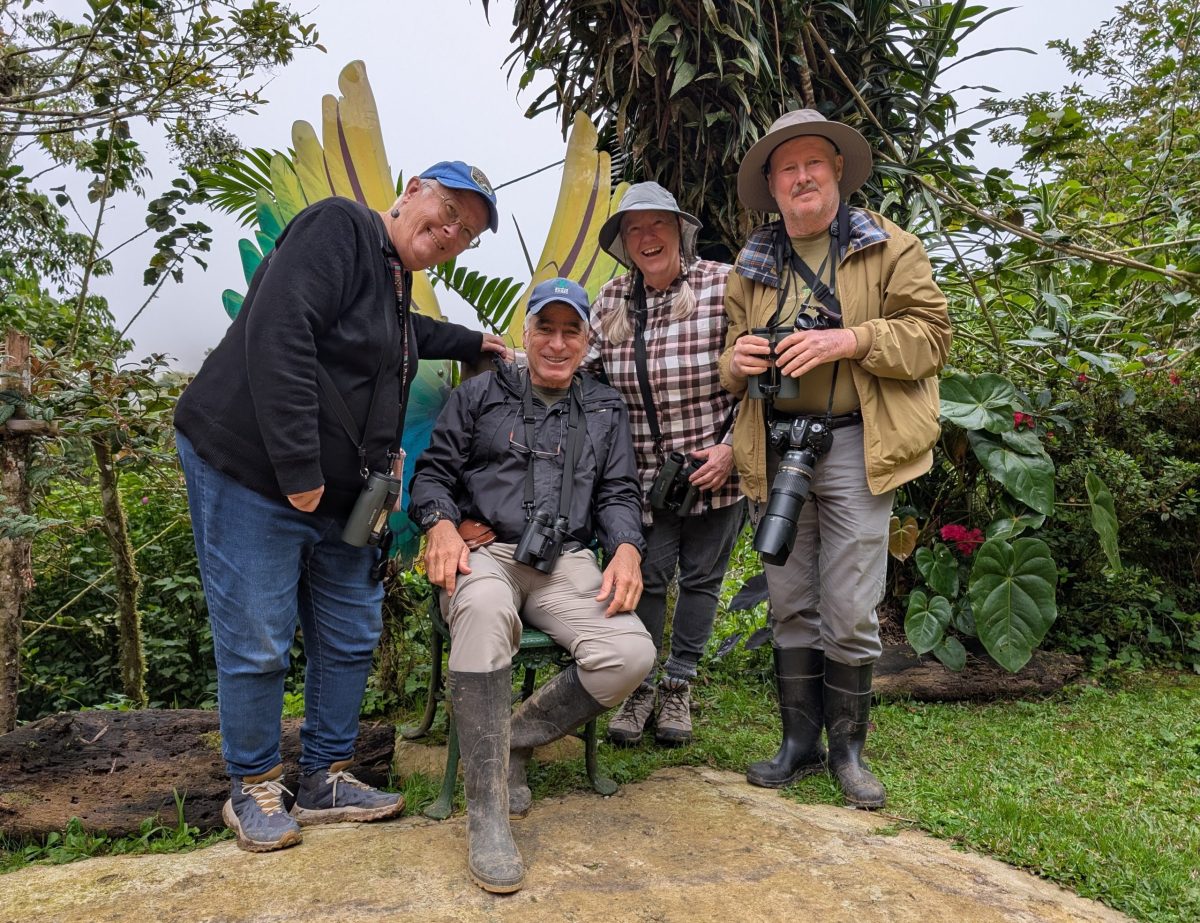
From left to right: Trudy, Daniel, Julie and Doug.
Day 1: The Multicolored Tanager at La Minga Ecolodge (1,994m)
Trudy, Julie, and Doug arrived in Cali the night before the official start, resting comfortably at the Hotel Dann Carlton. Our guide, Daniel Uribe, drove from Armenia early in the morning to meet the group at 10:00 AM, ensuring a punctual start to our private birding tours Colombia adventure. We immediately transferred to La Minga Ecolodge in Dapa, a 50-minute drive into the cloud forest.
Weather: Cloudy and misty with light afternoon rain.
We wasted no time beginning our search for Trudy’s highly wanted targets, specifically the endemic Multicolored Tanager and Red-headed Barbet. The lodge’s front porch, famous among Colombia bird photography tours, offered a front-row seat to active feeders.
Morning Highlights:
The activity was intense. We quickly secured stunning views of two male Long-tailed Sylphs in full plumage. The feeders were a battleground for dominance among Bronzy Inca, Fawn-breasted Brilliant, Crowned Woodnymph, White-necked Jacobin, Brown Violetear, Andean Emerald, Buff-tailed Coronet, and Steely-vented Hummingbird.
The gardens provided excellent views of the White-throated Daggerbill on Aphelandra flowers, while Verbenas attracted Speckled Hummingbird, the near-endemic Purple-throated Woodstar, and White-booted Racket-tail. A Green Hermit patrolled the Heliconias.
The Stars of the Show:
- Endemic Multicolored Tanager
- Red-headed Barbet
- Crimson-rumped Toucanet
- Endemic Colombian Chachalaca
- Flame-rumped Tanager, Metallic-green Tanager, Golden-naped Tanager, near-endemic Scrub Tanager, Saffron-crowned Tanager, Golden Tanager, Orange-bellied Euphonia and Green Honeycreeper.
Afternoon Highlights:
A gentle walk along the gravel road through the cloud forest produced the vocal but shy near-endemic Nariño Tapaculo. We spotted Montane Woodcreeper, Variegated Bristle-tyrant, Lineated Foliage-gleaner, Rufous-naped Greenlet, Whiskered Wren, Andean Solitaire, Ashy-throated Chlorospingus, a family of Green Jays, Chestnut-capped Brushfinch, plus Blackburnian and Canada Warbler.
The day ended with a gorgeous Mottled Owl called in just 80 yards from the parking lot.
Day 2: Iconic Feeders of the Western Andes: La Minga Ecolodge & Finca Alejandría
Early morning rains turned the foliage into bath time for the hummingbirds. We watched twelve White-necked Jacobins and other species bathing in the rain—a magical moment typical of Andes birding tours.
Morning Highlights:
- Endemic Chestnut Wood-quail: A family of five fed on cornstarch just 6 feet from the porch.
- Endemic Colombian Chachalaca (2) and Sickle-winged Guan.
- Metallic-green Tanager.
- Other notables included Blue-necked Tanager, Beryl-spangled Tanager, Rufous-crested Tanager, Black-winged Saltator, Yellow-vented Woodpecker, Montane Foliage-gleaner, Red-faced Spinetail, Uniform Antshrike, Plain Antvireo, Streaked Xenops, Spotted Barbtail, and Golden-bellied Flycatcher.
Afternoon Highlights:
We transferred to Finca La Florida. Along the road, we spotted Andean Motmot, Blue-capped Tanager, Squirrel Cuckoo, and Acadian Flycatcher. At Finca Alejandría we enjoyed second views of the endemic Multicolored Tanager, alongside Golden-naped Tanager, Golden Tanager, Saffron-crowned Tanager, White-lined Tanager, Green Honeycreeper, Red-headed Barbet, Andean Motmot and the endemic Colombian Chachalaca.
Hummingbirds were very active as usual, with the presence of White-necked Jacobin, Green Hermit, Brown Violetear, Long-tailed Sylph, Buff-tailed Coronet, White-booted Racket-tail, Fawn-breasted Brilliant, near-endemic Purple-throated Woodstar, Steely-vented Hummingbird and Andean Emeral.
Day 3: Chocó Endemics at Doña Dora’s
We started early with birds attracted to the night lights: Plain Antvireo, Russet-crowned Warbler, Andean Motmot, Gray-breasted Wood-wren, and Southern House Wren.
Before leaving La Florida, three endemic Chestnut Wood-quails crossed the trail, offering superb views.
Doña Dora’s Highlights (Chocó Specialties):
This location is essential for any Colombia endemic birds tour.
- Toucan Barbet (Chocó endemic): A family of four grooming just 9 feet away.
- Endemic Parker’s Antbird (male & female).
- Glistening-green Tanager (Chocó endemic).
- Rufous-throated Tanager (near-endemic/Chocó endemic).
- Indigo Flowerpiercer (Chocó endemic): An important lifer for Doug and Julie.
- Chocó Brushfinch (near-endemic) and Spot-crowned Barbet (Chocó endemic).
- Silver-throated Tanager, Golden Tanager, Tawny-crested Tanager, Chestnut-capped Brushfinch, Chestnut-headed Oropendola, Red-headed Barbet, Bay Wren, Scarlet-rumped Cacique, Red-faced Spinetail, and Olive-striped Flycatcher.
Hummingbird Highlights:
The feeders attracted specific Chocó specialties: Near-endemics White-whiskered Hermit, Violet-tailed Sylph, Rufous-gaped Hillstar, Velvet-purple Coronet, Purple-bibbed Whitetip, and Empress Brilliant. We also listed Green Thorntail, Crowned Woodnymph, Andean Emerald, Brown Violetear, and White-necked Hummingbird.
On the return to La Florida, we stopped for a massive 30-species mixed flock. We enjoyed the Rusty-winged Barbtail, Red-headed Barbet, Streak-capped Treehunter, Spotted Barbtail, Barred Becard, Variegated Bristle-tyrant, Black-billed Peppershrike, Three-striped Warbler, Blue-winged Mountain-tanager, endemic Multicolored Tanager, Streaked Xenops, and Montane Woodcreeper, among many others.
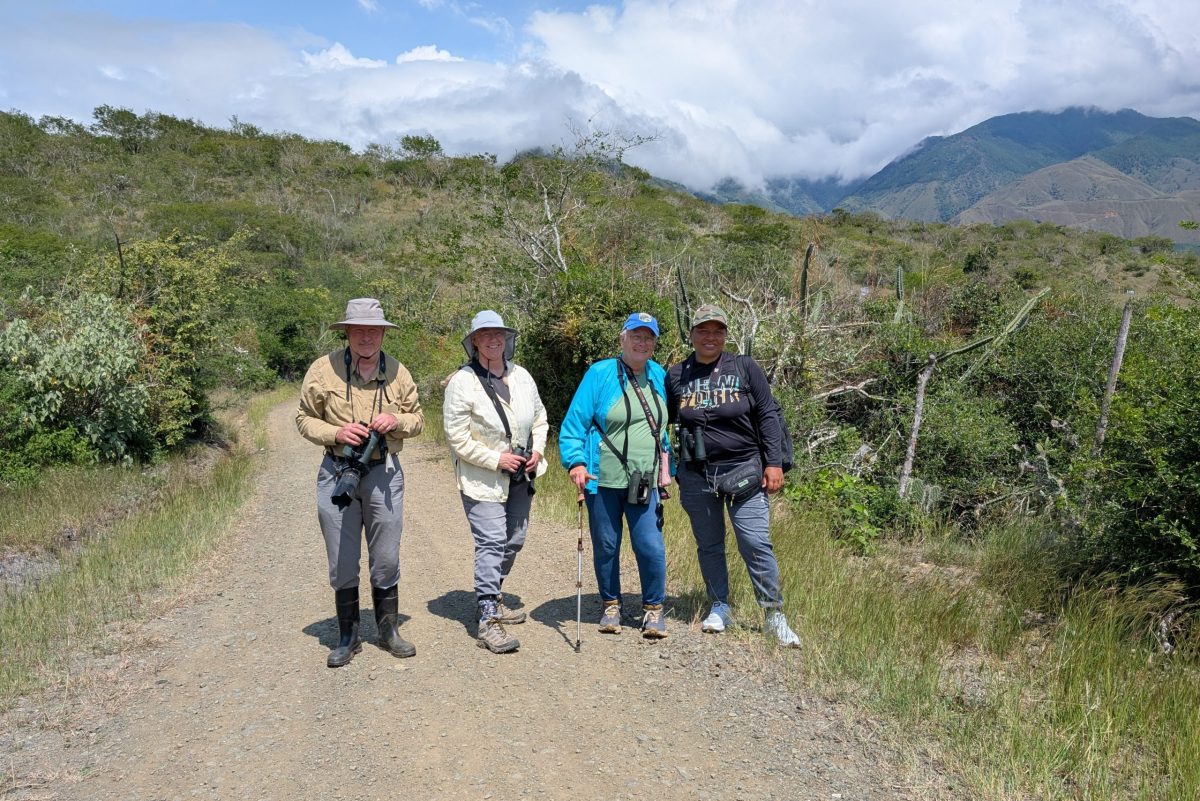
At Atuncela´s dry forest: Doug, Julie, Trudy and local guide Olga.
Day 4: Dry Forest Specialties at Atuncela & El Vínculo Reserve.
We met our local guide, Olga Arango, to explore the Dagua Canyon dry forest enclave.
Morning Highlights:
- Endemic Apical Flycatcher.
- Near-endemic Bar-crested Antshrike.
- Ruby-topaz Hummingbird: A top target for Julie.
- Striped Cuckoo, White-rumped Hawk, Slate-headed Tody-flycatcher, Southern-beardless Tyrannulet, Yellow-bellied Elaenia (nesting), Chivi Vireo, Orange-crowned Euphonia, and Yellow Oriole.
Afternoon at El Vínculo:
We observed White-tailed Hawk (two birds), Streak-headed Woodcreeper, Yellow-olive Flatbill, Sooty-headed Tyrannulet, Streaked Flycatcher, Tropical Parula, and Crimson-backed Tanager, among others.
Day 5: Sonso Marsh & Transfer to Montezuma
Joined by local guide Jhonathan Bedoya, we explored the scrublands and wetlands.
Highlights:
- Ruby-topaz Hummingbird: Two males offering magnificent views.
- Horned Screamer: Scope views of two individuals. A lifer for all three of the US birders.
- Endemic Apical Flycatcher: Second views.
- Guira Tanager (male) and Great Antshrike.
- Little Cuckoo, Common Potoo, Buff-necked Ibis, Cocoi Heron, Ringed Kingfisher, Amazon Kingfisher, Green Kingfisher, Spectacled Parrotlet, Yellow Oriole, and Oriole Blackbird.
- Lineated, Spot-breasted, and Red-crowned Woodpecker.
We then transferred to Cerro Montezuma, stopping in Pueblo Rico for provisions.
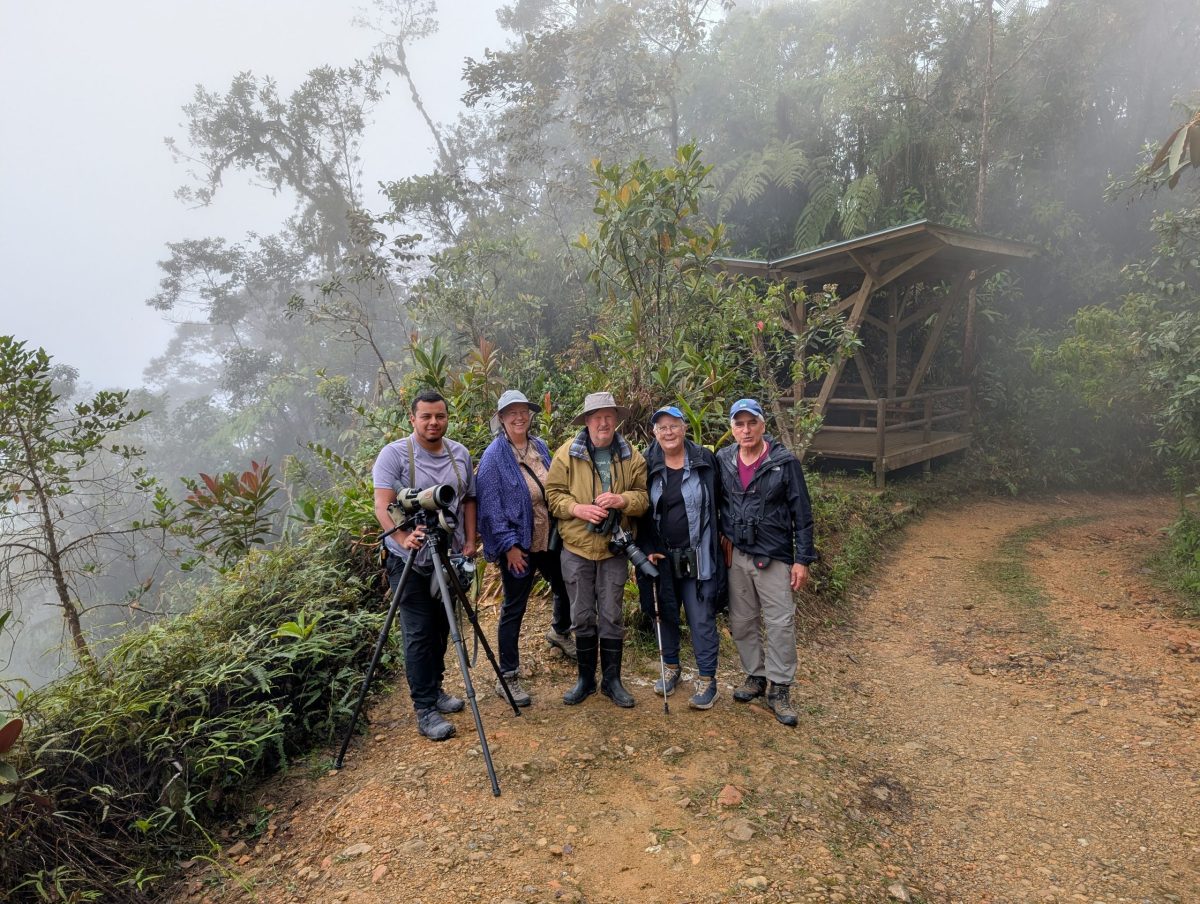
From left to right: Fernando, Julie, Doug, Trudy and Daniel, above Cajones at Cerro Montezuma.
Day 6: Montezuma Mid-Elevations
To avoid crowding with another group, we strategically focused on the mid-section of the mountain.
Morning Highlights:
- Near-endemic Beautiful Jay.
- Yellow-collared Chlorophonia (Chocó endemic).
- Near-endemic Chocó Brushfinch.
- Near-endemic Black-chinned Mountain-tanager and Purplish-mantled Tanager.
- Blue-fronted Parrotlet, Chestnut-breasted Chlorophonia, Black-throated Tody-tyrant, Green-and-black Fruiteater, Bluish Flowerpiercer, and Beryl-spangled Tanager.
Hummingbird List:
Violet-tailed Sylph, Greenish Puffleg, Brown Inca, Collared Inca, Velvet-purple Coronet, Rufous-gaped Hillstar, Empress Brilliant, Purple-throated Woodstar, Green-crowned Brilliant, and Tawny-bellied Hermit.
Afternoon Highlights:
- Endemic Gold-ringed Tanager.
- Near-endemic Orange-breasted Fruiteater (male).
- Near-endemic Uniform Treehunter and Fulvous-dotted Treerunner.
- Dusky Chlorospingus, Chocó Warbler, Glistening-green Tanager, Handsome Flycatcher, and White-capped Dipper.
Back at the lodge, we visited a nesting Endemic Grayish Piculet and saw a pair of Blackish Rails with juveniles.
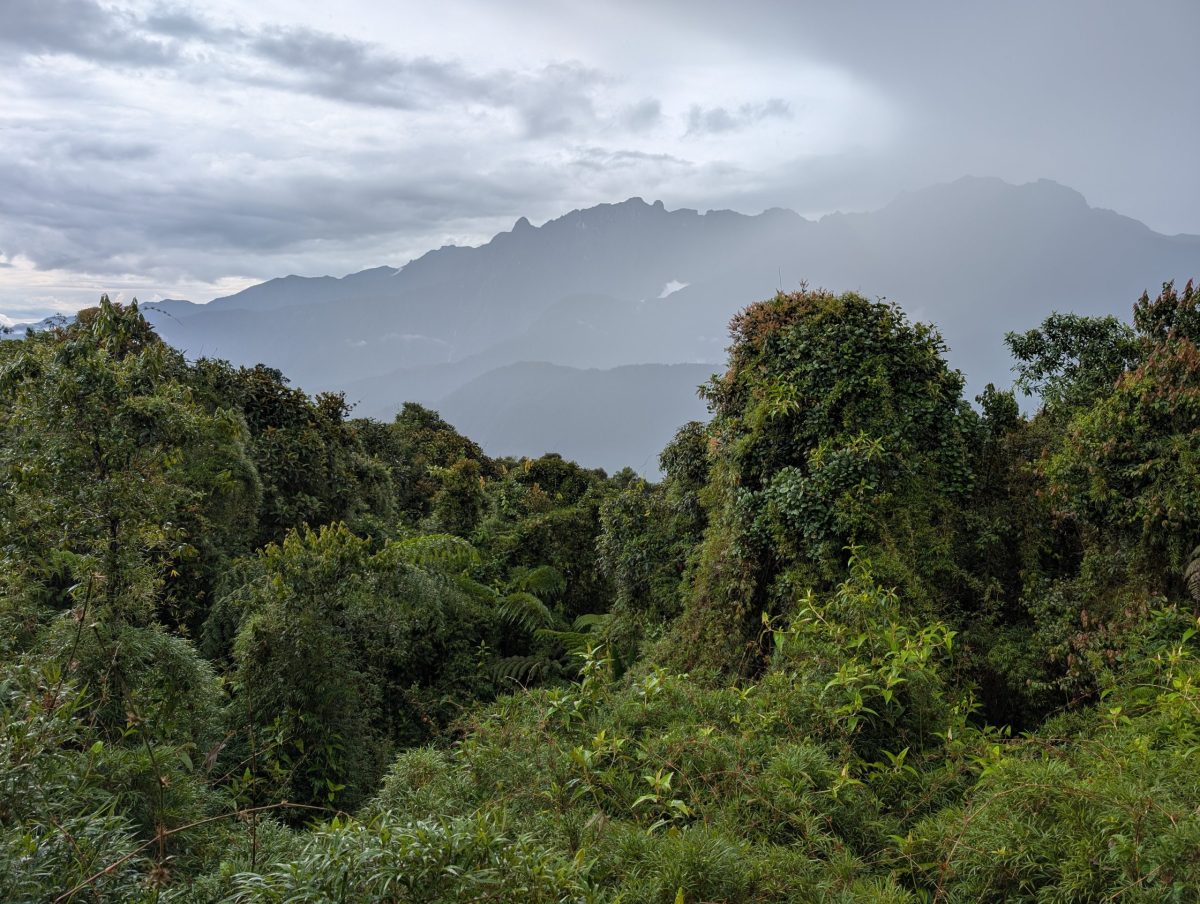
The Tatamá Peak, seen from the top of Cerro Montezuma.
Day 7: Montezuma High Elevations
A fresh 5:30 AM start took us to the top of the mountain for breakfast.
Summit Highlights:
- Endemic Chestnut-bellied Flowerpiercer (2).
- Endemic Munchique Wood-wren (2).
- Endemic Black-and-gold Tanager (4).
- Endemic Gold-ringed Tanager.
- Near-endemic Tanager Finch.
- Near-endemic Purplish-mantled Tanager.
- Near-endemic Nariño Tapacuo (Adult feeding juvenile).
- Toucan Barbet (4).
- Pacific Tuftedcheek (Chocó endemic).
- Northern Chestnut-breasted Wren, Plushcap, Scaled Fruiteater, Golden-fronted Redstart, Green-and-black Fruiteater, Rufous Spinetail, Slaty Antwren, Ornate Flycatcher, Cinnamon Flycatcher, and Streak-necked Flycatcher.
- Hummingbirds: Tourmaline Sunangel, Buff-tailed Coronet, and Violet-tailed Sylph at close range.
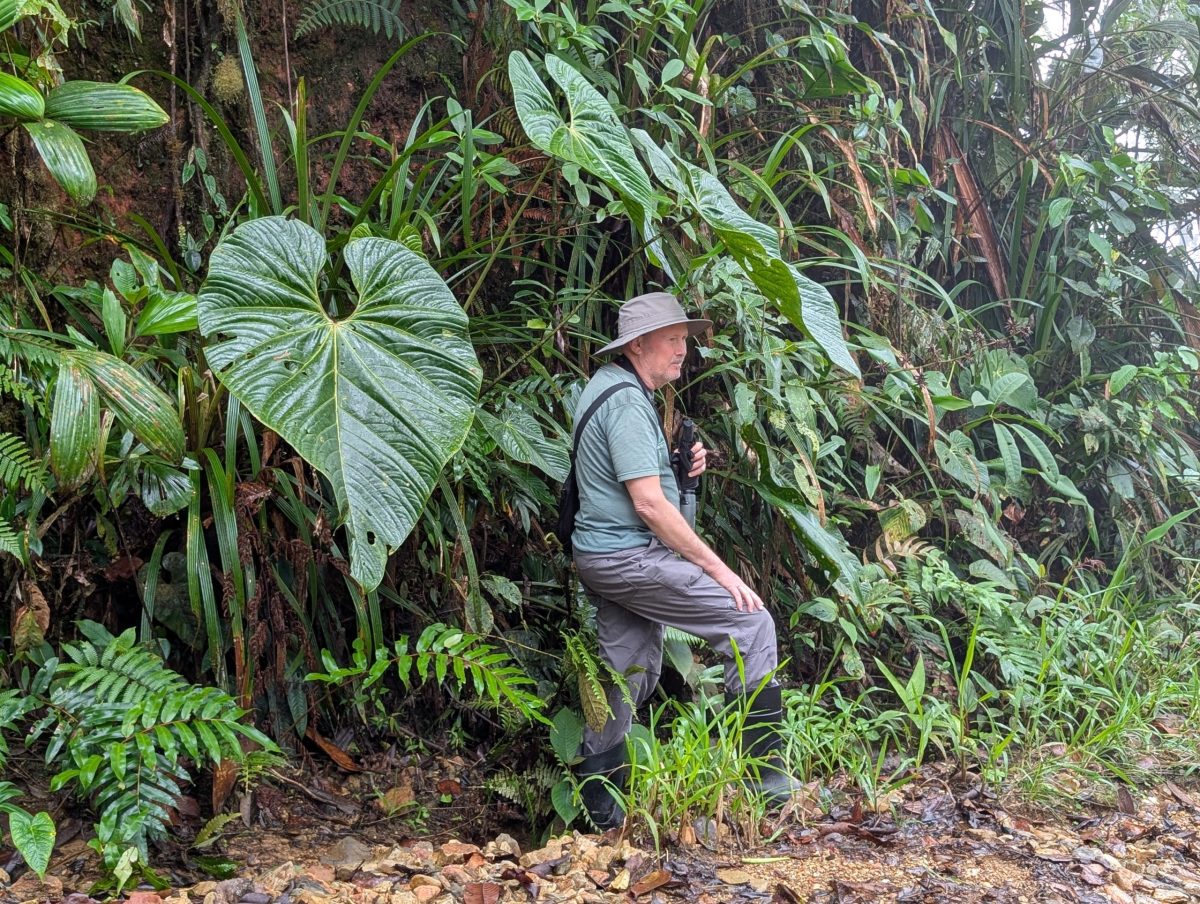
Doug sheltering below the anthurium leaves, under light rain in Cerro Montezuma.
Day 8: Montezuma Low Elevations & Apía
Morning Highlights (Montezuma):
- Near-endemic Club-winged Manakin (male).
- Near-endemic Chocó Tapaculo and Sooty-headed Wren.
- Zeledon´s Antbird, Barred Hawk, Rufous-rumped Antwren, Yellow-breasted Antwren, Black-headed Brushfinch, Russet-backed Oropendola, Chestnut-headed Oropendola, Smoky-brown Woodpecker, Rufous-naped Greenlet, Western Emerald, Stripe-throated Hermit, Northern Plain-Xenops, Buff-fronted Foliage-gleaner, Plumbeous Pigeon, and Olive-striped Flycatcher.
- Migrants: Robust numbers of Cerulean, Mourning, Bay-breasted, Tennessee, Black-and-white, and Blackburnian Warblers.
Afternoon Highlight:
Our visit to Apía Birding was a success, granting us close views of the endemic Tatamá Tapaculo carrying food.
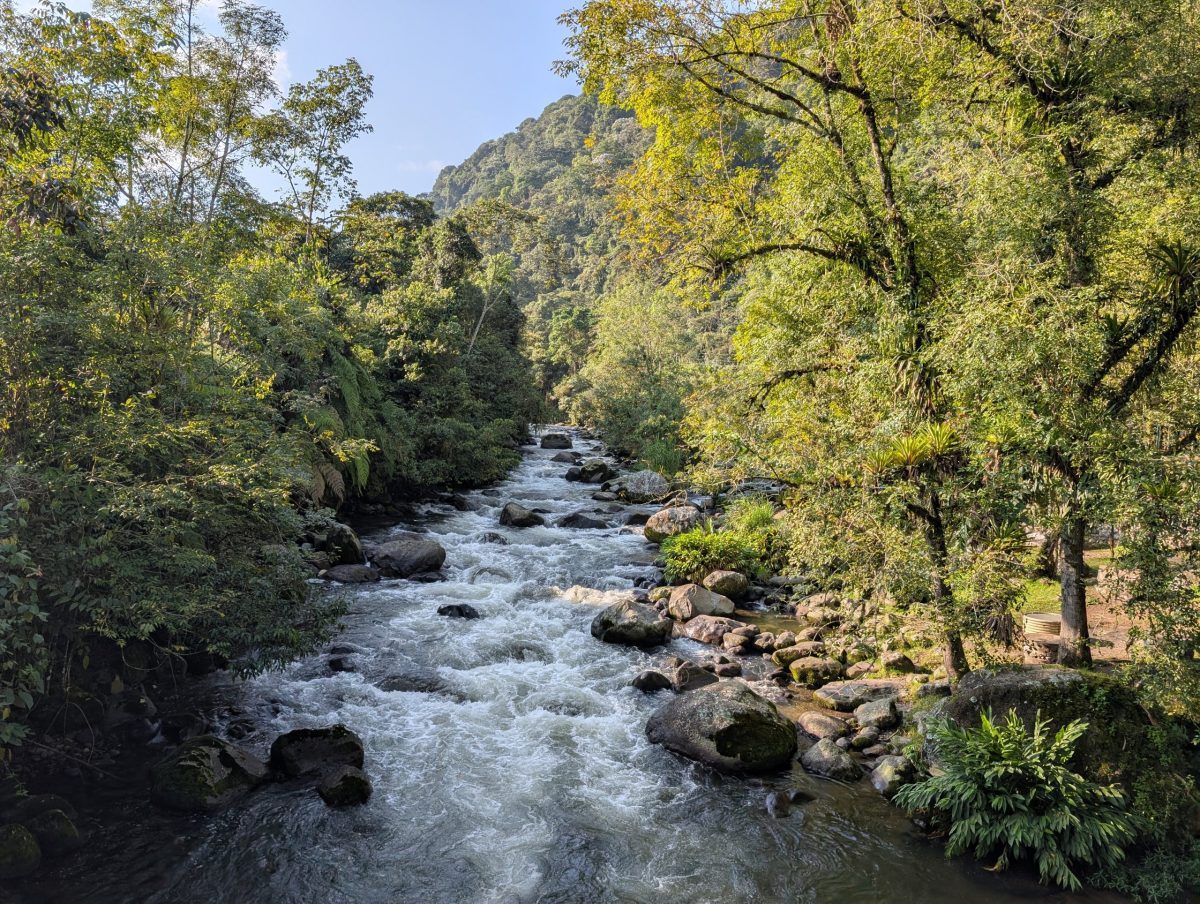
The Otún River at Otún-Quimbaya Wildlife Sanctuary.
Day 9: Otún-Quimbaya Wildlife Sanctuary & Cameguadua Marsh
Morning Highlights (Otún-Quimbaya):
- Endemic & endangered Cauca Guan: Once thought extinct, seen along the road.
- Endemic Parker´s Antbird: A pair seen singing in duet.
- Prolonged and close views of Torrent Duck (male & female), White-capped Dipper, and Torrent Tyrannulet along the river.
- A gracious Green-fronted Lancebill catching insects in flight over the torrential water of the Otún River.
- White-crowned Tapaculo, Red-ruffed Fruitcrow, Bronze-winged Parrots, Black-and-white Seedeater, Andean Motmot, Green Jay, Western Wood-Pewee, Rose-breasted Grosbeak, Summer Tanager, Hepatic Tanager, Green Honeycreeper, Broad-winged Hawk, White-winged Becard, Slaty-capped Flycatcher, Golden-faced Tyrannulet, and others.
Afternoon Highlights (Cameguadua Marsh):
A productive stop en route to Manizales yielded 52 species, including Blue-winged Teal (120), Blackish Rail (6), Purple Gallinule (4), Black-necked Stilt (16), Spotted Sandpiper, Solitary Sandpiper, Lesser Yellowlegs, Greater Yellowlegs, Neotropic Cormorant (35), Bare-faced Ibis (250), Black-crowned Night Heron (3), Yellow Oriole, Yellow-backed Oriole, and Olive-gray Saltator.
Day 10: The Antpittas of Río Blanco
This reserve is a premier destination for Colombia antpitta feeding stations.
Morning Highlights:
- Endemic Brown-banded Antpitta.
- Chestnut-crowned Antpitta and Slate-crowned Antpitta.
- Masked Saltator: Prolonged views of this rare bird feeding on berries.
- Grass-green Tanager: A main target for Trudy.
- Black-billed Mountain-toucan (3) and Southern Emerald-toucanet.
- Masked Trogon, Tyrannine Woodcreeper, Montane Woodcreeper, Pearled Treerunner, Green-and-black Fruiteater, Chestnut-bellied Chat-tyrant, Flavescent Flycatcher, Rufous-crowned Tody-flycatcher, Mountain Wren, Sharpe´s Wren, Slaty-backed Nightingale-thrush, Northern Slaty Brushfinch, Black-capped Hemispingus, Superciliaried Hemispingus, Blue-capped Tanager, Blue-and-black Tanager, Metallic-green Tanager, Blue-winged Mountain-tanager, Saffron-crowned Tanager, Pink-billed Cnemoscopus, Masked Flowerpiercer, White-sided Flowerpiercer, and Cinnamon Flycatcher.
Hummingbird Highlights:
Sparkling Violetear, Lesser Violetear, Tourmaline Sunangel, Speckled Hummingbird, Long-tailed Sylph, Bronzy Inca, Collared Inca, Buff-tailed Coronet, and Fawn-breasted Brilliant.
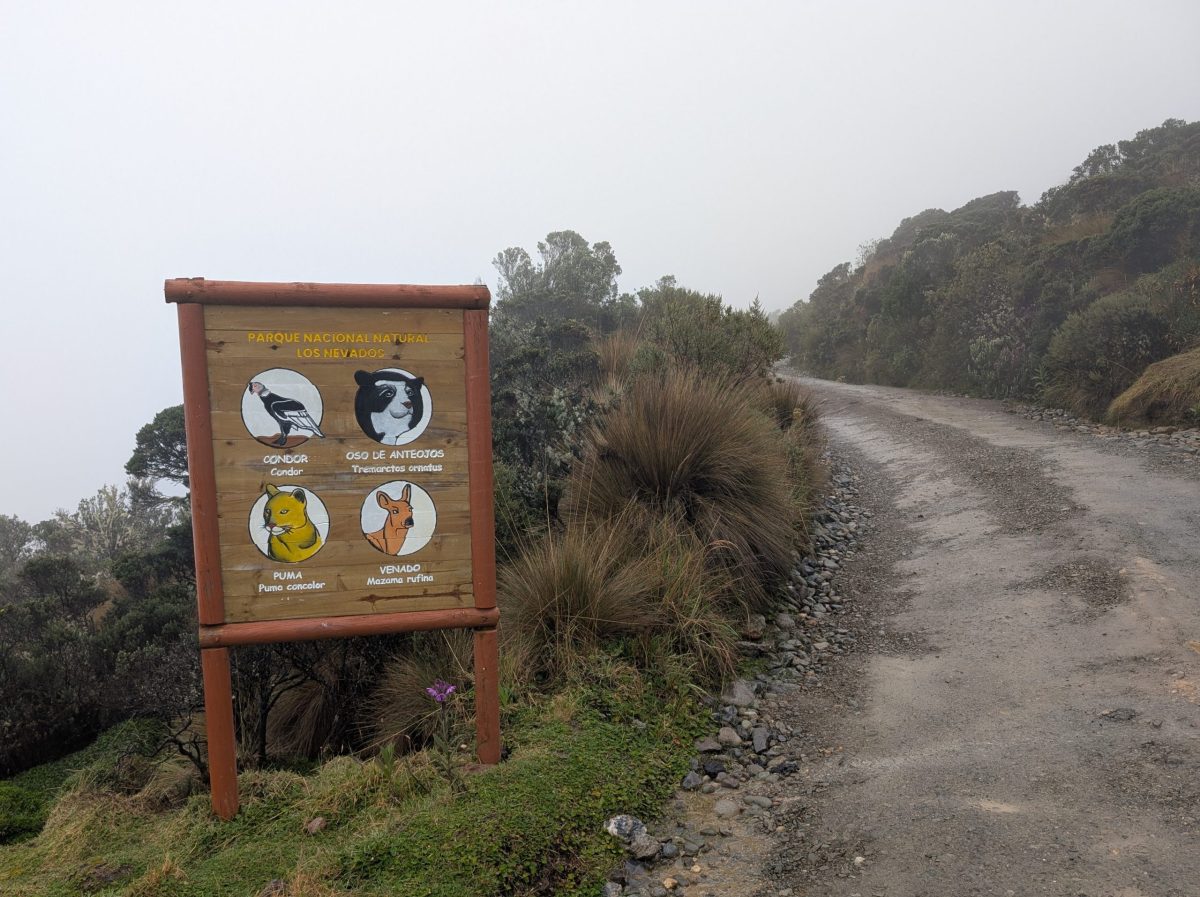
The road to the Visitor´s Center at Los Nevados National Park.
Day 11: High Andes at Los Nevados National Park
We explored the stunning Páramo ecosystem amidst mist and rock cliffs.
Highlights:
- Endemic Buffy Helmetcrest: A male seen in the high Páramo.
- Near-endemic Golden-breasted Puffleg.
- Rainbow-bearded Thornbill (male & female).
- Shining Sunbeam, Great Sapphirewing, Viridian Metaltail.
- Lacrimose Mountain-tanager, Scarlet-bellied Mountain-tanager, Pale-naped Brushfinch, Plumbeous Sierra Finch, Glossy Flowerpiercer, Masked Flowerpiercer, Grass Wren, Plain-colored Seedeater, and Andean Teal.
- Mixed flock sightings included White-banded Tyrannulet, White-throated Tyrannulet, Superciliaried Hemispingus, Golden-fronted Redstart, and Páramo Tapaculo.
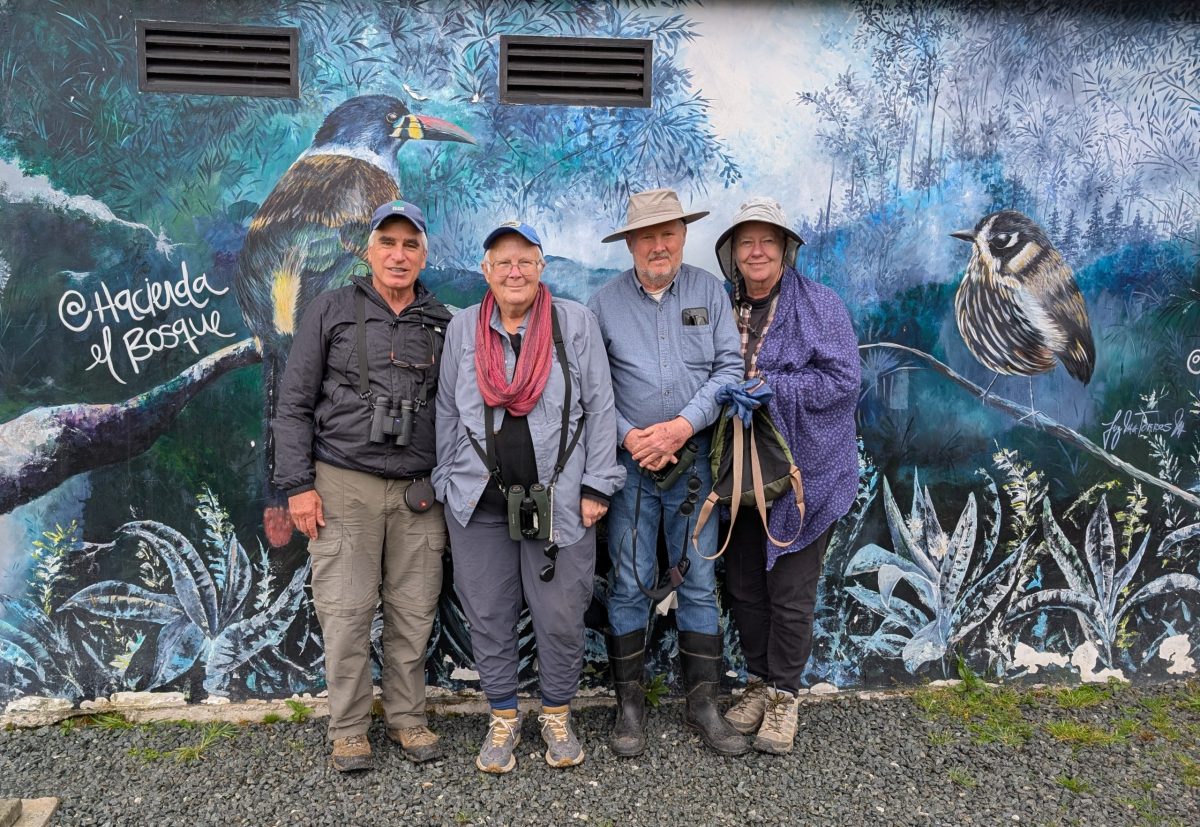
Daniel, Trudy, Doug and Julie at Hacienda El Bosque.
Day 12: Hacienda El Bosque
We joined Cristian, the local guide and “Antpitta Master”.
Highlights:
- Equatorial Antpitta (2).
- Gray-breasted Mountain-toucan (2).
- White-browed Spinetail (2): Feeding on worms at the antpitta station.
- Gray-browed Brushfinch and Northern Slaty Brushfinch.
- Blue-capped Tanager, Black-crested Warbler, Yellow-bellied Chat-tyrant, Black-capped Tyrannulet, Mountain Wren, Grass Wren, Sickle-winged Guan, Andean Guan, White-throated Quail-dove, Black Flowerpiercer, Masked Flowerpiercer, Scaly-naped Amazon, and Band-tailed Pigeon.
Hummingbird Highlights:
We added four new species for the trip: Sword-billed Hummingbird, near-endemic Black-thighed Puffleg, Buff-winged Starfrontlet, and Mountain Velvetbreast. Also seen were Shining Sunbeam, Collared Inca, Sparkling Violetear, and Tourmaline Sunangel.
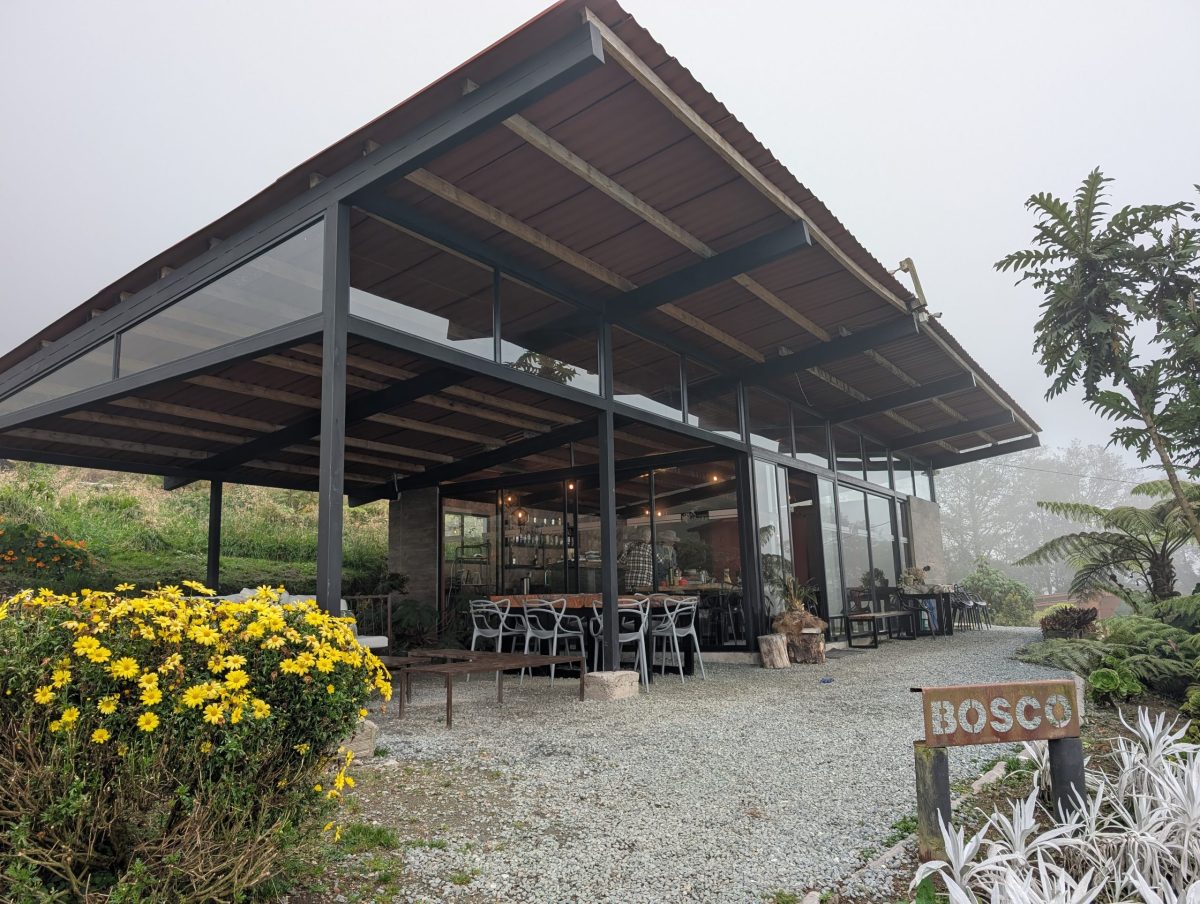
Restaurante El Bosco at Hacienda El Bosque (3,300mt)
Day 13: Finale at Tinamú Lodge & transfer to Pereira´s airport
Our final day was a celebration of Colombia birding tours, featuring excellent feeding stations and local guides Fernando and Brayan.
Highlights:
- Blue-lored Antbird: Spectacular views of a female and male feeding on worms.
- Jet Antbird: A male appeared from the dense lianas.
- Great Antshrike and Bar-crested Antshrike: Both males seen at close range.
- Golden-collared Manakin: Two males displaying at a lek.
- Moustached Puffbird and Gray-headed Dove.
- Speckle-breasted Wren, Ochre-bellied Flycatcher, Plain-brown Woodcreeper, Rusty-margined Flycatcher, Great Kiskadee, Common Tody-flycatcher, Yellow-olive Flatbill, Streaked Flycatcher, Golden-crowned Warbler, Canada Warbler, and Acadian Flycatcher.
- The gardens were alive with White-necked Jacobin, Black-throated Mango, White-vented Plumeleteer, Steely-vented Hummingbird, Rufous-tailed Hummingbird, Flame-rumped Tanager, Scrub Tanager, Blue-and-gray Tanager, Palm Tanager, Summer Tanager, Clay-colored Thrush, Black-billed Thrush, Red-crowned Woodpecker, Green Honeycreeper, and Bananaquit.
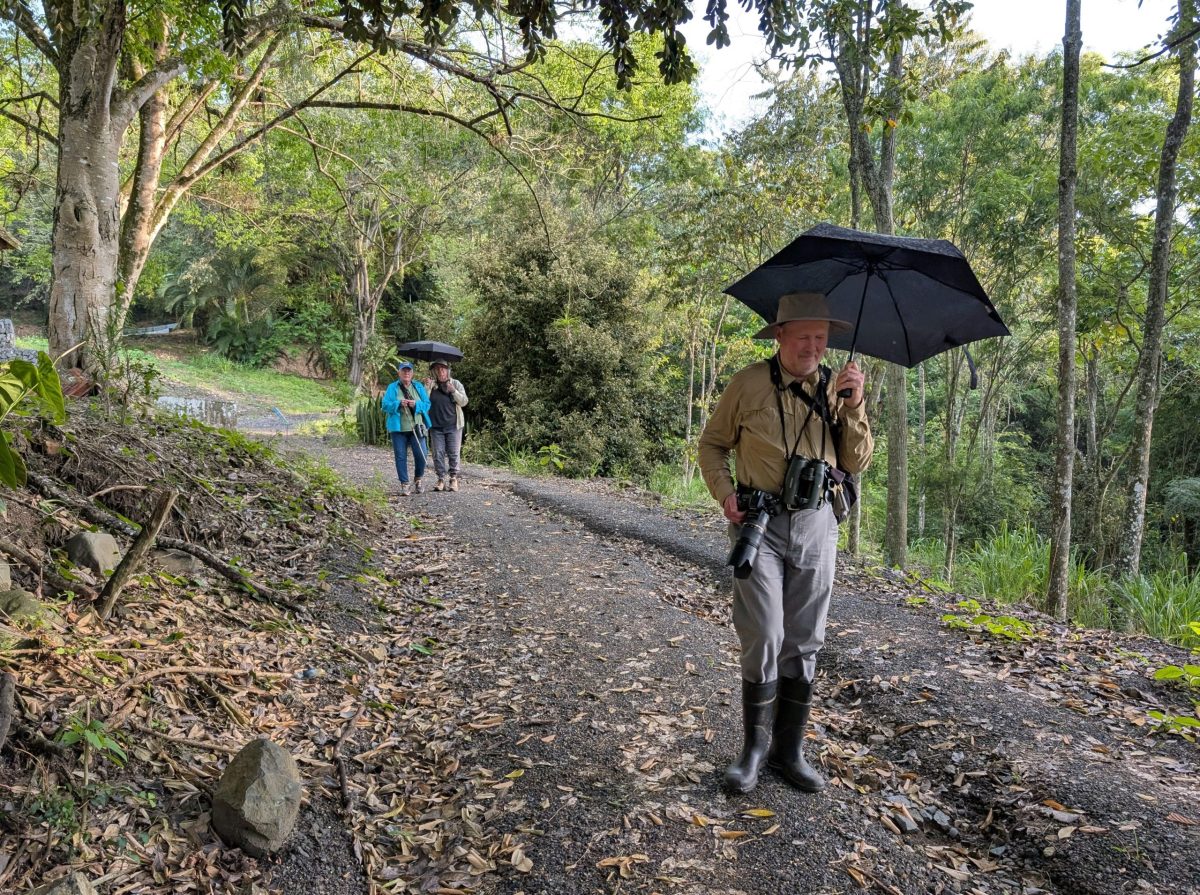
The birding comes to an end at El Vínculo dry forest.
Book Your Colombia Birding Adventure
Are you ready to experience the “thrill of the find”? Whether you are a birder or a bird photographer seeking the perfect shot, Birding Tours Colombia crafts private, expert-led itineraries just for you. This trip was a custom design, but it mirrors our popular 10-day Andes birding tours.
Explore our scheduled tours and custom birding trips across Colombia’s Andes and Chocó region today.
YOU MAY ALSO LIKE
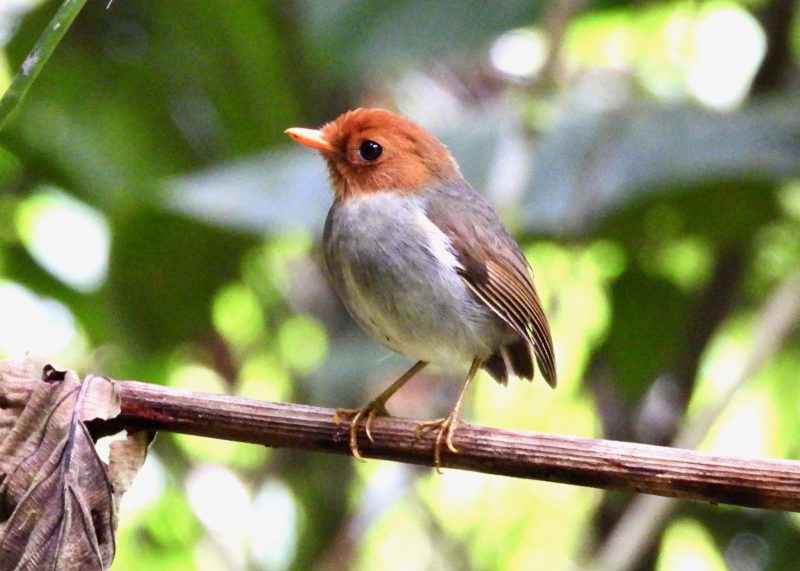
Putumayo & Huila Birding Trip Report: A Private Colombia Birding Tour (Oct 2025) with Judy Harackiewicz & Cliff Thurber from Madison
SEE MORE
Birding & photographing birds along the Central & Western Andes with Doug & Gail Cheeseman (April 22 – May 8, 2019).
SEE MORE
Birding the Central & Western Andes with Anthony Kaduck & Ken Edwards from Canada (March 20 – April 5, 2019).
SEE MORE


Birding Mitú, Inírida & the Perijá Mountains for key species with Hans Jornvall from Sweden (January 5 - 23, 2019).
SEE MORE

Second birding trip to Colombia for Ernest Bradley & Dale Brinker (November 19 – December 03, 2018).
SEE MORE


Birding Hato La Aurora in the Eastern Llanos with Todd Pepper & Mark Eaton (December 1 – 4, 2017).
SEE MORE
Birding the Central & Western Andes of Colombia with Anthony Collerton (July 14 – 23, 2017).
SEE MORE
Andean Endemics tour with British crew: from the Eastern Andes to the mid-Magdalena Valley & Central Andes of Colombia (March 1 – 14, 2017).
SEE MORE
Another challenging & productive trip for Hans Jörnvall from Sweden (January 2 – 15, 2017).
SEE MORE
The Eastern Andes from Bogota to Soata: birding trip for recordist Terry Morgan & Karen Walz (November 18-30, 2016).
SEE MORE
Second birding trip for Katy Krigbaum & Birgit Felser: the Western & Central Andes of Colombia (September 1-20, 2016).
SEE MORE
Birding for much desired targets with Keith Betton, Andrew Herbert (UK) and Rainer Kopa (Germany) (April 17-May 7, 2016).
SEE MORE
Birding the Western & Central Andes with Richard & Jennifer Kershaw from UK (March 10-31, 2016).
SEE MORE
Second birding trip for Steve Huggins & Glenn Giacinto from Chicago, Illinois (January 23 – February 2, 2016).
SEE MORE
Birding along the Western & Central Andes of Colombia with Bob & Katie Self from the UK (November 9 – 26, 2015).
SEE MORE
Birding in Colombia from the Western Andes to the Santa Marta Mountains & Guajira peninsula, with a recapitulation.
SEE MORE
The Eastern Andes, mid-Magdalena Valley, Santa Marta Mountains & La Guajira peninsula with Katy Krigbaum & Birgit Felser (Sept. 2 – 21, 2015).
SEE MORE
Bird photo tour for photographers from Taiwan & China: The Western & Central Andes of Colombia (July 18 – August 8, 2015).
SEE MORE
Second birding trip for Debby Reynolds & David Copas (UK), and Jane Andrews (USA) (January 20 – February 6, 2015).
SEE MORE
Short but productive bird photo trip for family group from Canada and Colombia (December 16-20, 2014).
SEE MORE

Medium length birding trip through the Western & Central Andes of Colombia with Bruce Webb, Jeanne Conry & Peter Gent from USA (May 18 - 27, 2014).
SEE MORE
Short birding escapade for James Taylor & Christine Forster from Victoria, British Columbia (Canada) (May 8-11, 2014).
SEE MORE
Bird photography trip for Japanese photographers – Hisao komori & Yasunobu Shiga (April 26-May 4, 2014).
SEE MORE

Birding the Eastern, Central & Western Andes with Andy & Gill Swash, Debby Reynolds & David Copas from UK (January 15 – February 5, 2014).
SEE MORE
Birding the Central Andes of Colombia with Steven Huggins & Glenn Giacinto from Chicago, Illinois (January 3 – 13, 2014).
SEE MORE


Bird photography trip to the Eastern Andes of Colombia for Juan José Arango & Anabel Vanin (July 31 - August 04, 2013).
SEE MORE


Back to Colombia for a second time: Peter Hawrylyshyn & Bob Lewis search for more hummingbird species and bird specialties at new birding sites (February 15 – March 03, 2013).
SEE MORE
Central Andes short tour with Happy Warblers touring company from New York (February 5 – 13, 2013).
SEE MORE
More Andean endemics with magnificent birding crew from USA, UK & Canada (Dec. 28, 2012 to Jan. 5, 2013).
SEE MORE

Touring for Central Andes Endemics: how good birding in Colombia can be (October 6 – 15, 2012).
SEE MORE
Bird photography trip for Peter Hawrylyshyn, Bob & Hanno Lewis with emphasis on hummingbirds (August 22 – September 9, 2012).
SEE MORE

Birding Otún-Quimbaya Wildlife Sanctuary for some bird images with Juan Jose Arango and Anabel Vanin (August 3 – 5, 2012).
SEE MORE
Enjoying the Rio Blanco antpittas and Central Andes endemics with Eugenia Carey from Dauphin Island (July 5 – 12, 2012).
SEE MORE


Promoting Colombia as a travel destination with British presenter & producer Nigel Marven (February 6 – 11, 2012).
SEE MORE
Bogota Sunangel or not? The intriguing hummingbird at Rogitama Private Nature Reserve (2011).
SEE MORE
Birding with Dominic Mitchell – Managing Editor of Birdwatch Magazine (UK) (November 27 – December 4, 2011).
SEE MORE
Guiding and operating for Birding Adventures TV episodes in Colombia (November 27 – December 4, 2011).
SEE MORE


Putumayo & Huila Birding Trip Report: A Private Colombia Birding Tour (Oct 2025) with Judy Harackiewicz & Cliff Thurber from Madison
20 - 10 - 2025
From October 1–15, 2025, we at www.birdingtourscolombia.com embarked on a rewarding private birding tour in southern Colombia, exploring the Putumayo region and the southernmost tip of the Eastern Andes in Huila Department, where a wealth of unique and range-restricted bird species can be found. This custom Colombia birding trip itinerary for Judy Harackiewicz and Cliff Thurber from Madison, Wisconsin (USA), was focused on observing new life birds and enjoying any primate encounters that would bring delight to Judy & Cliff during the journey.
Dates: October 1 – 15, 2025
Total Species: 372
Complete eBird trip report: https://ebird.org/tripreport/434734
An Andean Birding Colombia Itinerary: the Huila Department
Our adventure began on the western slope of the Eastern Andes, in the scenic municipality of Palestina, Huila, where we explored the premontane forests at El Encanto Lodge and Drymophila Nature Reserve owned by the Molina family. These sites are home to a wonderful diversity of Andean tanagers, antpittas, and hummingbirds, making it a perfect start for any Colombia hummingbird tour.
Descending into the Amazonian Foothills Birding – From Huila to Putumayo
As our itinerary progressed, we continued southward and downslope toward the Amazon Basin, following the transition from cool Andean forest to humid Amazonian foothill habitats. We spent productive time birding at the Discosura Birding Center, a hotspot known for the exceptional hummingbird diversity and mixed-species flocks. The diversity of birds in this transition zone, where Andean and Amazonian ecosystems meet, makes it one of the most fascinating regions for birdwatching in Colombia.
Climbing the Trampolín de las Aves – Gateway to the Colombian Massif
One of the most memorable parts of our journey was visiting the legendary Trampolín de las Aves, a winding mountain road famous among birders for its breathtaking scenery and incredible bird diversity. This steep route leads toward the Colombian Massif, an immense uplift of the Andes where the mountains broaden before splitting into three distinct ranges: the Eastern, Central, and Western Cordilleras.
This geological formation is not only dramatic in its landscapes but also fundamental to Colombia’s extraordinary biodiversity. The complex topography created by the separation of the Andes has given rise to countless microhabitats and endemic species, making Colombia the most bird-rich country on Earth.
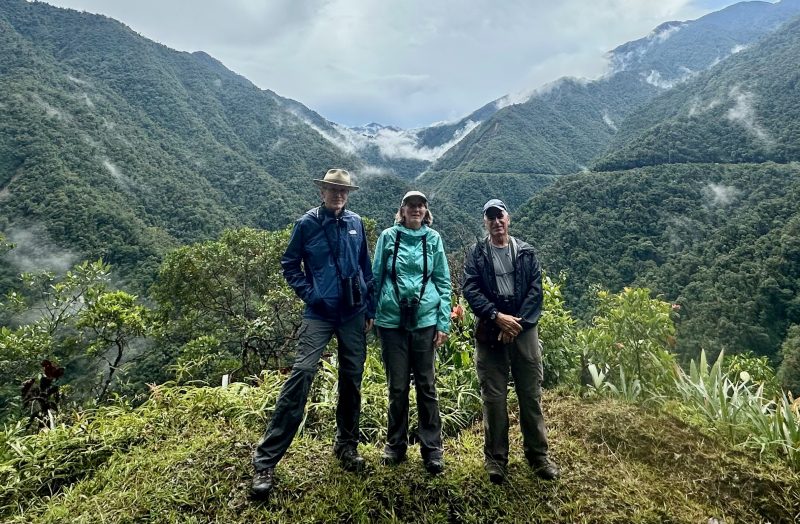
Colombia Birdwatching Tours: Lowland Forests of the Amazon Basin
The second half of our journey focused on exploring the lowland Amazonian forests near Puerto Asís and along the mighty Putumayo River, one of the principal tributaries of the Amazon River. Our birding efforts took us through El Escondite Nature Reserve, Hojarasca Center, Playa Rica, and the Boutú Community Reserve, the latter two located on the scenic riverbanks of the Putumayo. In addition to seeking out the region’s exceptional avian diversity, one of our special goals was to encounter the Pink River Dolphins — an iconic symbol of the Amazon’s vibrant wildlife.
Over these two unforgettable weeks, we experienced the very essence of Colombian birding — from the cool Andean slopes to the warm Amazonian foothills. The tour combined spectacular scenery, diverse birdlife, and the warm hospitality of local families and guides who share their passion for nature.
Day 1 – Arrival in Huila: First Encounters at El Encanto Lodge
Our trip began with Judy and Cliff taking a short morning flight from Bogotá to Neiva, followed by a scenic four-hour drive south through the Magdalena Valley toward Pitalito and Palestina, in the department of Huila. Along the road, we observed Black-bellied Whistling-Duck, Buff-necked Ibis, Snail Kite, Roadside Hawk, Limpkin, Southern Lapwing, Wattled Jacana, Great Egret, Cattle Egret, Bare-faced Ibis, Eared and Ruddy Ground-Dove, and flocks of Yellow-hooded Blackbirds brightening the rice fields.
Upon arrival in the small town of Palestina, we met our local guide Brayan Coral Jaramillo, who would accompany us for the entire journey. Brayan is an exceptional birder & expert birding guide from the Sibundoy Valley in the Colombian Massif, with extensive field experience supporting biological research projects across the Putumayo region. His deep knowledge of local avifauna, primates and ecosystems was an invaluable addition to our private birding tour in Colombia.
Just ten minutes from town, we reached El Encanto Lodge by mid-afternoon, arriving with enough daylight for our first birding walk around the lodge grounds — and what a welcome it was!
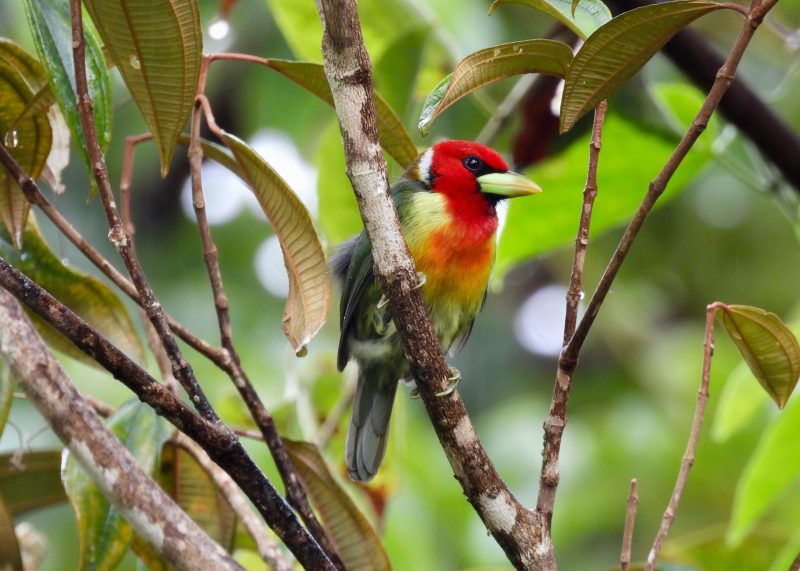
The fruit feeders were alive with color, attracting a parade of dazzling species: Golden-eared Tanager (male and female), Bay-headed Tanager, Red-headed Barbet (both sexes), near-endemic Scrub Tanager, Blue-necked Tanager, Crimson-backed Tanager, Tropical Mockingbird, White-lined, Blue-gray and Palm Tanagers, Green Honeycreeper, Buff-throated and Streaked Saltators, and Thick-billed Euphonia, among others. The endemic Colombian Chachalaca made several lively appearances, hopping confidently onto the feeders.
The blooming verbenas in the garden drew a spectacular array of hummingbirds. We enjoyed close views of a jewel-like male Gorgeted Woodstar and a brilliant Red-billed Emerald. The nectar feeders attracted the endemic Indigo-capped Hummingbird, Shining-green Hummingbird, Brown Violetear, White-vented Plumeleteer, and Rufous-tailed Hummingbird — a vibrant display of colors and activity.
Nearby forest edges and scrublands produced additional treasures, including Apical Flycatcher (endemic to Colombia), Solitary Black Cacique, Ash-browed and Slaty Spinetails, Bar-crested Antshrike, Squirrel Cuckoo, Rusty-margined Flycatcher, Great Kiskadee, Smooth-billed Ani, Southern House Wren, Pale-breasted and Black-billed Thrush, Blue-black Grassquit, Yellow-bellied Seedeater, and Saffron Finch.
Adding a northern touch, several Neotropical migrants enriched the afternoon’s list — notably eight Cerulean Warblers, three Blackburnian Warblers, and a Western Wood-Pewee.
As daylight faded, Bronze-winged Parrots and Scarlet-fronted Parakeets passed overhead, heading to their evening roosts, while Gray-rumped Swifts swooped gracefully above, catching insects in the dimming light.
The day closed beautifully with the calls of Mottled Owl and Tropical Screech-Owl echoing through the night, a fitting serenade to mark the start of our birding adventure in southern Colombia.
Day 2 – Exploring the Forests and Coffee Landscapes of Palestina, Huila
Our first full day of birding was designed as an easy and relaxed introduction to the diverse avifauna of southern Huila — the perfect pace for Judy and Cliff to recover from their long journey from the United States to Colombia.
We met at 6:00 a.m. to start the morning right where the action was — around the lodge lights, which had been left on overnight to attract insects. This “insect buffet” drew a wonderful mix of early-rising birds feeding enthusiastically at dawn. Highlights included Bar-crested Antshrike, Gray-headed Tanager, Common Tody-Flycatcher, Tropical Mockingbird, Crimson-backed, Blue-gray, Palm and Blue-necked Tanagers, and Rufous-collared Sparrow, among others — a lively and colorful start to the day.
Morning Birding on Forest Trails
After this exciting warm-up, we took a short hike on the forest trails adjacent to El Encanto Lodge, a lush mosaic of secondary forest and edge habitat teeming with activity. Among the morning’s best sightings were Rufous-naped Greenlet, Green Jay, Streaked Xenops, Olivaceous Piculet, Smoky-brown and Red-crowned Woodpeckers, Ash-browed Spinetail, Scrub Tanager, Gray-breasted Wood-Wren, Plain Antvireo (male and female), Roadside Hawk, Squirrel Cuckoo, Black-throated Mango, Golden-faced Tyrannulet, Yellow-olive Flatbill, Boat-billed Flycatcher, Andean Solitaire, Pale-breasted Thrush, Green Honeycreeper, and Slate-throated Redstart.
The combination of Andean foothill forest and open garden edges made this an exceptionally productive session — rich in diversity and filled with birdsong.
Birding the Coffee Country
After a hearty breakfast, we continued birding along a quiet rural road that winds through the nearby community. The trail passes coffee plantations, home gardens, and secondary forests dotted with magnificent shade trees — a classic landscape of Colombian coffee country.
The birding here was superb, with standout species including the rare White-fronted Tyrannulet, over a dozen Cerulean Warblers, several Blackburnian and Canada Warblers, Bronze-green Euphonia (male and female), Crimson-rumped Toucanet, Spot-breasted Woodpecker, Red-headed Barbet, Gray-breasted Sabrewing, Short-tailed Emerald, Slaty Spinetail, Slaty-capped Flycatcher, White-winged Becard, Rufous-browed Peppershrike, Orange-billed Nightingale-Thrush, Swainson’s Thrush, Golden Tanager, Yellow-faced and Dull-colored Grassquits, Summer and Hepatic Tanagers, Chestnut-capped Warbler, and Lesser Goldfinch.
This mix of resident and migratory species illustrated beautifully how Colombia’s coffee-growing landscapes serve as crucial stopover habitats for Neotropical migrants like the Cerulean Warbler.
Afternoon Birding at “El Alma del Bosque”
Following a delicious lunch and a well-earned midday rest, we drove to “El Alma del Bosque” (The Forest’s Soul), a charming shade-grown coffee plantation interspersed with open pastures and scattered trees. We took a leisurely stroll along a gentle downhill path, finding another impressive variety of birds.
Among the highlights were a Short-tailed Hawk perched beautifully before taking flight, engaging briefly on a vocal dispute with a Roadside Hawk; the endemic Dusky-headed Brushfinch; White-naped Brushfinch; and the Colombian Chachalaca, another endemic species common to this region. We also noted White-throated Crake (heard), White-tipped Dove, Bronze-winged Parrot, Scarlet-fronted Parakeet, Brown, Lesser and Sparkling Violetears, Pale-breasted and Ash-browed Spinetails, Yellow-bellied Elaenia, Western Wood-Pewee, Olive-sided Flycatcher, Vermilion Flycatcher, Bran-colored Flycatcher, Rusty-margined Flycatcher, Great Kiskadee, Streaked Flycatcher, Tropical Kingbird, Southern Rough-winged Swallow, White-lined Tanager, Blue-necked and Bay-headed Tanagers, Ruddy-breasted, Yellow-bellied and Gray Seedeaters, Buff-throated and Streaked Saltators, and Black-striped Sparrow.
As sunset approached, we returned to El Encanto Lodge to enjoy one last session around the hummingbird feeders and flowering verbenas. The evening display involved the Brown, Lesser, and Sparkling Violetears engaged in fierce aerial chases, while Black-throated Mango, White-vented Plumeleteer, Rufous-tailed Hummingbird, Indigo-capped Hummingbird, Andean Emerald, and Shining-green Hummingbird all made regular appearances.
It was a perfect conclusion to a day that combined gentle exploration and the vibrant charm of birding in the coffee landscapes of southern Huila.
Days 3 & 4 – Birding the Drymophila Reserve and the Wetlands of Pitalito
These two days were dedicated to exploring the beautiful forests of the Drymophila Reserve, where we enjoyed a superb collection of southern Colombian specialties. After a 5:00 a.m. coffee, we set off for the reserve — an 11-kilometer drive along a steep gravel and clay road that took about 45 minutes.
The reserve takes its name from Drymophila, the scientific genus of the East Andean Antbird, an endemic species restricted to Colombia’s Eastern Andes. Nestled at mid-elevation within the buffer zone of the iconic Cueva de los Guácharos National Park (“Guácharo” being the Spanish name for the Oilbird), the site offers pristine cloud forest, comfortable facilities, and an impressive diversity of birds.
A well-built wooden cabin provided a cozy shelter from the rain and a pleasant base for meals and rest, complete with a dining area, kitchen, and hammocks on the deck. The reserve’s trails cut gently across the mountainside, making for easy and rewarding hiking, with little need to venture off the paths.
Birding at the Feeders and Around the Cabin
Right outside the deck, the feeders were constantly active, drawing an astonishing variety of hummingbirds and tanagers. We enjoyed incredibly close views of at least three males of the endemic Tolima Blossomcrown, along with Violet-fronted Brilliant, Rufous-vented Whitetip, Short-tailed Emerald, Gorgeted Woodstar, Crowned Woodnymph, White-booted Racket-tail, Andean Emerald, Bronzy Inca, Long-tailed Sylph, Speckled Hummingbird, Buff-tailed Coronet, Fawn-breasted Brilliant, and the ubiquitous Brown, Lesser, and Sparkling Violetears. The diversity of species and the abundance of individuals makes this reserve a must for bird photography tours in Colombia.
Fruit and cornmeal feeders attracted equally colorful visitors, including Red-bellied Grackles (endemic), Dusky-headed Brushfinch (endemic), Flame-faced Tanager, Green Jay, Scarlet-rumped Cacique, Gray-headed Tanager, Blue-gray and Palm Tanagers, Green Honeycreeper, and Yellow-backed Oriole.
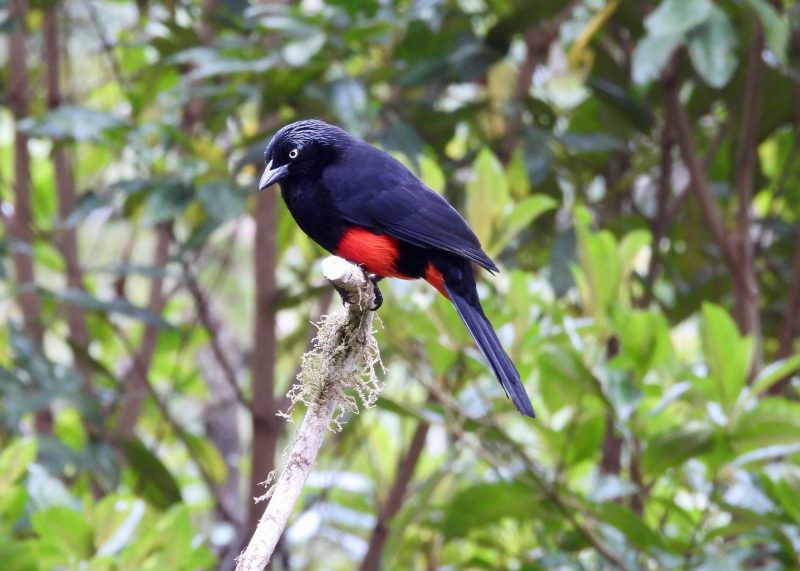
A nearby fruiting Cecropia tree added even more activity, frequently visited by a male Golden-winged Manakin, Chestnut-bellied Thrush, Golden-rumped Euphonia, and a vivid assortment of Golden, Scrub, Blue-necked, and Golden-naped Tanagers.
At the forest edge, the endemic & endangered Tolima Dove and White-throated Quail-Dove made repeated visits to the ground feeders, while a Western Fire-eye fed on insects drawn to the night lamps, alongside Chestnut-capped Brushfinch, Gray-breasted Wood-Wren, Russet-crowned and Three-striped Warblers, Slate-throated Redstart, and Canada Warbler.
Perhaps the stars of the show were the White-bellied Antpitta and the near-endemic Hooded Antpitta — three individuals that cooperatively came to feed on earthworms. Nearby, Schwartz’s Antthrush vocalized persistently but remained elusive. This reserve is a key location for any Colombia antpitta guide or enthusiast.
Forest Trails and Mixed Flocks
Walking along the trails, we enjoyed views of the East Andean Antbird (the reserve’s namesake and endemic highlight), a striking male Black-chested Fruiteater, Rufous-tailed Tyrant, Plumbeous-crowned Tyrannulet, Uniform Antshrike, Masked Trogon, Crimson-rumped Toucanet, Russet-backed Oropendola, Acorn Woodpecker, Squirrel Cuckoo, Bar-crested Antshrike, Andean Solitaire, Azara’s Spinetail, Golden-faced Tyrannulet, Western and Eastern Wood-Pewees, Olive-sided Flycatcher, Smoke-colored Pewee, Magpie Tanager, Red-headed Barbet, Tawny-bellied Hermit, and Yellow-bellied Siskin.
Mixed flocks added even more excitement, with Oleagineous Hemispingus, Cinnamon and Pale-edged Flycatchers, Rufous-breasted and Streak-necked Flycatchers, Lineated and Montane Foliage-Gleaners, and both Cerulean and Blackburnian Warblers among the highlights.
Throughout the forest, we also heard Yellow-throated Spadebill, Golden-headed Quetzal, Black-billed Peppershrike, Southern Emerald Toucanet, Black-streaked Puffbird, Crimson-crested Woodpecker, Long-tailed Tapaculo, Lemon-browed and Golden-bellied Flycatchers, Brown-capped Vireo, Whiskered Wren, and Blue-naped Chlorophonia.
While Barred and Collared Forest-Falcons called from within the dense canopy, they stayed hidden from view — as did the ever-vocal Ruddy Pigeon. Small flocks of Barred and Scarlet-fronted Parakeets, Red-billed, and Bronze-winged Parrots passed overhead, and a group of four Maroon-tailed Parakeets was seen briefly as they crossed the valley.
Afternoon Birding at the Coneco Wetland of Pitalito
In the early afternoon of Day 3, we descended the mountain to visit the Coneco wetland remnant near Pitalito, a small city about 50 minutes from the lodge. Our local guide, Michael Molina, had kindly arranged permission with the landowner of a cattle ranch where a fragment of this once-extensive wetland still survives.
To our delight, we were greeted by a magnificent Horned Screamer guarding five juveniles. The scope views of its ornate horn were spectacular, and Judy managed excellent photos.
We then strolled along the marsh edge through open pastures dotted with trees, stopping by a large Guadua bamboo stand, where we successfully located our target — the rarely seen Large-headed Flatbill. Over fifty Eastern Kingbirds were actively migrating through, perching in the tallest trees before continuing their journey south.
For about two hours we enjoyed a wealth of waterbirds, including Black-bellied Whistling-Duck, Cinnamon Teal, Blue-winged Teal, Buff-necked Ibis, Black-crowned Night-Heron, Striated Heron, Wattled Jacana, Bare-faced Ibis, Southern Lapwing, Spotted Sandpiper, Common Gallinule, and numerous Yellow-hooded Blackbirds.
The scattered trees in the pastures provided good habitat for the endemic Velvet-fronted Euphonia, as well as Spot-breasted and Lineated Woodpeckers, Scrub Greenlet, Greater and Smooth-billed Anis, Yellow-bellied Elaenia, Eastern Wood-Pewee, Olive-sided Flycatcher, Vermilion Flycatcher, Social Flycatcher, Cattle Tyrant, Great Kiskadee, Tropical Kingbird, and Ruddy-breasted Seedeater. Common species such as Great and Snowy Egrets, Western Cattle Egret, Black Vulture, Yellow-headed Caracara, Ruddy Ground Dove, Shiny Cowbird, and Saffron Finch completed the list.
As the sun dipped behind the hills, a large group of Common Nighthawks and White-collared Swifts appeared, gliding gracefully and feeding in the evening sky alongside Blue-and-white Swallows — a serene end to another outstanding day of birding in southern Colombia.
Day 5 – Birding the gateway to the Amazon Basin: From Pitalito to Mocoa
Our birding adventure continued south into the foothills of the Colombian Amazon, a fascinating transition zone where Andean and Amazonian ecosystems meet. The day’s journey took us from Pitalito to Mocoa, a region renowned for its rich biodiversity and breathtaking forested landscapes.
Spectacled Prickletail and a Premontane Mix Flock
Our first stop was the Parador Turístico Ruta 45, where we met our local bird guide Hernando (“Nando”), who led us into a nearby property—a trout farm surrounded by pristine premontane forest. The habitat was alive with bird activity, and within minutes, we had our first highlight: a Red-ruffed Fruitcrow, a spectacular and elusive species that gave us long, satisfying views of a glowing male.
As the tropical rain poured and then cleared, the forest erupted with life. A massive mixed flock moved through the canopy, offering thrilling birdwatching moments. Among the many species we recorded were:
Spectacled Prickletail, Montane Woodcreeper, Orange-eared Tanager, Rufous-crested Tanager, Short-billed and Yellow-throated Chlorospingus, Beryl-spangled Tanager, Black-capped Tanager, Blue-necked Tanager, Flame-faced Tanager, Fawn-breasted Tanager, Squirrel Cuckoo, near-endemic Rufous-breasted Flycatcher, Variegated Bristle-Tyrant, Golden-faced Tyrannulet, Cinnamon Flycatcher, Chestnut-bellied Thrush, Slate-throated Redstart, Deep-blue and Masked Flowerpiercers, Orange-bellied Euphonia, and Blue-naped Chlorophonia.
It was one of those magical Andean birding moments—alive with sound, color, and movement.
After the excitement of the flock, we returned to the parador, where the gardens offered excellent views of several hummingbird species. While enjoying a well-deserved coffee, we observed Geoffroy’s Daggerbill and Black-throated Mango feeding on the crimson blooms of Erythrina trees, joined by a delicate Speckled Hummingbird.
Hummingbirds and Amazonian Cuisine
As we continued south, descending in altitude, we arrived at the Discosura Birding Center, where Ilder and his family welcomed us warmly. The moment we stepped out of the vehicle, we were surrounded by birdsong and movement — the forest alive with color and sound.
The garden flowers attracted a parade of dazzling species: Golden-tailed Sapphire, Blue-tailed Emerald, Violet-headed Hummingbird, Fork-tailed Woodnymph, Glittering-throated Emerald, a spectacular Long-tailed Sylph, and once again, Black-throated Mango.
As we savored a delicious Amazonian-style tilapia, wrapped in plantain leaves and perfectly seasoned, Cliff caught a glimpse of a Wire-crested Thorntail—a rare and unexpected visitor at this time of year.
Around the same gardens, we also recorded Scaled Piculet, Yellow-browed Sparrow, Yellow-bellied Seedeater, Saffron Finch, and Bananaquit.
Birding from the Viewpoint and Along the Trail
From the parking area, short forest trails, and the elevated view tower (still under construction), we added an impressive list of Amazon foothill birds:
Black-streaked Puffbird, Gilded Barbet, Little Woodpecker, Ornate Flycatcher, Rusty-winged Antwren, Rufous-tailed Foliage-gleaner, Speckled Chachalaca, Ruddy Pigeon, Olive-striped Flycatcher, Slaty-capped Flycatcher, Common Tody-flycatcher, Violaceous Jay, Green-backed Trogon, Long-tailed Tyrant, Western Wood-Pewee, Short-crested Flycatcher, White-bearded Manakin, Thrush-like Wren, Paradise Tanager, Green-and-gold Tanager, Flame-crested Tanager, Magpie Tanager, White-lined Tanager, Golden Tanager, Silver-beaked Tanager, Swallow Tanager, Blue-gray Tanager (White-edged form), Black-faced Dacnis, Deep-blue Flowerpiercer, Russet-backed Oropendola, and Yellow-rumped Cacique.
The abundance and diversity of birdlife in this area make it one of the best birding destinations in southern Colombia, especially for those interested in the transition between Andean and Amazonian ecosystems.
As we descended toward Mocoa, the open areas and roadside habitats provided additional sightings from the moving vehicle, including: Roadside Hawk preying on a small lizard, American Kestrel, Yellow-headed Caracara, Southern Lapwing, Bare-faced Ibis, White-naped Brushfinch, endemic Dusky-headed Brushfinch, Pale-breasted Spinetail, Black Phoebe, Saffron Finch, Black-billed Thrush, Tropical Kingbird, Yellow-bellied Seedeater, Bananaquit, and Eastern Meadowlark.
Arriving in Mocoa early in the evening, we were thrilled by the day’s rich list of species—an unforgettable introduction to the Amazonian foothills of Colombia, where Andean beauty meets tropical diversity.
Day 6 – El Trampolín de Las Aves
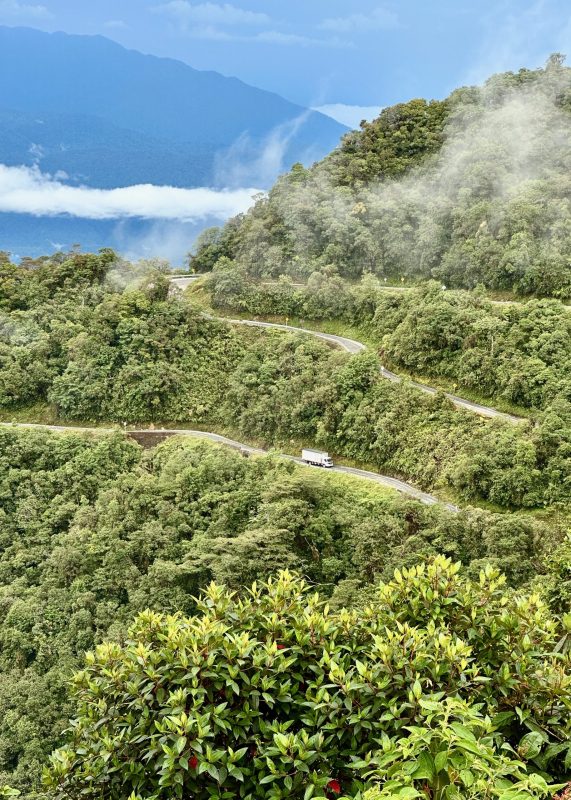
With a 5:45 a.m. departure from Dantayaco Hotel, we set out toward the iconic Trampolín de Las Aves, a steep mountain road that climbs from Mocoa to Sibundoy through the dramatic landscapes of the Colombian Massif. We stopped for breakfast at a small local shop, where bird activity was already lively. Judy spotted two male and one female Andean Cock-of-the-rock—a fantastic start for any Andean Cock-of-the-rock tour— followed by great views of Gilded and Red-headed Barbets, three Speckled Chachalacas, Glittering-throated Emerald, Roadside Hawk, Blue-headed Parrot, Smooth-billed Ani, Social Flycatcher, Violaceous Jay, Silver-beaked and Magpie Tanagers, Swallow Tanager, Purple Honeycreepers, a charming pair of Thrush-like Wrens, and the ever-present Russet-backed Oropendola.
We began the ascent along the Trampolín, first on paved sections and then onto a narrow, winding gravel road overlooking the vast Mocoa Valley and the Serranía de los Churumbelos. Stopping regularly to bird along the way, we enjoyed excellent views of Sickle-winged Guan, Plain-brown Woodcreeper, Green-fronted Lancebill, Greenish Puffleg, Green-backed Hillstar, Golden-winged Manakin, Uniform Antshrike, Dusky and Rufous Spinetails, Chestnut-bellied Chat-Tyrant, Golden-bellied Flycatcher, Coraya Wren, Great and Chestnut-bellied Thrushes, and a colorful array of tanagers including Blue-winged Mountain, Blue-necked, Bay-headed, and Golden. Flowerpiercers, euphonias, and the songs of White-crowned Tapaculo, Dusky Piha, and Gray-breasted Wood-Wren enriched the soundscape.
A magical moment came when seventeen Swallow-tailed Kites glided gracefully above the canopy, with a single Turkey Vulture among them—an unforgettable sight.
By late morning, a sudden storm broke, forcing us to take shelter at a small roadside café as thunder and lightning rolled through the valley. Mist and intermittent rain lingered for the rest of the day, slowing bird activity. Even so, Brayan led us to a reliable spot for Chestnut-breasted Coronet, which offered only a fleeting view.
Our luck improved on the descent toward Mocoa. We enjoyed close views of White-rimmed Brushfinch, a family group of four White-capped Tanagers, and a magnificent Black-billed Mountain-Toucan that perched in full view. A passing mixed flock yielded further gems—Orange-eared and Golden-eared Tanagers, Golden-collared Honeycreeper, Black-billed Treehunter, Lineated Foliage-Gleaner, Olive-striped and Rufous-breasted Flycatchers, Cinnamon Flycatcher, Deep-blue Flowerpiercer, Three-striped Warbler, and Slate-throated Redstart—bringing a fine close to a day of spectacular Andean birding.
Day 7 – Birding at El Escondite Nature Reserve and Surroundings
We enjoyed a slow and pleasant start today, with breakfast at 7:30 a.m. followed by a short walk around the restaurant, which is surrounded by beautiful secondary forest. Even from the parking lot, bird activity was remarkable. Among the first sightings were Red-capped Cardinal, Masked Tanager, Turquoise Tanager, Magpie Tanager, Yellow-bellied Dacnis, Purple Honeycreeper, Thrush-like Wren, Yellow-crowned Tyrannulet, Gray-capped Flycatcher, Common Tody-Flycatcher, Silver-beaked Tanager, Blue-gray and Palm Tanagers, Buff-throated Saltator, Crested Oropendola, Glittering-throated Emerald, and Black-throated Mango — an excellent start to the day.
Afterward, we drove about 50 minutes to El Escondite Nature Reserve, where we were warmly welcomed by the owner and staff. The reserve’s headquarters, surrounded by lush secondary forest and flower-filled gardens, proved highly productive for birding even before we ventured onto the trails. Standing in the garden, we quickly spotted Orange-fronted Plushcrown, Orange-eyed Flatbill, Gray-capped Flycatcher, Lafresnaye’s Piculet, Fork-tailed Woodnymph, White-winged Becard, Glittering-throated Emerald, Streaked Flycatcher, Piratic Flycatcher, Social Flycatcher, Short-crested Flycatcher, Boat-billed Flycatcher, Yellow-bellied Dacnis, and Purple Honeycreeper — a wonderful sampling of the region’s Amazonian birdlife, and a must for bird photography tours in Colombia.
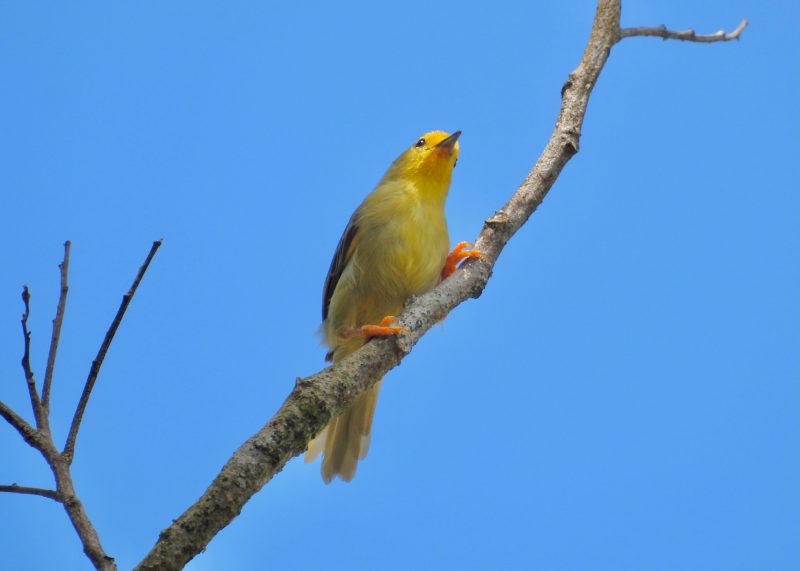
After lunch, we enjoyed a well-deserved hammock siesta while the midday heat passed. Later in the afternoon, we hiked along a shaded trail that followed a crystal-clear stream. Bird activity was naturally slower under the strong sun, but patience was rewarded when we encountered a lively fast-moving group of canopy birds featuring White-throated Toucan, Purple-throated Fruitcrow, Violaceous Jay, Russet-backed Oropendola, Chestnut Woodpecker, Olive-faced Flatbill, and the distinctive calls of Large-headed and Gray-crowned Flatbills.
In the late afternoon, we explored a short stretch of local road flanked by pastures and forest patches that were buzzing with bird activity. Brayan skillfully called in a Cinnamon Attila, which responded beautifully, followed by excellent views of two White-chinned Jacamars. A Chestnut Woodpecker and a pair of Cream-colored Woodpeckers gave truly spectacular views — one of the trip’s most memorable moments. Swallow-winged Puffbirds perched conspicuously on low branches and bushes scattered across the pastures.
As we moved along, we encountered a fine pair of Yellow-browed Tody-Flycatchers, Lafresnaye’s Piculet, Yellow-tufted Woodpecker, Black-tailed Tityra, Straight-billed Woodcreeper, Lesser Kiskadee, Social & Piratic Flycatcher, Southern House Wren, Turquoise & Summer Tanager, Russet-backed Oropendola, and Yellow-rumped Cacique.
Birding along the shaded road continued to deliver: a pair of Masked Crimson Tanagers glowed in the soft light, and Lineated Woodpecker, Plumbeous Kite, Roadside Hawk, Yellow-headed Caracara, Greater Ani, and Smooth-billed Ani showed well. Overhead, five Red-bellied Macaws cruised by while numerous Short-tailed Swifts bounced gracefully in the sky.
A Pale-vented Pigeon, perched under full sunlight, revealed its beautiful iridescent tones and deep red eyes. Above the canopy, two Black-hawk Eagles circled and called repeatedly. As dusk approached, the haunting calls of Undulated Tinamou and White-throated Toucan filled the forest, joined later by the repeated calls of a Ferruginous Pygmy-Owl.
One of the day’s most remarkable scenes came just before sunset: a female Crimson-crested Woodpecker fiercely confronting a group of five Violaceous Jays. The cause of the altercation remained a mystery, but it was clear there was no winner — only a display of strength and defiance, perfectly capturing the wild spirit of Putumayo’s forests.
Day 8 – Birding at Hojarasca Center, Puerto Asís
Our morning in Puerto Asís began with the rhythmic sound of heavy rain, which had persisted through the night and well into the early hours. By 7:30 a.m., the clouds finally lifted, revealing a bright, humid morning in the lowlands of Putumayo. We drove a short 20 minutes to the Hojarasca Center, where we were welcomed by Diego Rocha, an expert birding guide and owner of one of the properties within this unique gated community. The area features a network of quiet roads that cross through wetlands, gardens, orchards, and remnant forest—an excellent mosaic for lowland birding.
As breakfast was being prepared, the activity around the house was vibrant. Scarlet-crowned Barbet, Lettered and Chestnut-eared Aracaris, and Speckled Chachalacas brightened the morning. We also enjoyed close views of Lafresnaye’s Piculet, Yellow-tufted Woodpecker, Yellow-browed and Common Tody-Flycatchers, Olive-faced Flatbill, Social Flycatcher, Great Kiskadee, Boat-billed Flycatcher, Yellow-browed Sparrow, and both Wing-barred (Caquetá) and Chestnut-bellied Seedeaters.
After breakfast, we visited a small wetland where we had a close and thrilling encounter with an Ash-throated Crake, while Black-banded and Rufous-sided Crakes called nearby, along with a Gray-cowled Wood-Rail. We obtained our first good looks at Green Ibis, and also saw Bare-faced Ibis, Osprey, and Blush-gray Saltator.
We then strolled along the inner roads of the community, adding a long list of exciting species, including Red-bellied Macaw, Dusky-headed Parakeet, Riparian and Cobalt-winged Parakeets, Blue-headed Parrot, Orange-winged Amazon, Hoatzin, Russet-backed Oropendola, Squirrel Cuckoo, Gray-fronted Dove, Plumbeous Kite, Black Caracara, Pale-vented Pigeon, Crimson-crested Woodpecker, Cinnamon-throated and Straight-billed Woodcreepers, Piratic Flycatcher, Short-crested Flycatcher, White-winged Becard, Violaceous Jay, Spot-breasted and Little Woodpeckers, Yellow-rumped Cacique, and Orange-backed Troupial.
A particularly memorable moment came with a group of four Orange-fronted Plushcrowns, which were actively foraging in the treetops, allowing satisfying views.
Near a shaded stream, we encountered a productive bird activity with Brown Jacamar, Peruvian Warbling-Antbird, Great Antshrike, Black-fronted Nunbird, Swallow-winged Puffbird, Red-capped Cardinal, Purple-throated Fruitcrow, and Magpie Tanager. Even more exciting were the Rufous-headed and Chestnut Woodpeckers, both showing beautifully. A Black-spotted Bare-eye moved furtively through dense undergrowth, while attempts to coax out White-shouldered Antbird and White-lored Antpitta were unsuccessful this time.
Several species of swifts—Fork-tailed Palm-Swift, White-collared, and Short-tailed Swift—were feeding overhead. A Ferruginous Pygmy-Owl was heard, and when we played its call, a mobbing wave of small birds appeared, including a female Plum-throated Cotinga, Turquoise Tanager, Yellow-bellied Dacnis, White-vented, Golden-bellied, and Thick-billed Euphonias, along with Long-billed Starthroat, Glittering-throated Emerald, Mouse-colored and Yellow-crowned Tyrannulets, Streaked Flycatcher, Silver-beaked, Blue-gray, and Palm Tanagers, Yellow Warbler, and Saffron Finch.
A highlight of the morning was a stunning male Bare-necked Fruitcrow that flew overhead and perched conspicuously, giving us excellent views of this spectacular cotinga. Shortly afterward, we enjoyed our second encounter with the brilliantly colored Masked Crimson Tanager.
Other species recorded included Undulated Tinamou, Amazonian Motmot, Dark-breasted Spinetail, and Cinnamon Attila, all heard but not seen.
To wrap up the morning, we visited a series of nearby fish ponds where we found to our surprise a Wilson´s Phalarope actively feeding on shallow water next to several North American migrants: Pectoral and Least Sandpipers, Spotted and Solitary Sandpipers, Greater and Lesser Yellowlegs, another Osprey, Ringed Kingfisher, Purple Gallinule, Striated Heron, Great Egret, and Snowy Egret.
Despite the challenging weather at dawn, the visit to Hojarasca Center turned into one of the most productive mornings of the trip. The combination of wetlands, forest edge, and secondary growth made for an extraordinary diversity of species, confirming the birding richness of the Putumayo lowlands—a region that will continue to surprise with its abundance and variety of Amazonian and foothill birds.
Days 9 & 10 – Exploring the Putumayo River
The next two days were devoted to exploring the Putumayo River, birding by boat and visiting two local riverine communities: Playa Rica, home to around thirty-five families, and Boutú, located further downstream. Playa Rica lies only about 20 minutes by boat from Puerto Asís, while Boutú requires a longer journey of about 1 hour and 45 minutes along the sinuous course of the river. The local community manages both transportation and meals for visitors, and we were treated to delicious breakfasts and lunches prepared by the families.
Playa Rica: Community Birding Along the River Path
At Playa Rica, a concrete path runs along the riverbank—a walkway used by locals that also provides an excellent birding trail, especially during the rainy season when the ground elsewhere becomes muddy. We spent the morning birding along this path and later followed a short dirt trail that wound deeper into the greenery, crossing patches of secondary forest and small plantations of rice, manioc, and plantain.
We enjoyed memorable sightings of a booming male Amazonian Umbrellabird and a female Bare-necked Fruitcrow, both perched in the canopy. A pair of Black-capped Donacobius responded well to playback, offering prolonged views.
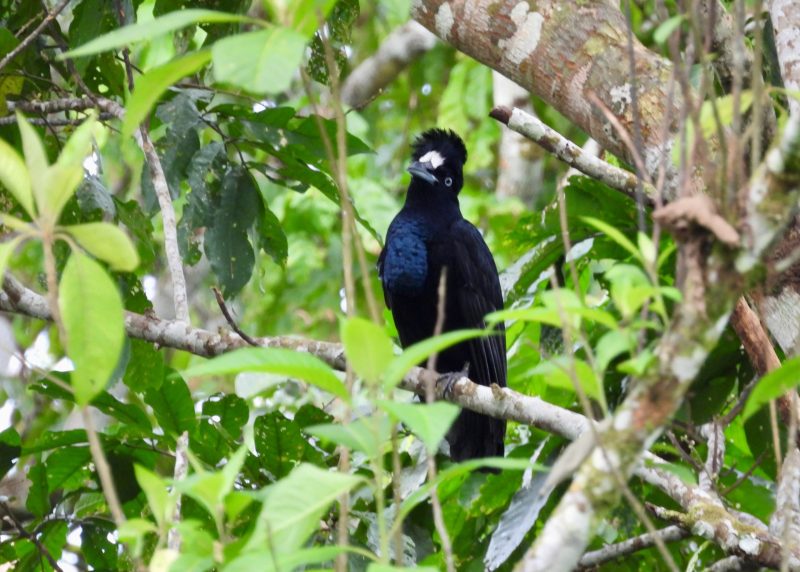
Among the highlights were Riparian Antbird, White-eared and White-chinned Jacamars, Speckled Chachalaca, Rufescent Tiger-Heron, Ferruginous Pygmy-Owl, Black and Yellow-headed Caracaras, Cobalt-winged and Dusky-headed Parakeet, Red-bellied Macaw, Fork-tailed Palm-Swift, Black-fronted Nunbird, Swallow-winged Puffbird, Scarlet-crowned Barbet, Chestnut-eared Aracari, Yellow-tufted and Spot-breasted Woodpeckers, Great Antshrike (male and female) moving alongside a Cinnamon-throated Woodcreeper, Straight-billed Woodcreeper, Olive-faced Flatbill, Lesser Kiskadee, Piratic Flycatcher, Short-crested Flycatcher, Black-crowned Tityra, Violaceous Jay, Magpie Tanager, Silver-beaked Tanager, Russet-backed and Crested Oropendolas, and Yellow-rumped Cacique.
A migrating flock of about twenty Eastern Kingbirds added a sense of movement to the day, while Gray-breasted Martins and Bank Swallows patrolled the river edge.
Boutú and the Cuembí Stream: Dolphins, Hoatzins, and Sunbitterns
Reaching Boutú required navigating further downstream and into a narrow blackwater tributary known as the Cuembí Stream. Our main goal here was to look for the Amazonian Pink Dolphin, a species that continues to thrive in these quiet waters.
Indeed, we were joyfully surprised when an unobtrusive Pink Dolphin surfaced close to our boat, which was parked along the bank near the Boutú Center. It surfaced a second time a bit farther away, closer to the opposite bank, where a fisherman had just arrived home. Then, at least three more dolphins began to appear irregularly—here and there—as we gently maneuvered the boat to keep up with them. Their movements lacked any clear pattern, but we were completely absorbed by the surprise and unpredictability of their behavior. We followed them along the stream for about thirty minutes, until they finally drifted away down the dark, calm waters of the Cuembí.
Along the way, we also encountered a remarkable diversity of riverine birds. A Ladder-tailed Nightjar was found roosting low on a branch over the water, while more than thirty Hoatzins moved noisily from one riverbank to another. A Sunbittern welcomed us at Boutú with a short flight that displayed its intricate and colorful wing pattern. Over the water, White-banded and White-winged Swallows glided effortlessly in pursuit of insects.
From the boat, we also observed Drab Water-Tyrant, Osprey, Neotropic Cormorant, Striated Heron, Short-tailed Swift, Great and Snowy Egrets, Cocoi Heron, Turkey and Black Vultures, Southern Lapwing, Spotted Sandpiper, Yellow-billed Tern, Ringed Kingfisher, Southern Rough-winged Swallow and some beautiful Hoatzins!
Three Green-backed Trogons and a pair of Amazonian Trogons were particularly active and vocal. We also saw Lafresnaye’s Piculet, and both male and female Plum-throated Cotingas perched beautifully nearby. From a viewing tower, we added Opal-crowned Tanager, Turquoise Tanager, Yellow-bellied Dacnis, Long-billed Starthroat, Gray-capped Flycatcher, Boat-billed Flycatcher, and White-vented Euphonia.
Some species remained only heard from the moving boat, including Cinereous and Undulated Tinamous, Plumbeous Pigeon, White-throated Toucan, Cream-colored Woodpecker and Buff-throated Woodcreeper.
Birding along the Putumayo River was an unforgettable experience—two days of gentle navigation, extraordinary wildlife, and the warmth of the riverside communities. From colorful cotingas and umbrellabirds to Pink Dolphins surfacing in blackwater creeks, this stretch of the Colombian Amazon revealed its richness and calm beauty. These moments remind us how ecotourism can connect people and nature, sustaining both the biodiversity of the region and the lives of those who call the river home.
Day 11 – Revisiting the Hojarasca Center and Return to Bogotá
Our final morning was spent revisiting the Hojarasca Center, hoping to find two elusive species that had previously evaded us — the Black-banded and Rufous-sided Crakes. We also visited a newly established feeding station deep in the forest, where Diego Rocha had just begun attracting a White-lored Antpitta only two days earlier. To our delight, the bird responded almost immediately to Diego’s soft calls and his offering of earthworms. It appeared briefly, hopping into view just long enough for everyone to appreciate its delicate features before vanishing once again into the dense understory.
Although the crakes refused to cooperate, the morning still proved rewarding. We enjoyed excellent close views of a Rusty-fronted Tody-flycatcher, and soon after, a Black Hawk-Eagle soared low overhead, circling and calling above us — a fitting finale to our Andean and Amazonian birding adventure.
After a delicious lunch and a refreshing shower, we packed up and drove to the Puerto Asís airport, where we bid farewell to Judy and Cliff as they checked in with Satena Airlines. The following day, everyone arrived home safely — Judy and Cliff to Madison, Brayan to Sibundoy, and Daniel to Armenia — bringing to a close a wonderful journey across the wild and diverse landscapes of the Putumayo region.
Primate Encounters
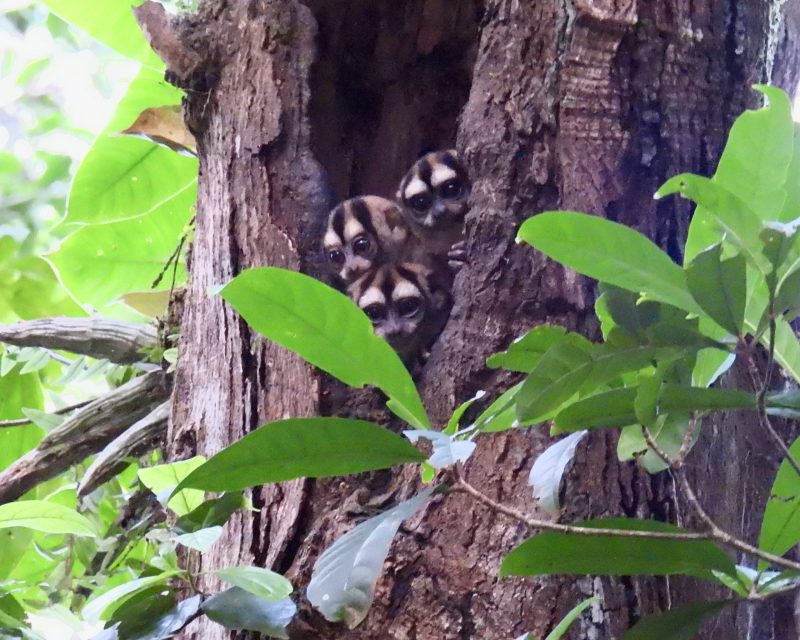
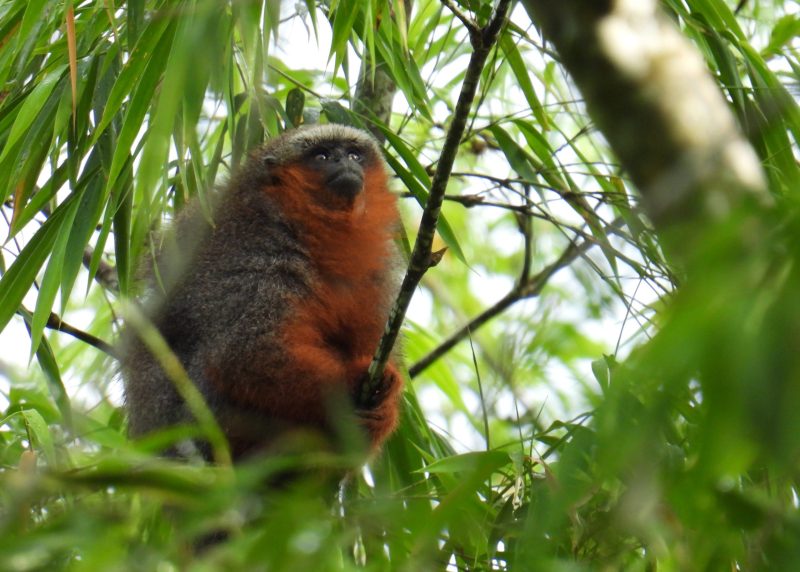
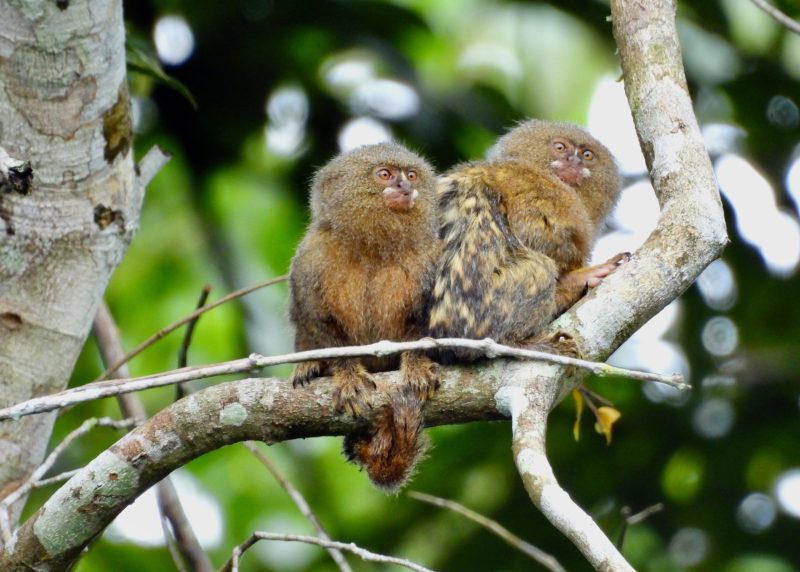
In addition to the rich birdlife, our days in the Putumayo region also offered exceptional opportunities to observe Amazonian primates. Over the course of our stay, we recorded five species: Spix’s Night Monkey (Aotus vociferans), Lesson’s Saddle-back Tamarin (Leontocebus fuscus), Humboldt’s Squirrel Monkey (Saimiri cassiquiarensis), Western Pygmy Marmoset (Cebuella pygmaea), and White-tailed Titi Monkey (Plecturocebus discolor). With really good views of all of them!
Each sighting brought a special sense of wonder, highlighting the extraordinary biodiversity of this corner of Colombia and adding a delightful dimension to our Amazonian experience.
YOU MAY ALSO LIKE
Putumayo & Huila Birding Trip Report: A Private Colombia Birding Tour (Oct 2025) with Judy Harackiewicz & Cliff Thurber from Madison
SEE MORE
Birding & photographing birds along the Central & Western Andes with Doug & Gail Cheeseman (April 22 – May 8, 2019).
SEE MORE
Birding the Central & Western Andes with Anthony Kaduck & Ken Edwards from Canada (March 20 – April 5, 2019).
SEE MORE
Birding Mitú, Inírida & the Perijá Mountains for key species with Hans Jornvall from Sweden (January 5 - 23, 2019).
SEE MORE
Second birding trip to Colombia for Ernest Bradley & Dale Brinker (November 19 – December 03, 2018).
SEE MORE
Birding Hato La Aurora in the Eastern Llanos with Todd Pepper & Mark Eaton (December 1 – 4, 2017).
SEE MORE
Birding the Central & Western Andes of Colombia with Anthony Collerton (July 14 – 23, 2017).
SEE MORE
Andean Endemics tour with British crew: from the Eastern Andes to the mid-Magdalena Valley & Central Andes of Colombia (March 1 – 14, 2017).
SEE MORE
Another challenging & productive trip for Hans Jörnvall from Sweden (January 2 – 15, 2017).
SEE MORE
The Eastern Andes from Bogota to Soata: birding trip for recordist Terry Morgan & Karen Walz (November 18-30, 2016).
SEE MORE
Second birding trip for Katy Krigbaum & Birgit Felser: the Western & Central Andes of Colombia (September 1-20, 2016).
SEE MORE
Birding for much desired targets with Keith Betton, Andrew Herbert (UK) and Rainer Kopa (Germany) (April 17-May 7, 2016).
SEE MORE
Birding the Western & Central Andes with Richard & Jennifer Kershaw from UK (March 10-31, 2016).
SEE MORE
Second birding trip for Steve Huggins & Glenn Giacinto from Chicago, Illinois (January 23 – February 2, 2016).
SEE MORE
Birding along the Western & Central Andes of Colombia with Bob & Katie Self from the UK (November 9 – 26, 2015).
SEE MORE
Birding in Colombia from the Western Andes to the Santa Marta Mountains & Guajira peninsula, with a recapitulation.
SEE MORE
The Eastern Andes, mid-Magdalena Valley, Santa Marta Mountains & La Guajira peninsula with Katy Krigbaum & Birgit Felser (Sept. 2 – 21, 2015).
SEE MORE
Bird photo tour for photographers from Taiwan & China: The Western & Central Andes of Colombia (July 18 – August 8, 2015).
SEE MORE
Second birding trip for Debby Reynolds & David Copas (UK), and Jane Andrews (USA) (January 20 – February 6, 2015).
SEE MORE
Short but productive bird photo trip for family group from Canada and Colombia (December 16-20, 2014).
SEE MORE
Medium length birding trip through the Western & Central Andes of Colombia with Bruce Webb, Jeanne Conry & Peter Gent from USA (May 18 - 27, 2014).
SEE MORE
Short birding escapade for James Taylor & Christine Forster from Victoria, British Columbia (Canada) (May 8-11, 2014).
SEE MORE
Bird photography trip for Japanese photographers – Hisao komori & Yasunobu Shiga (April 26-May 4, 2014).
SEE MORE
Birding the Eastern, Central & Western Andes with Andy & Gill Swash, Debby Reynolds & David Copas from UK (January 15 – February 5, 2014).
SEE MORE
Birding the Central Andes of Colombia with Steven Huggins & Glenn Giacinto from Chicago, Illinois (January 3 – 13, 2014).
SEE MORE
Bird photography trip to the Eastern Andes of Colombia for Juan José Arango & Anabel Vanin (July 31 - August 04, 2013).
SEE MORE
Back to Colombia for a second time: Peter Hawrylyshyn & Bob Lewis search for more hummingbird species and bird specialties at new birding sites (February 15 – March 03, 2013).
SEE MORE
Central Andes short tour with Happy Warblers touring company from New York (February 5 – 13, 2013).
SEE MORE
More Andean endemics with magnificent birding crew from USA, UK & Canada (Dec. 28, 2012 to Jan. 5, 2013).
SEE MORE
Touring for Central Andes Endemics: how good birding in Colombia can be (October 6 – 15, 2012).
SEE MORE
Bird photography trip for Peter Hawrylyshyn, Bob & Hanno Lewis with emphasis on hummingbirds (August 22 – September 9, 2012).
SEE MORE
Birding Otún-Quimbaya Wildlife Sanctuary for some bird images with Juan Jose Arango and Anabel Vanin (August 3 – 5, 2012).
SEE MORE
Enjoying the Rio Blanco antpittas and Central Andes endemics with Eugenia Carey from Dauphin Island (July 5 – 12, 2012).
SEE MORE
Promoting Colombia as a travel destination with British presenter & producer Nigel Marven (February 6 – 11, 2012).
SEE MORE
Bogota Sunangel or not? The intriguing hummingbird at Rogitama Private Nature Reserve (2011).
SEE MORE
Birding with Dominic Mitchell – Managing Editor of Birdwatch Magazine (UK) (November 27 – December 4, 2011).
SEE MORE
Guiding and operating for Birding Adventures TV episodes in Colombia (November 27 – December 4, 2011).
SEE MORECentral & Western Andes: A Colombia Bird Photography Tour Trip Report.
01 - 10 - 2025
Our clients at www.birdingtourscolombia.com live and breathe the avian wonders of this extraordinary country. Colombia, a land of unparalleled biodiversity, offers an experience that transcends mere birdwatching; it’s an immersive journey into a vibrant tapestry of life, a photographer’s dream, and a birder’s ultimate quest. We are thrilled to share highlights from a recent bespoke private bird photography tour in Colombia undertaken by Janet Zinn and Alan Baratz, from July 14-27, 2025, traversing the rich landscapes of the Central and Western Andes.
Dates: July 14 – 27, 2025
Total Species: 320
Complete eBird trip report: https://ebird.org/tripreport/434739
This 14-day expedition, a meticulously crafted custom Colombia birding trip, showcased the incredible avian wealth of Colombia, with a potential to encounter up to 687 species. In this opportunity, our focus was on providing good photographic opportunities for Janet & Alan.
A Journey Through Avian Paradises: A Colombia Birding Itinerary Unveiled
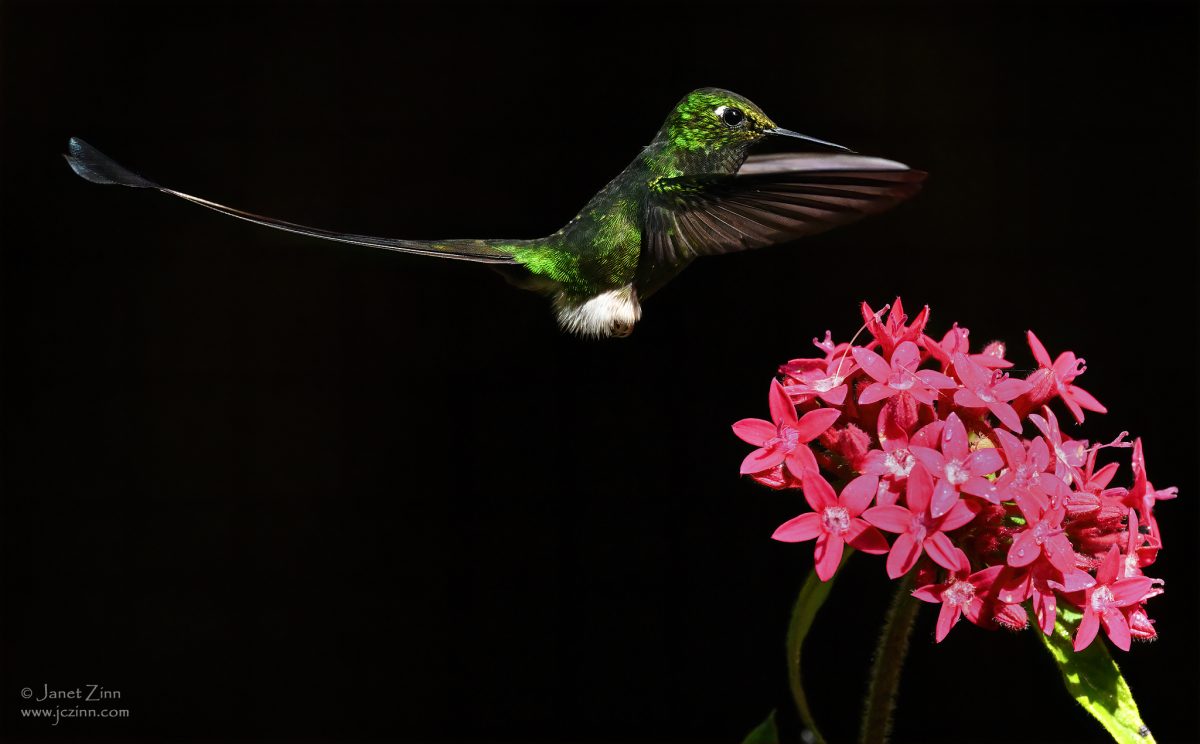
Our adventure began in Cali, the gateway to Western Andes birding. After a restful pre-tour day, we plunged into the verdant Upper Anchicayá Valley on Day 1. Here, at Doña Dora’s renowned site, we immediately immersed ourselves in the world of Mountain Chocó endemics and specialties. The feeders and gardens provided incredible close-up photographic opportunities, allowing us to capture the vibrant hues of species like the Toucan Barbet, Glistening-green Tanager, Flame-rumped Tanager (lemon rumped), Choco Brushfinch, Golden Tanager, Silver-throated Tanager, Green Honeycreeper. On the upper deck of the house, photographs were taken in flight of the White-necked Jacobin, Brown Violetear, Black-throated Mango, Green Thorntail, Crowned Woodnymph and Andean Emerald. We sighted the Plumbeous Pigeon and Red-headed Barbets feeding on fruits of a large Ficus tree and Common Tody-Flycatcher & Slaty-capped Flycatcher foraging the leaves for insects. We concluded our day with more photos at the rich hummingbird & tanager feeders of the charming & comfortable Araucana Lodge, a haven for birders with its own impressive array of feeder birds. Here, ample images were taken of the Crimson-rumped Toucanet, Red-headed Barbet & Lineated Woodpecker; and flight shots of the Steely-vented & Rufous-tailed Hummingbird, Purple-throated Woodstar, Andean Emerald and Brown Violetear.
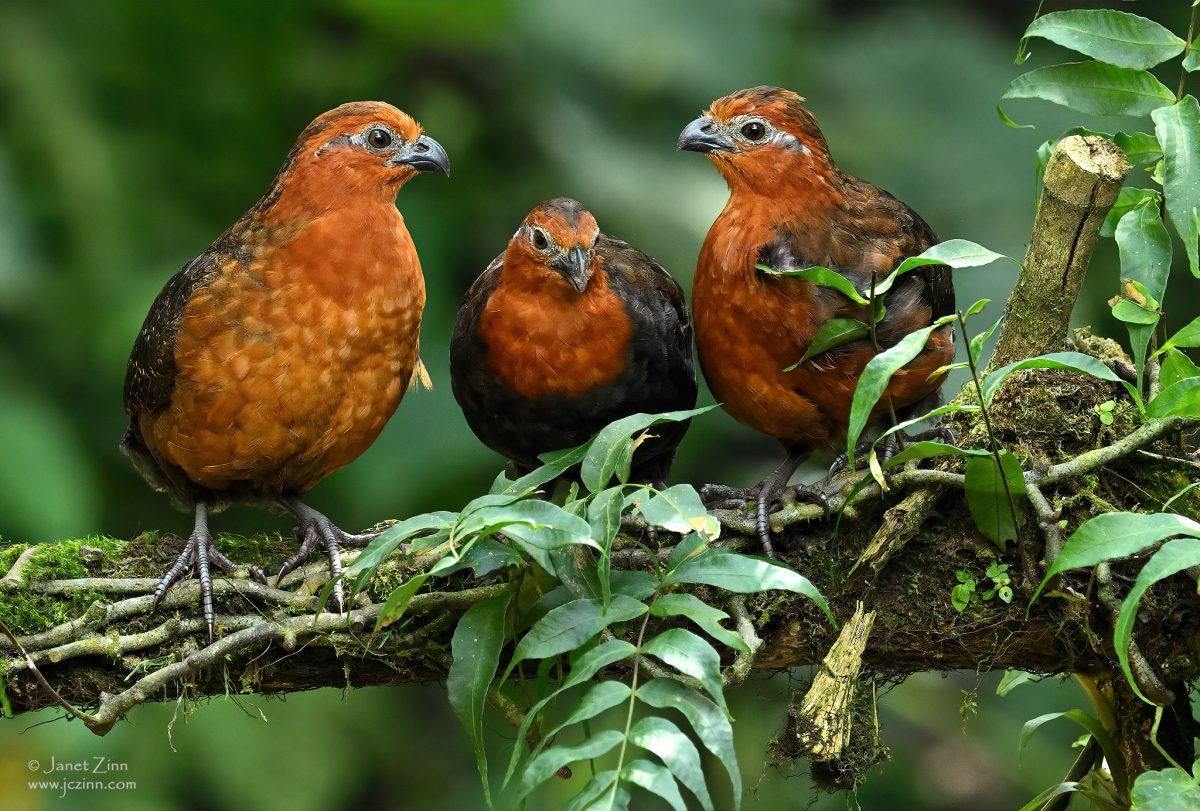
Days 2 and 3 saw us exploring more treasures at Finca La Florida (Km 18), where we encountered the elusive endemic Chestnut Wood-Quail and the dazzling endemic Multicolored Tanager, true jewels of the Andes. Highlights at the feeders included the Andean Motmot, Red-headed Barbet, Flame-rumped Tanager (flame rumped), Blue-winged Mountain-Tanager, Golden-naped Tanager, Saffron-Crowned Tanager, Golden Tanager and Acorn Woodpecker. Momentarily, the banana feeders were assaulted by Sickle-winged Guans & endemic Colombian Chachalacas. Two Ornate Hawk-Eagles circled while calling above our heads. A nice set of hummingbird feeders offered the right amount of light inside the forest, providing flight photos of the White-booted Racket-Tail, Long-tailed Sylph, Sparkling Violetear, Purple-throated Woodstar, Crowned Woodnymph, Greenish Puffleg, Bronzy Inca, Tawny-bellied Hermit, Speckled Hummingbird, Black-throated Mango, Brown Violetear, White-necked Jacobin and Fawn-breasted Brilliant, among others. Deep inside the forest, the White-throated Quail-Dove stood calmly for close-up photos.
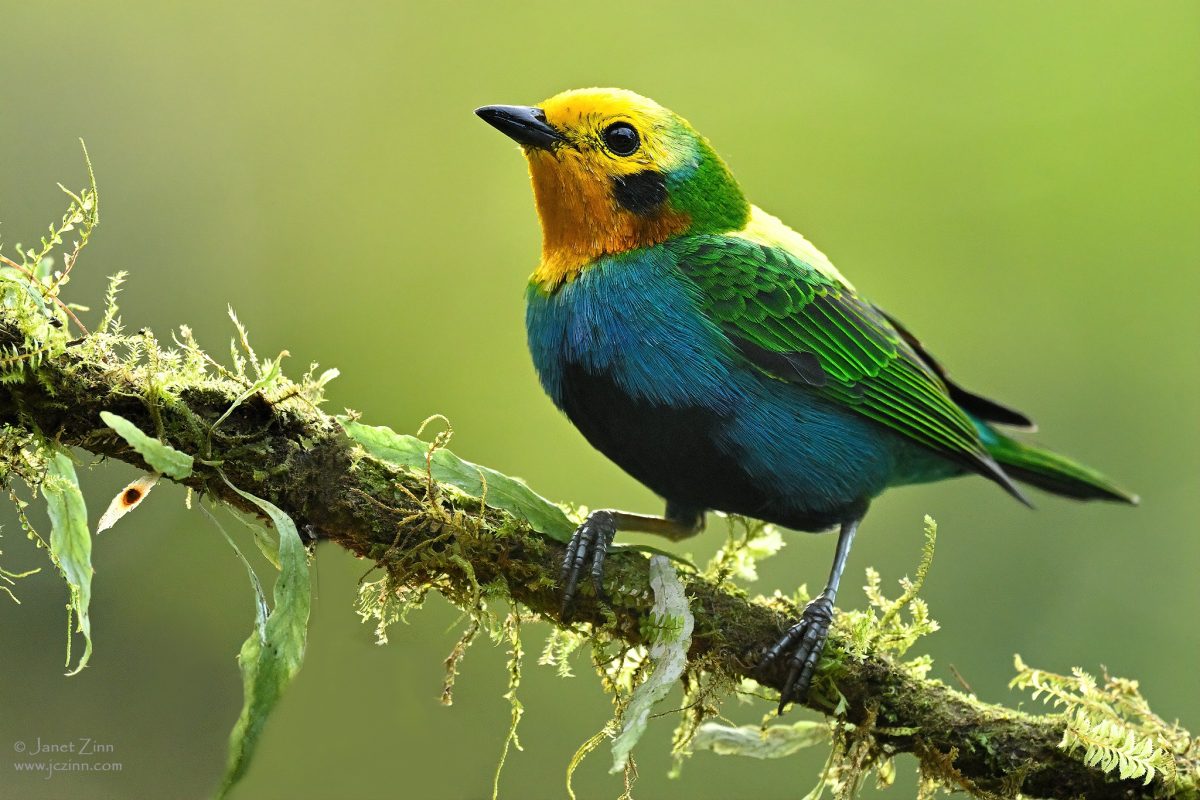
Our visits to Finca San Felipe Birding and Finca Alejandría further enriched our experience, offering more feeder action and diverse photographic subjects such as the shy Little Tinamou, the elegant Chestnut-capped Brushfinch and second great images of the endemic Chestnut Wood-Quail. Also, the Black-capped, Blue-necked & Scrub Tanager, Black-winged Saltator, Andean Motmot and beautiful Scarlet-fronted Parakeet. Along the road to Dapa we met with the Marble-faced Bristle-Tyrant, Montane Woodcreeper, Lineated Foliage-Gleaner and Black-billed Peppershrike, among others. All walks were designed to be short and easily accessible, maximizing observation and photography time.
Mid-tour, we ventured into new ecological zones. Day 4 led us to the sub-xerophytic forest at Atuncela, where we enjoyed the Hook-billed Kite, Crested & Yellow-headed Caracaras, Spectacled Parrotlet, Dwarf Cuckoo, Dark-billed Cuckoo, endemic Apical Flycatcher and the splendid Ruby-topaz Hummingbird & Vermilion Flycatcher. Highlights here also included the Ultramarine Grosbeak, Orange-crowned Euphonia, Bar-crested & Great Antshrike, Northern Mouse-Colored Tyrannulet, Yellow-bellied Elaenia, Dull-colored & Yellow-faced Grassquit, Streaked Saltator and Southern Beardless-Tyrannulet. We then had a smooth drive to Buga, followed by a brief visit to El Vínculo dry forest with close views of the Streak-headed Woodcreeper, Rufous-naped Greenlet and photos of the Jet Antbird and Cocoa Woodcreeper. These transitions brought new species into view, showcasing Colombia’s remarkable habitat diversity.
Day 5 was dedicated to the wetlands of Laguna de Sonso, a vital habitat for riparian birds, waterbirds and marsh specialists. A long list of birds was obtained thanks in great part to the enthusiasm of our expert birding guide Jhonathan Bedoya. We started with good telescope views of a Horned Screamer, followed by much closer views of Fulvous Whistling-Duck, Buff-necked Ibis, Snail Kite, Limpkin, Anhinga, Neotropical Cormorant, Black-crowned Night-Heron, Striated Heron, Cocoi Heron, Glossy & Bare-faced Ibis, Little Blue Heron and Snowy Egret. A nicely feathered Gray-cowled Wood-Rail provided amazing views from the vehicle. The list was followed by Purple Gallinule, Collared Plover, Black-necked Stilt, Wattled Jacana, Pale-vented Pigeon, Blue-headed Parrot and Yellow-crowned Amazon. Highlights included a beautiful Little Cuckoo, Common Potoo and a pair of roosting Tropical Screech-Owls, all at close range.
Other birds seen and photographed at Sonso marsh included three species of Kingfishers – the Ringed, Amazon & Green Kingfishers, along with Red-crowned, Spot-breasted & Lineated Woodpeckers. Not to forget the photo opportunities for Common Tody-Flycatcher, Yellow-Olive Flatbill, Rusty-margined Flycatcher, Guira & Crimson-backed Tanager, Yellow Oriole and Oriole Blackbird.
A Chocó Birding Tour Highlight: Cerro Montezuma
The true pinnacle of our Western Andes exploration unfolded over three magnificent days (Days 5-8) at Cerro Montezuma, a site globally recognized as one of Colombia’s premier birding localities and a key part of any Chocó birding tour. Staying at the hospitable Cerro Montezuma Rainforest Lodge, we had unparalleled access to its incredible avian bounty. Each day focused on different altitudinal ranges, maximizing our chances for diverse encounters.
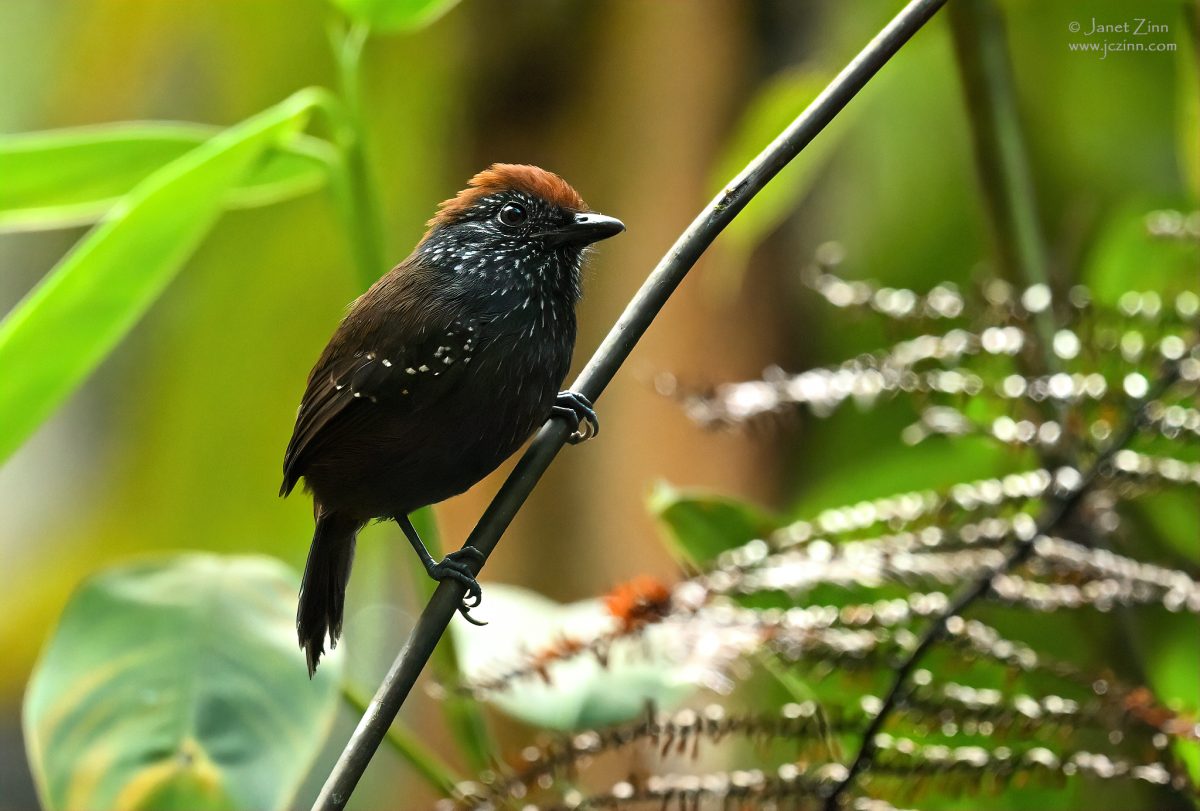
Montezuma is a stronghold for Chocó endemics and near-endemics. At higher altitudes we were privileged to photograph the stunning endemics Gold-ringed Tanager, Chestnut-bellied Flowerpiercer and a singular trio of Munchique Wood-Wrens with incredible sightings. More specialties followed with the near-endemics Black Solitaire, Orange-breasted Fruiteater, Black-chinned Mountain-Tanager, Purplish-mantled Tanager, Uniform Treehunter, Glistening-green Tanager, Rufous-throated Tanager, Scrub Tanager, Dusky Chlorospingus, Ochre-breasted Tanager and Yellow-collared Chlorophonia. On lower terrain we saw the endemic Crested Ant-Tanager.
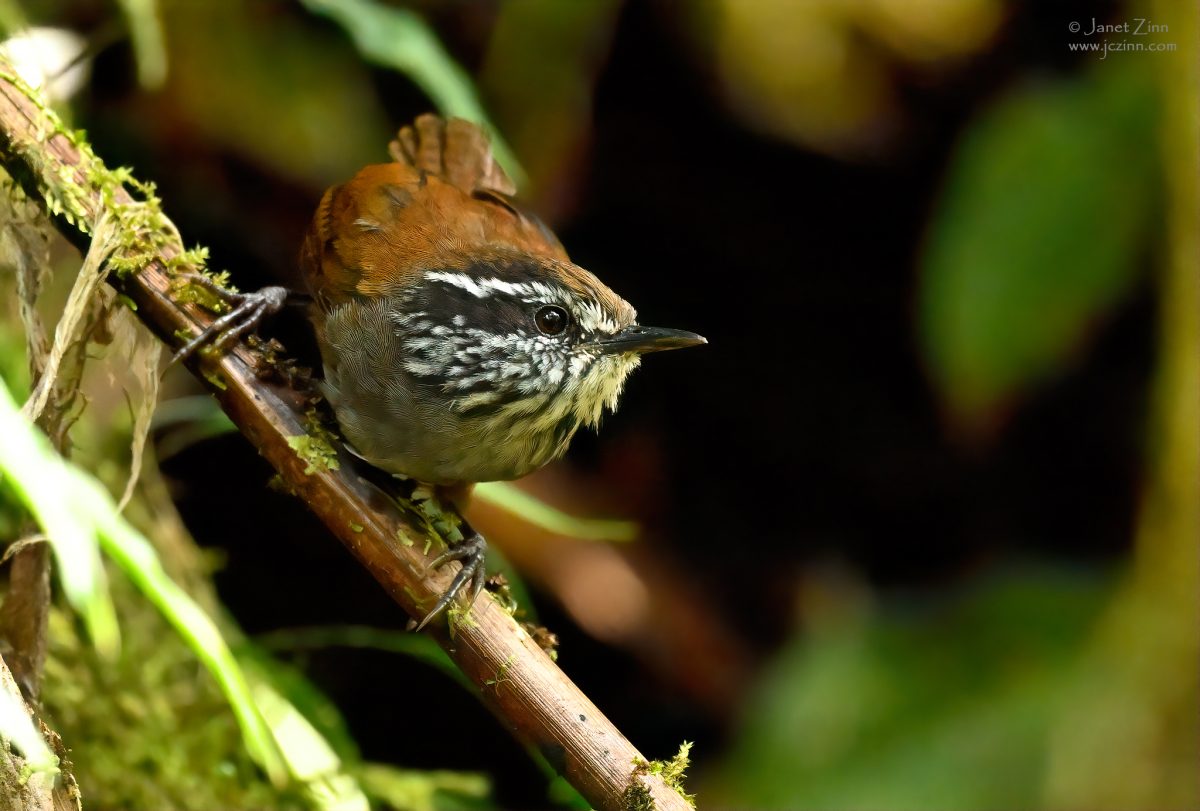
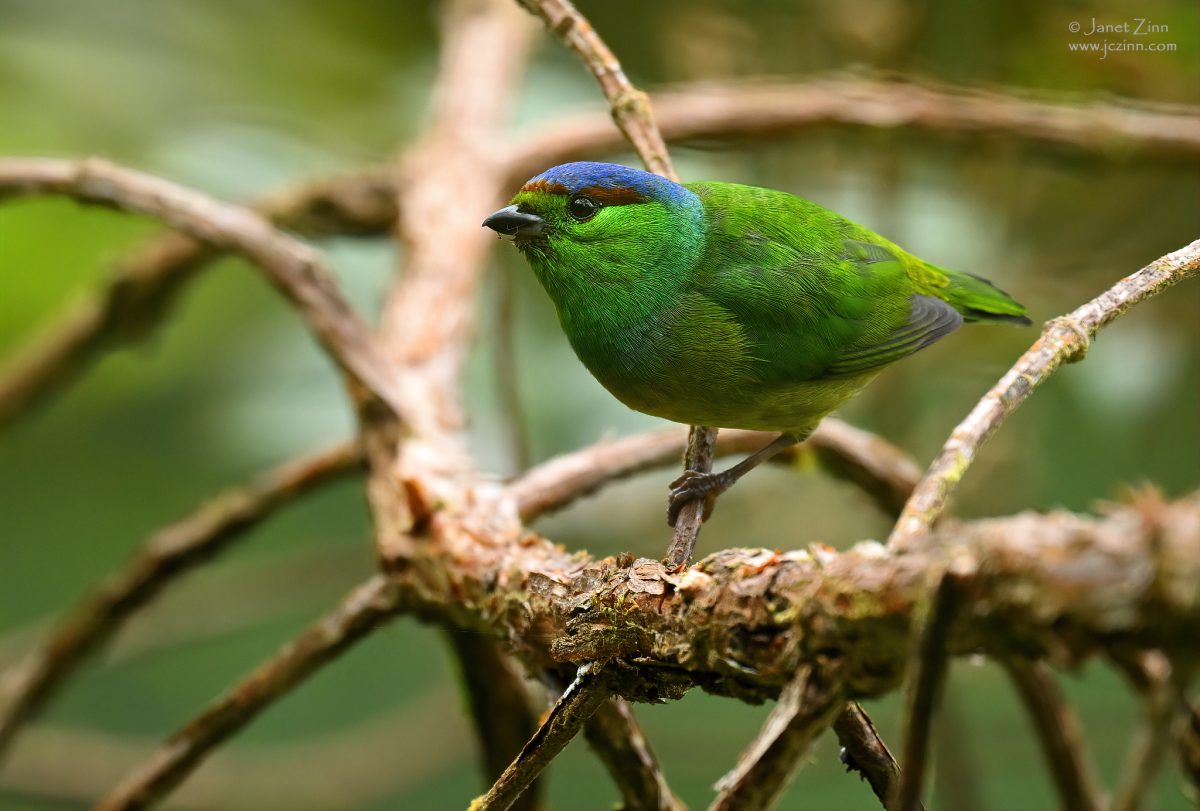
Local guide Fernando Guarín did an extraordinary job finding the birds, sometimes under very difficult sunny or misty circumstances. We encountered the Golden-headed Quetzal, Collared Trogon, Green-fronted Lancebill, Lanceolated Monklet and the rare Rusty-winged Barbtail; also the Buff-fronted Foliage-Gleaner, Fulvous-dotted Treerunner, Ashy-headed Tyrannulet, Bronze-olive Pygmy-Tyrant, Ornate Flycatcher, Olive-striped Flycatcher, Handsome Flycatcher, Green-and-black Fruiteater, Striolated Manakin, Masked Tityra, White-winged Becard, Beryl-spangled & Metallic-green Tanager, Bay-headed Tanager, Bluish Flowerpiercer, and Golden-bellied (Choco) Warbler.
Highlights included photographing the near-endemic female Bicolored Antvireo, the very special Yellow-vented Woodpecker and the stunning male & female Chestnut-breasted Chlorophonia, arguably the most beautiful bird in this forest.
Outside our rooms we saw the Blackish Rail with chicks, the Squirrel Cuckoo and heard the Wattled Guan calling late at night and early mornings. Hummingbirds were a constant spectacle outside the dining room, with iridescent species such as the near-endemics Purple-throated Woodstar, Violet-tailed Sylph, Velvet-purple Coronet, Brown Inca and the majestic Empress Brilliant. Also present were the Green-crowned Brilliant, White-whiskered Hermit, Green Thorntail, White-booted Racket-Tail, Rufous-gaped Hillstar, Purple-bibbed Whitetip and the Western & Andean Emerald, all gracing the feeders and flowering bushes.
The Coffee Axis: An Andean Birding in Colombia Experience
Leaving the Choco region, we journeyed to Manizales (Day 8), the main headquarter for Central Andes birding. Our base at Hotel Estelar El Cable provided comfortable lodging for our excursions. Days 9-11 were dedicated to exploring the rich cloud forests and high-altitude páramos around Manizales, a prime region for Andean birding in Colombia. Birding Rio Blanco Reserve we experienced the magic of antpitta feeding stations, where the endemic Brown-banded Antpitta, and the Chestnut-crowned and Slate-crowned Antpitta made memorable appearances all along with the very rare Masked Saltator, the graceful Green-and-black Fruiteater and the seldom seen Slaty-backed Nightingale-Thrush. Walking along the nice paths of the mountain ridge we encountered the beautiful Black-billed Mountain-Toucan, Crimson-mantled Woodpecker (no doubt one of the most beautiful woodpeckers in the world), Streak-headed Antbird, Montane Woodcreeper, Streaked Xenops, Pearled Treerunner, Azara’s Spinetail, Mountain Elaenia, Rufous-crowned Tody Flycatcher, Cinnamon Flycatcher, Pale-edged Flycatcher, Sharpe´s Wren, White-capped Dipper, Andean Guan, Glossy-black Thrush and Black-eared Hemispingus. A nice surprise was seeing a nice male Slaty Finch feeding on seeded bamboo (Chusquea spp.).
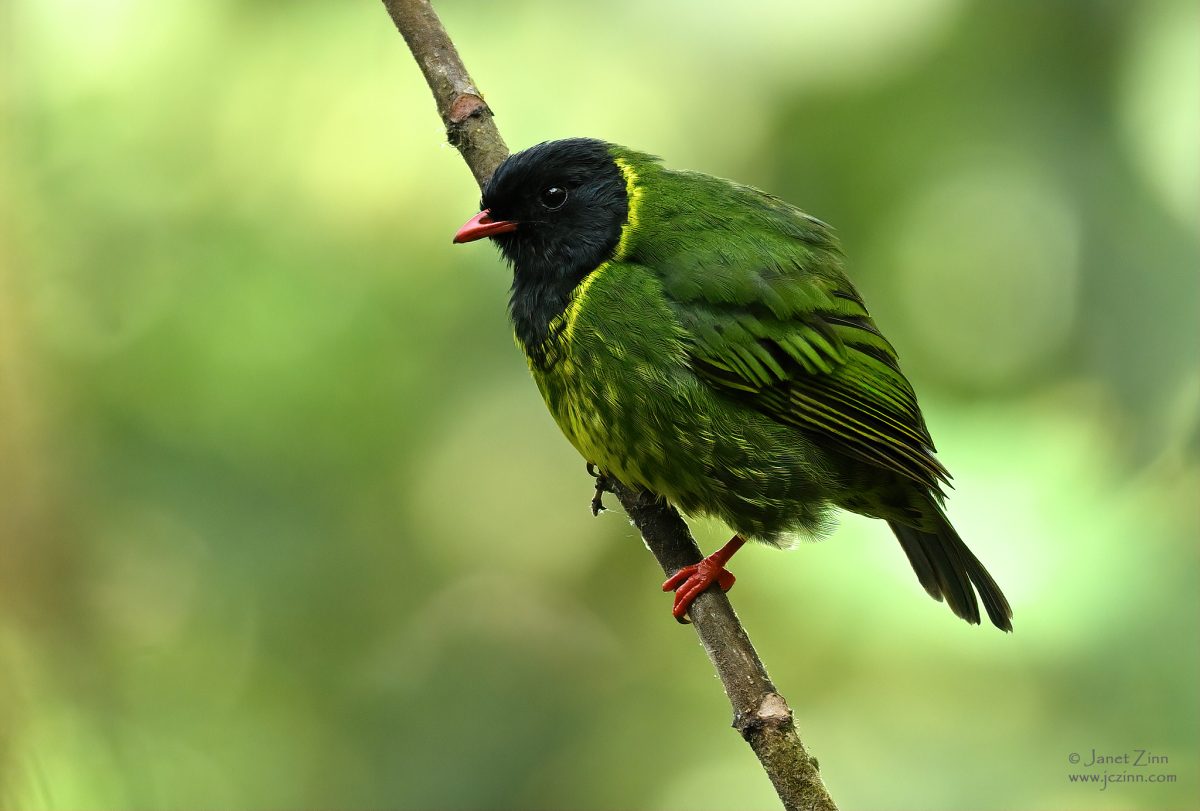
More joy came with the good views of the tanagers, especially the Grass-green, Blue-capped, Black-capped, Blue-and-black, Beryl-spangled and Saffron-crowned Tanagers. On the lodge gardens we saw the rare White-throated Daggerbill and the elegant Slaty Brushfinch, and we had time for photos of the Masked & White-sided Flowerpiercers, as well as flight shots of the visiting hummingbirds including the Collared Inca, White-bellied Woodstar, Fawn-breasted Brilliant, Bronzy Inca, Sparkling Violetear, Tourmaline Sunangel, Specked Hummingbird and Buff-tailed Coronet.
Hacienda El Bosque offered joyful photographic encounters with the incredibly rare Crescent-faced Antpitta, alongside the impressive Gray-breasted Mountain-Toucan and a variety of high-altitude hummingbirds including the Sword-billed Hummingbird, Buff-winged Starfrontlet, Sparkling Violetear, Shining Sunbean, Tourmaline Sunangel and Buff-tailed Coronet, among others. Any serious Colombia Antpitta guide would consider this a must-visit location.
Prior to calling in the Crescent-faced Antpitta, the local guide Cristian fed worms to the charming Grass Wren, and a Red-crested Cotinga perched briefly at the top of a nearby tree. The antpitta feeder was graced with the visits of a pair of Slaty Brushfinches, a pair of Yellow-bellied Chat-Tyrants and a pair of the beautiful Barred Fruiteaters. Also, three Mountain Wrens joined the feeding frenzy. On the other side, the toucan feeder was visited by the Andean & Sickle-winged Guans, Gray-browed Brushfinches, Eared Doves, Great Thrushes and Rufous-collared Sparrows.
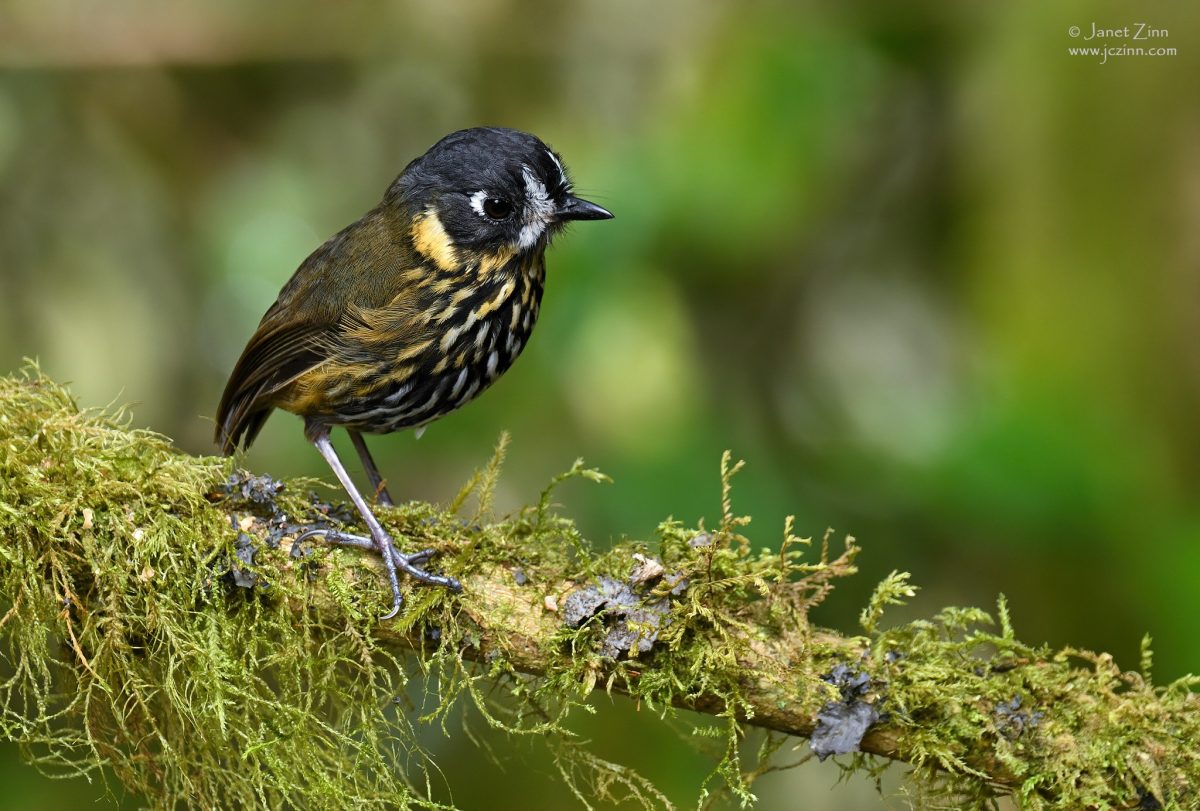
While photographing the toucan, a mixed flock crossed in front of the hide, with the striking Golden-fronted Redstart, Blue-backed Conebill, Masked & Black Flowerpiercers and a pair of White-banded Tyrannulets. And nearby bloomed bushes were visited by a stunning male Purple-backed Thornbill.
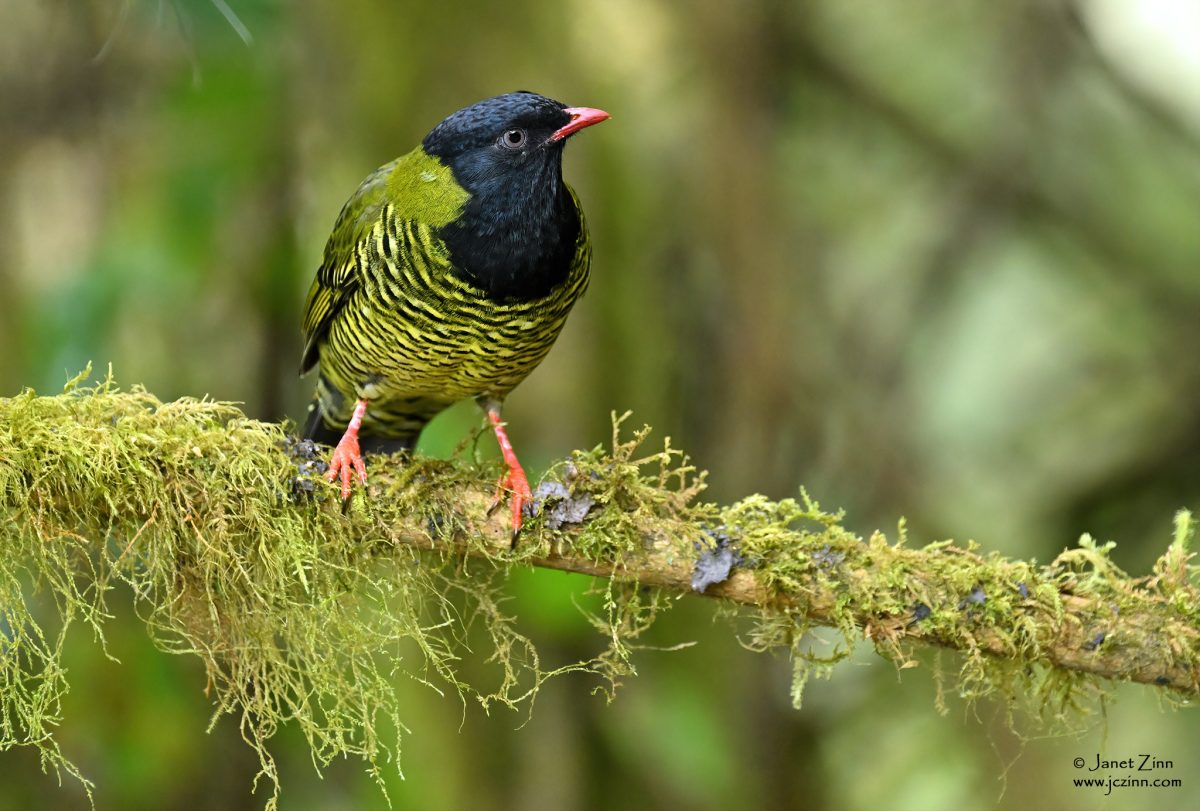
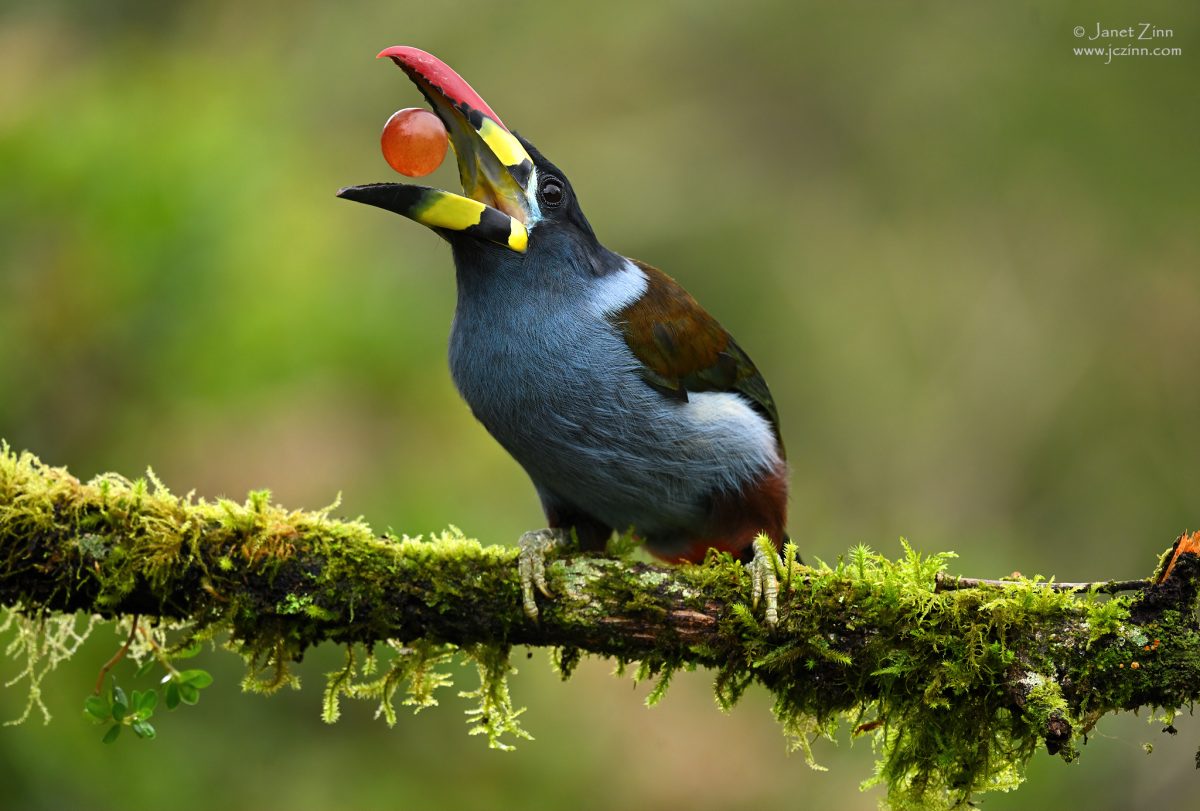
Alan has a passion for orchids and a visit to Finca La Romelia (below Manizales at La Cabaña, 1,300m) merited dropping from the high páramo to the warmer foothills of the Central Andes. Here, we had a very pleasant 3-hr visit to the collection of orchids guided by their owners.
Birding Los Nevados National Park brought us into the realm of specialized páramo birds and more high-altitude hummingbirds, including the stunning endemic Buffy Helmetcrest, the charming Brown-backed Chat-Tyrant and the playful Stout-billed Cinclodes. We had telescope views of Andean Teal & Andean Duck at Laguna Negra. In spite of moderate constant wind, and while searching for the endemic Buffy Helmetcrest at Las Brisas, an Andean Condor (male) glided graciously providing great views. A Black-chested Buzzard-Eagle cruised fast not far from us. The weather worsened with thunder, rain and mist. Nonetheless we were able to see & photograph well the Andean Tit-Spinetail, near-endemic Golden-breasted Puffleg, Shining Sunbeam & Plain-colored Seedeater, among others. Brown-bellied Swallows were nesting on rocky cliffs.
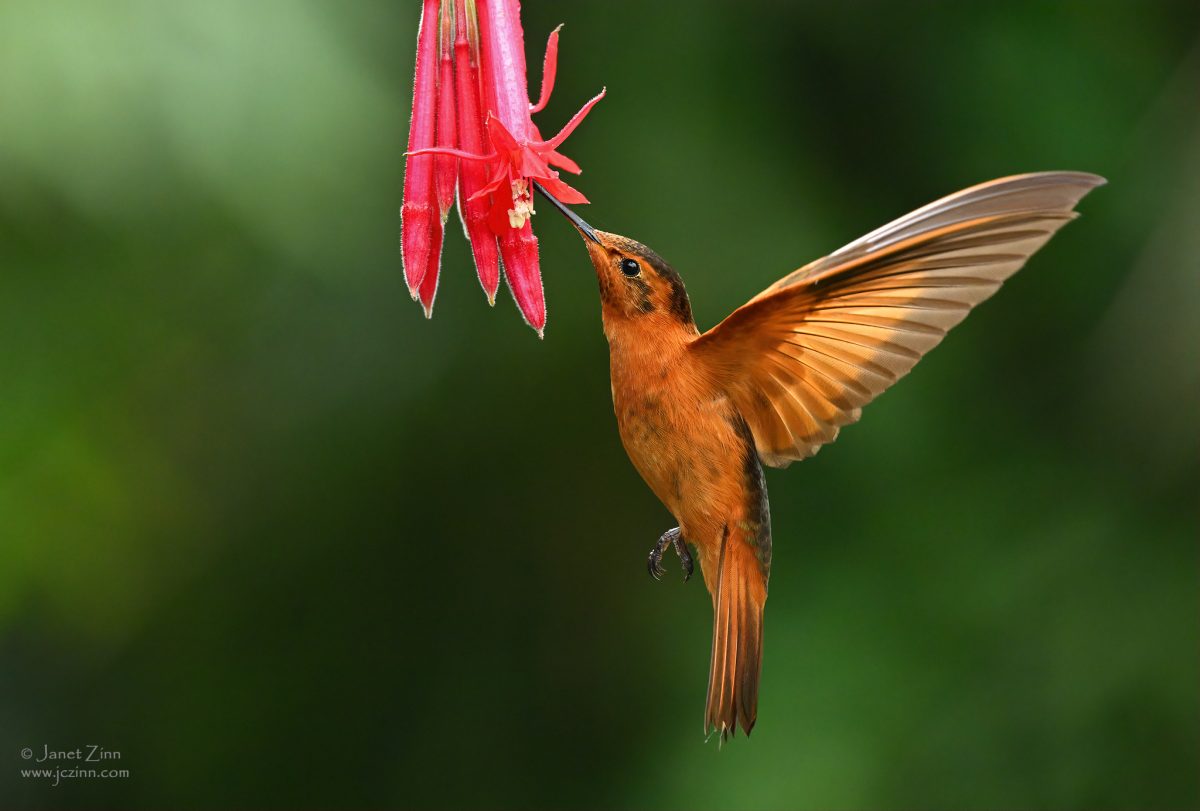
Our journey continued with a morning visit to Tinamu Lodge (Day 12), a mid-elevation coffee farm turned into an island of forest and secondary regrowth known to attract and protect a diverse avifauna. Big highlights included photographing for a long time the Blue-lored Antbird as a new feeder with worms has been established inside the forest. Otherwise, this bird is often heard but seldom seen and even more infrequently photographed due to his shy and concealed behavior. A couple came to the calls given by local guide Brayan Giraldo, and soon after two young birds came in to be fed by their parents. After a very comfortable photographic session we visited the lek of the Golden-collared Manakin with great views and photos.
Other birds that we managed to see and/or photograph included the Bay-headed Tanager, Spectacled Parrotlet, Andean Motmot, Moustached Puffbird, Plain-brown & Cocoa Woodcreeper, Common Tody-Flycatcher, Great Kiskadee, Streaked Flycatcher, White-winged Becard, Rufous-naped Greenlet, White-breasted Wood-Wren, Crimson-backed Tanager, Flame-rumped Tanager, Scrub Tanager, Streaked Saltator, Golden-crowned Warbler and Thick-billed Euphonia, among many others.
Finally, we moved into the Jardín area (afternoon of Day 12), a picturesque town nestled in the Western Andes. We had to divert from our main route because a huge landslide had destroyed the main road. The best option was to head towards Riosucio and spend the night there, reversing the direction for birding the road to Ventana’s Pass and visiting Doña Lucía’s place at Peñas Blancas, which we did the following day. A first stop along the road aiming for the endemic Yellow-headed Brushfinch allowed us for views of the Azara´s Spinetail, Golden-faced Tyrannulet, Flame-rumped, Black-capped, Bay-headed and Golden Tanagers along with the Green Honeycreeper & Black-winged Saltator. Immediately after arriving at Doña Lucías Place we saw & photographed the Margay that has been habituated to come close to the main house. The hummingbirds were very active at the feeders and Martín – Doña Lucías son – arranged a photographic setup with flowers under appropriate light & background. This allowed for flight shots of the Long-tailed Sylph, Sparkling & Lesser Violetear, Tourmaline Sunangel, Speckled Hummingbird, Collared Inca and Fawn-breasted Brilliant.
Pouring rain prevented us from visiting the antpitta station for the Chestnut-naped & Chami Antpittas. Along the way to Jardín we faced the frustrating intermittence of rain and thick mist that kept the birds hidden and quiet. We managed to find the Black-capped Hemispingus, Purplish-mantled Tanager, Yellow-bellied Chat-Tyrant, Black-capped Tyrannulet, Cinnamon Flycatcher, Green Jay, Mountain Elaenia, Roadside Hawk, Red-headed Barbet, Russet-backed Oropendola, Scarlet-rumped Cacique and Sharpe´s Wren, but unfortunately the dense clouds turned into strong rain and thick mist, preventing us from making contact with most of the main targets such as the endemic Yellow-eared Parrot and Red-bellied Grackles. We arrived in Jardin at 3pm, checked in the hotel and took a mototaxi but torrential rain hampered our visit to the Cock-of-the-Rock lek near town.
The grand finale on Day 14 brought us to Medellín/Rionegro. Before our farewell, we visited Alma del Bosque, a specialized orchid farm in Rionegro. This unique addition to the itinerary provided a beautiful botanical interlude, showcasing Colombia’s floral diversity and offering a different kind of majestic beauty.
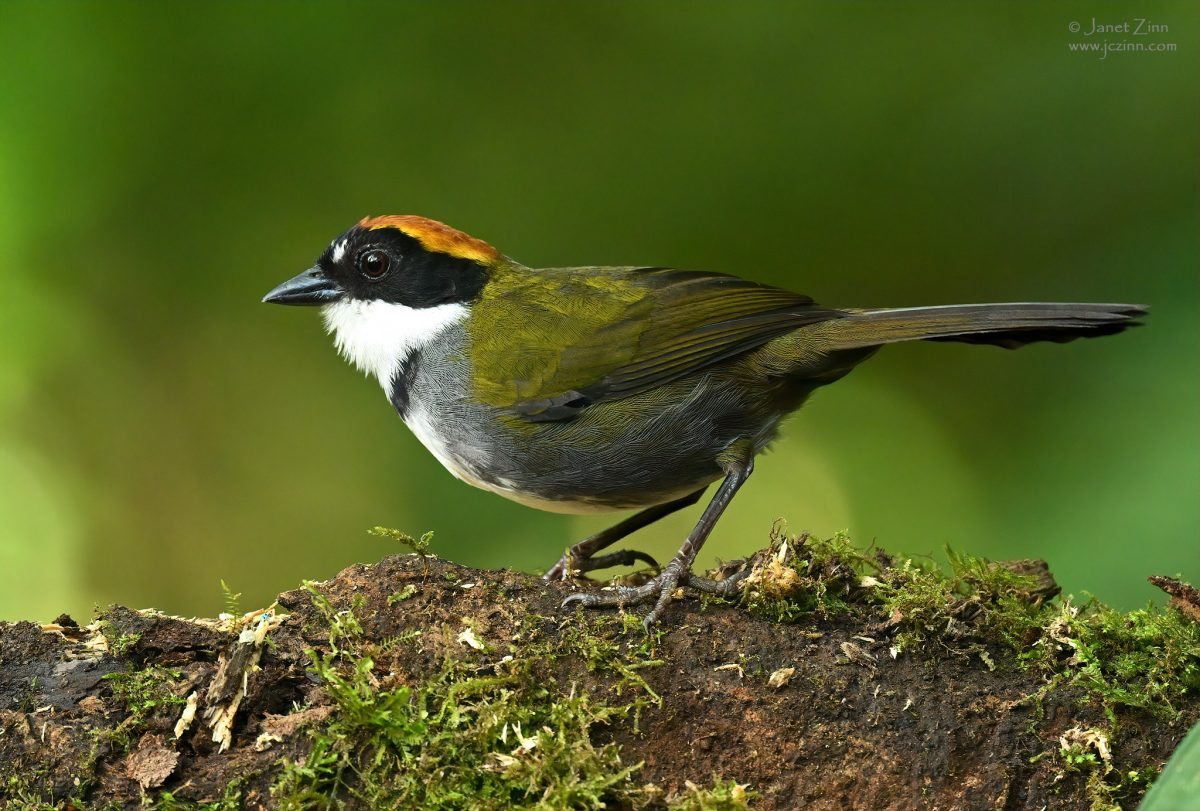
The Birding Tours Colombia Difference
This private birding tour in Colombia for Janet and Alan exemplifies the Birding Tours Colombia commitment to excellence. Our tours are characterized by:
- Expert Guidance: A highly experienced team of the best birding guides in Colombia. Our bilingual (English-Spanish) professional birding guides will be with you. We know the terrain and how to move smoothly through the regions and localities we visit. We know the local people and, most importantly, we work with the best local guides available. With them, you are assured of unparalleled local knowledge and keen eyes & ears for finding even the most elusive species.
- Comfort and Convenience: All transport is via modern Vans or private 4×4 vehicles (Toyota Land Cruiser), ensuring comfortable and reliable travel across diverse terrains. Our chosen hotels and lodges are selected for their comfort to rest, hospitality and proximity to the birding spots.
- Photographer-Friendly Design: We prioritize locations with excellent photographic potential, including feeder stations and accessible trails, allowing you to capture stunning images of Colombia’s avian wonders.
- Comprehensive Experience: From all meals and accommodations to entrance fees for nature reserves and local guide fees, every detail is meticulously arranged, allowing you to focus solely on the birds.
- Unrivaled Biodiversity: With a route potential of 687 species, our itinerary for the Central & Western Andes of Colombia offers an extraordinary opportunity to expand your life list and witness an incredible array of endemic, near-endemic, and specialty birds.
Colombia is calling. If you are an experienced birder or a passionate bird photographer seeking an unforgettable adventure into one of the world’s most biodiverse countries, a private tour with Birding Tours Colombia is your answer. Let us craft your bespoke journey, where every moment is a discovery and every photograph tells a story.
Contact us at birdingtourscolombia@gmail.com to plan your Colombia birding holiday.
Key Avian Highlights: A Deeper Dive
This tour offered great opportunities to encounter a remarkable diversity of species. Here are some of the most important and sought-after birds observed, categorized by their significance and group:
Colombia Endemic Birds Tour Highlights (Crown Jewels):
- Chestnut Wood-Quail: An elusive endemic, often heard but rarely seen, making its sighting at Finca La Florida a true highlight. Its secretive nature makes it a prized photographic subject.
- Multicolored Tanager: A true showstopper endemic, this highly photogenic tanager is a specialty best seen in the Western Andes, known for its dazzling array of colors.
- Gold-ringed Tanager: A spectacular endemic of the Chocó region, this vibrant tanager with its distinctive gold rings is a top target for any birder visiting Montezuma. Its striking plumage & calm behavior makes it incredibly photogenic.
- Munchique Wood-Wren: A highly localized endemic, this small, skulking wren is a true specialty of the Mountain Chocó cloud forests.
- Crested Ant-Tanager: A beautiful endemic with a distinctive crest and rich coloration, often joining mixed flocks and with a distinctive call.
- Crescent-faced Antpitta: An incredibly rare and localized near-endemic, its sighting at Hacienda El Bosque is a great highlight.
- Buffy Helmetcrest: This striking high-altitude hummingbird is an endemic jewel of the páramo, with its crest, violet throat and unique appearance.
Specialties & Rare/Scarce Species:
- Toucan Barbet: A charismatic Chocó specialty, its vibrant colors and unique bill make it a favorite for photographers.
- Ornate Flycatcher: A vibrant and active flycatcher, adding a splash of color to the forest.
- Uniform Treehunter: A unique and interesting species, often found foraging in the mid-story of the cloud forest.
- Orange-breasted Fruiteater: A colorful and captivating species, adding a tropical flair to the forest.
- Black Solitaire: A somber but melodious thrush, its haunting song is a characteristic sound of the Mountain Chocó cloud forest.
- Chestnut-breasted Chlorophonia: A small, vibrant, and highly photogenic species, its brilliant colors make it a joy to observe.
- Brown-banded,Chestnut-crowned & Slate-crowned Antpittas: These antpittas, seen at Rio Blanco, are key targets for their elusive nature and unique behaviors at feeding stations.
- Gray-breasted Mountain-Toucan: A magnificent and impressive toucan of the high Andes, its vibrant bill and striking plumage are a photographer’s delight.
Colorful & Photogenic Groups:
- Hummingbirds: Colombia is the hummingbird capital of the world, and this Colombia hummingbird tour delivered an incredible array of 43 species. These tiny jewels provided endless photographic opportunities at feeders and flowering plants.
- Tanagers: Beyond the endemic Gold-ringed and Multicolored Tanagers, the diverse tanager family offered a riot of colors, making them incredibly rewarding for both observation and photography.
- Quetzals & Trogons: Iconic and vibrantly colored birds, though their elusive nature makes them a special treat.
- Antpittas: These ground-dwelling and often secretive birds, including the Crescent-faced, Brown-banded, Chestnut-crowned and Slate-crowned Antpittas, represent some of the most challenging and rewarding species to find.
- Flycatchers: The diverse family of flycatchers showcased a range of behaviors and plumages.
The Central & Western Andes birding itinerary offers a route potential of 687 species! Colombia is calling. If you are an experienced birder wanting to expand your life list and witness an incredible array of endemic, near-endemic and specialty birds, or a passionate bird photographer seeking an unforgettable adventure into one of the world’s most biodiverse countries, a private tour with Birding Tours Colombia is your answer. Let us craft your bespoke journey, where every moment is a discovery and every photograph tells a story.
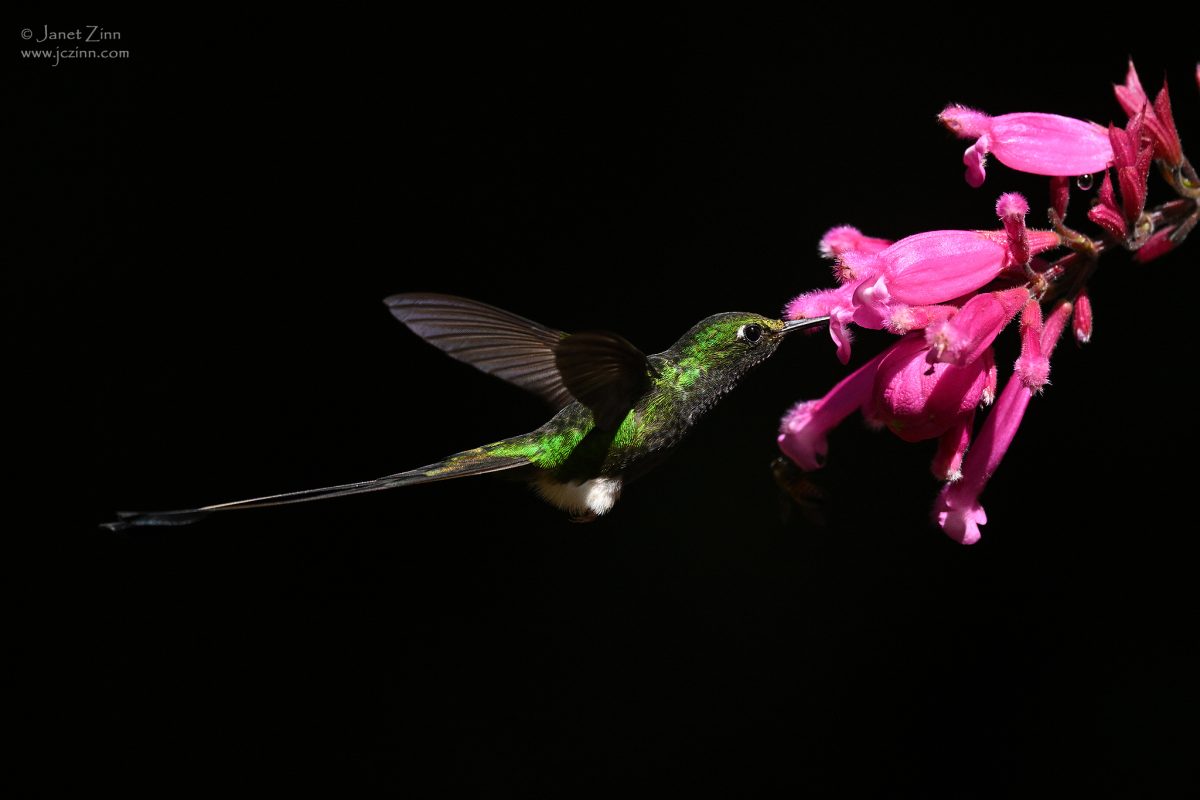
YOU MAY ALSO LIKE
Putumayo & Huila Birding Trip Report: A Private Colombia Birding Tour (Oct 2025) with Judy Harackiewicz & Cliff Thurber from Madison
SEE MORE
Birding & photographing birds along the Central & Western Andes with Doug & Gail Cheeseman (April 22 – May 8, 2019).
SEE MORE
Birding the Central & Western Andes with Anthony Kaduck & Ken Edwards from Canada (March 20 – April 5, 2019).
SEE MORE
Birding Mitú, Inírida & the Perijá Mountains for key species with Hans Jornvall from Sweden (January 5 - 23, 2019).
SEE MORE
Second birding trip to Colombia for Ernest Bradley & Dale Brinker (November 19 – December 03, 2018).
SEE MORE
Birding Hato La Aurora in the Eastern Llanos with Todd Pepper & Mark Eaton (December 1 – 4, 2017).
SEE MORE
Birding the Central & Western Andes of Colombia with Anthony Collerton (July 14 – 23, 2017).
SEE MORE
Andean Endemics tour with British crew: from the Eastern Andes to the mid-Magdalena Valley & Central Andes of Colombia (March 1 – 14, 2017).
SEE MORE
Another challenging & productive trip for Hans Jörnvall from Sweden (January 2 – 15, 2017).
SEE MORE
The Eastern Andes from Bogota to Soata: birding trip for recordist Terry Morgan & Karen Walz (November 18-30, 2016).
SEE MORE
Second birding trip for Katy Krigbaum & Birgit Felser: the Western & Central Andes of Colombia (September 1-20, 2016).
SEE MORE
Birding for much desired targets with Keith Betton, Andrew Herbert (UK) and Rainer Kopa (Germany) (April 17-May 7, 2016).
SEE MORE
Birding the Western & Central Andes with Richard & Jennifer Kershaw from UK (March 10-31, 2016).
SEE MORE
Second birding trip for Steve Huggins & Glenn Giacinto from Chicago, Illinois (January 23 – February 2, 2016).
SEE MORE
Birding along the Western & Central Andes of Colombia with Bob & Katie Self from the UK (November 9 – 26, 2015).
SEE MORE
Birding in Colombia from the Western Andes to the Santa Marta Mountains & Guajira peninsula, with a recapitulation.
SEE MORE
The Eastern Andes, mid-Magdalena Valley, Santa Marta Mountains & La Guajira peninsula with Katy Krigbaum & Birgit Felser (Sept. 2 – 21, 2015).
SEE MORE
Bird photo tour for photographers from Taiwan & China: The Western & Central Andes of Colombia (July 18 – August 8, 2015).
SEE MORE
Second birding trip for Debby Reynolds & David Copas (UK), and Jane Andrews (USA) (January 20 – February 6, 2015).
SEE MORE
Short but productive bird photo trip for family group from Canada and Colombia (December 16-20, 2014).
SEE MORE
Medium length birding trip through the Western & Central Andes of Colombia with Bruce Webb, Jeanne Conry & Peter Gent from USA (May 18 - 27, 2014).
SEE MORE
Short birding escapade for James Taylor & Christine Forster from Victoria, British Columbia (Canada) (May 8-11, 2014).
SEE MORE
Bird photography trip for Japanese photographers – Hisao komori & Yasunobu Shiga (April 26-May 4, 2014).
SEE MORE
Birding the Eastern, Central & Western Andes with Andy & Gill Swash, Debby Reynolds & David Copas from UK (January 15 – February 5, 2014).
SEE MORE
Birding the Central Andes of Colombia with Steven Huggins & Glenn Giacinto from Chicago, Illinois (January 3 – 13, 2014).
SEE MORE
Bird photography trip to the Eastern Andes of Colombia for Juan José Arango & Anabel Vanin (July 31 - August 04, 2013).
SEE MORE
Back to Colombia for a second time: Peter Hawrylyshyn & Bob Lewis search for more hummingbird species and bird specialties at new birding sites (February 15 – March 03, 2013).
SEE MORE
Central Andes short tour with Happy Warblers touring company from New York (February 5 – 13, 2013).
SEE MORE
More Andean endemics with magnificent birding crew from USA, UK & Canada (Dec. 28, 2012 to Jan. 5, 2013).
SEE MORE
Touring for Central Andes Endemics: how good birding in Colombia can be (October 6 – 15, 2012).
SEE MORE
Bird photography trip for Peter Hawrylyshyn, Bob & Hanno Lewis with emphasis on hummingbirds (August 22 – September 9, 2012).
SEE MORE
Birding Otún-Quimbaya Wildlife Sanctuary for some bird images with Juan Jose Arango and Anabel Vanin (August 3 – 5, 2012).
SEE MORE
Enjoying the Rio Blanco antpittas and Central Andes endemics with Eugenia Carey from Dauphin Island (July 5 – 12, 2012).
SEE MORE
Promoting Colombia as a travel destination with British presenter & producer Nigel Marven (February 6 – 11, 2012).
SEE MORE
Bogota Sunangel or not? The intriguing hummingbird at Rogitama Private Nature Reserve (2011).
SEE MORE
Birding with Dominic Mitchell – Managing Editor of Birdwatch Magazine (UK) (November 27 – December 4, 2011).
SEE MORE
Guiding and operating for Birding Adventures TV episodes in Colombia (November 27 – December 4, 2011).
SEE MOREBirding & photographing birds along the Central & Western Andes with Doug & Gail Cheeseman (April 22 – May 8, 2019).
09 - 05 - 2019
Total Species: 383
Complete eBird trip report: https://ebird.org/tripreport/435945
This was the first trip to Colombia for Doug and Gail Cheeseman, beginning in Cali and finishing in Pereira. The itinerary covered the Western Andes, focusing on the Mountain Chocó region, and continued through the Central Andes and the Cauca Valley to include a broad range of ecosystems and specialties.
We prioritized the best localities in the Western Andes near Cali — La Minga Ecolodge at Bitaco Forest, Finca Alejandría, San Antonio Forest, Doña Dora’s site near El Queremal, and Cerro Montezuma — while leaving Jardín and Las Tangaras for a future visit in 2020.
A compact and efficient itinerary also took us through the key areas of the Central Andes and Cauca Valley, visiting El Vínculo, Sonso Marsh, Otún-Quimbaya Sanctuary, Cameguadua Marsh, Los Nevados National Park, Río Blanco, and Tinamú Lodge, finishing with a convenient flight from Pereira to Bogotá and onward connections home.
As a keen birder, Gail was determined not to miss any of the endemics and regional specialties, while Doug aimed to photograph as many species as possible. Combining birding and photography at this level is always a challenge — but a rewarding one!
Western Andes: Cali Region
La Minga Ecolodge
La Minga offered a superb introduction to Colombian birding. Among the many species observed and/or photographed were:
Multicolored Tanager, Andean Motmot, Barred Becard, Slate-throated Redstart, Orange-bellied Euphonia, Blue-winged Mountain-Tanager, Scarlet-fronted Parakeet, Golden-headed Quetzal, Streak-capped Treehunter, Red-faced Spinetail, Glossy-black Thrush, Oleagineous Hemispingus, Chestnut-capped Brushfinch, White-naped Brushfinch, and Three-striped Warbler, among others.
Hummingbirds provided the best photographic poses, including the near-endemic Purple-throated Woodstar, Fawn-breasted Brilliant, Western Emerald, Crowned Woodnymph, Green Hermit, Green-fronted Lancebill, White-necked Jacobin, Brown Violetear, Long-tailed Sylph, Bronzy Inca, Buff-tailed Coronet, White-booted Racket-tail, Andean Emerald, Speckled Hummingbird, Rufous-tailed Hummingbird, and Steely-vented Hummingbird.
Finca Alejandría
Finca Alejandría offered second chances for most of the above hummingbirds and superb photo opportunities of colorful tanagers and fruit-eating species such as Red-headed Barbet, Flame-rumped Tanager, Blue-winged Mountain-Tanager, Multicolored Tanager, Golden-naped Tanager, Black-capped Tanager, near-endemic Scrub Tanager, Saffron-crowned Tanager, Golden Tanager, Green Honeycreeper, Masked Flowerpiercer, Rusty Flowerpiercer, Black-winged Saltator, and many others.

San Antonio Forest
At San Antonio Forest, we photographed the endemic Colombian Chachalaca at close range — an excellent addition to the photo list.
Doña Dora’s Site & Anchicayá Road
Our visits to Doña Dora’s place and the upper section of the Anchicayá road were highly productive, yielding views of Chestnut Wood-Quail, Swallow-tailed Kite, Plumbeous Pigeon, White-throated Quail-Dove, Squirrel Cuckoo, Tawny-bellied Hermit, Toucan Barbet, Crimson-rumped Toucanet, Smoky-brown Woodpecker, Uniform Antshrike, Slaty Spinetail, Slaty-capped Flycatcher, Olive-striped Flycatcher, Scale-crested Pygmy-Tyrant, Black-headed Tody-Flycatcher, Masked Tityra, Black-billed Peppershrike, Bay Wren, Sooty-headed Wren, Glistening-green Tanager, Golden-hooded Tanager, Rufous-throated Tanager, Beryl-spangled Tanager, Bay-headed Tanager, Silver-throated Tanager, Blue Dacnis, Variable Seedeater, Yellow-throated Chlorospingus, Crested Ant-Tanager, and Buff-rumped Warbler, among others.
Photographed species included White-whiskered Hermit, Empress Brilliant, Crowned Woodnymph, Red-headed Barbet, Golden-crowned Flycatcher, White-lined Tanager, Black-headed Brushfinch, Chocó Brushfinch, and Chestnut-headed Oropendola.
Cauca Valley Wetlands: El Vínculo & Sonso Marsh
These lowland wetlands produced a completely different suite of species. Highlights included Horned Screamer, Black-bellied & Fulvous Whistling-Duck, Pied-billed Grebe, Black-crowned Night-Heron, Striated Heron, Cocoi Heron, Snowy Egret, Glossy & Bare-faced Ibis, Limpkin, Purple & Common Gallinule, and American Coot.
We also observed Dwarf Cuckoo, Greater Ani, Common Potoo, Ringed Kingfisher, Amazon Kingfisher, Green Kingfisher, Lineated Woodpecker, Spectacled Parrotlet, Blue-headed Parrot, Bar-crested Antshrike, Jet Antbird, Cocoa Woodcreeper, Sooty-headed Tyrannulet, Southern Beardless-Tyrannulet, Mouse-colored Tyrannulet, Yellow-olive Flycatcher, Vermilion Flycatcher, Apical Flycatcher, Pied Water-Tyrant, and Crimson-backed Tanager.
Cerro Montezuma
At Cerro Montezuma, we experienced some of the most exciting birding of the trip. Endemics included Chestnut-bellied Flowerpiercer, Munchique Wood-Wren, Crested Ant-Tanager, Black-and-gold Tanager, and Gold-ringed Tanager. Near-endemics were also abundant: Orange-breasted Fruiteater, Club-winged Manakin, Black-chinned Mountain-Tanager, Purplish-mantled Tanager, Dusky Chlorospingus, Velvet-purple Coronet, Violet-tailed Sylph, and Brown Inca.
Raptors included Ornate Hawk-Eagle and Barred Hawk. New hummingbirds for the trip were Greenish Puffleg, Rufous-gaped Hillstar, Purple-bibbed Whitetip, Green-crowned Brilliant, and Long-billed Starthroat.
Other great sightings included Moustached Puffbird, Yellow-vented Woodpecker, Smoky-brown Woodpecker, Zeledon’s Antbird, Buffy Tuftedcheek, Fulvous-dotted Treerunner, Rufous Spinetail, Black-capped Tyrannulet, Ornate Flycatcher, Cinnamon Flycatcher, Handsome Flycatcher, Smoky Bush-Tyrant, Lemon-browed Flycatcher, Masked Tityra, White-breasted & Gray-breasted Wood-Wren, Buff-throated Saltator, Olive Finch, Chocó Brushfinch, Ochre-breasted Tanager, Russet-backed Oropendola, and Yellow-collared Chlorophonia.

Central Andes:
Otún-Quimbaya Sanctuary
As always, Otún-Quimbaya delivered excellent birding and photography. We saw the endemic Cauca Guan and Stiles’s Tapaculo, as well as Red-ruffed Fruitcrow, Torrent Duck, Green Jay, Torrent Tyrannulet, Dusky-capped Flycatcher, Golden-faced Tyrannulet, Yellow-bellied Siskin, Rufous-naped Greenlet, Fawn-breasted & Blue-necked Tanager.
Other highlights included Bronzy Inca, Plumbeous-crowned Tyrannulet, Streak-necked Flycatcher, Slaty-backed Chat-Tyrant, White-winged Becard, White-capped Dipper, Metallic-green Tanager, and the uncommon White-winged Tanager.
Cameguadua Marsh
A short but productive visit yielded the endemic Grayish Piculet, along with Blackish Rail, Gray Seedeater, Thick-billed Seed-Finch, and Grayish Saltator, among others.
Los Nevados National Park
A rainy, windy, and cold day awaited us at Los Nevados, but birding remained productive. At Laguna Negra, we observed Andean Teal and Andean Duck, while roadside stops added Paramo Tapaculo, Stout-billed Cinclodes, White-throated Tyrannulet, Brown-backed Chat-Tyrant, Brown-bellied Swallow, Sedge Wren, Lacrimose Mountain-Tanager, Scarlet-bellied Mountain-Tanager, Glossy Flowerpiercer, Plumbeous Sierra-Finch, Plain-colored Seedeater, Paramo Seedeater, Pale-naped Brushfinch, and the near-endemic Golden-fronted Redstart.
Although the Buffy Helmetcrest was heard singing persistently, strong winds and low temperatures prevented a visual sighting.

At the Hotel Termales del Ruiz feeders, we enjoyed superb hummingbird activity, photographing Rainbow-bearded Thornbill, Tourmaline Sunangel, Tyrian Metaltail, Viridian Metaltail, near-endemics Black-thighed & Golden-breasted Puffleg, Shining Sunbeam, Buff-winged Starfrontlet, Mountain Velvetbreast, and Great Sapphirewing.

Río Blanco Reserve
Río Blanco was, as always, full of birds. We added Sickle-winged Guan, Andean Guan, Scaly-naped Parrot, Lyre-tailed Nightjar, Slaty-backed Nightingale-Thrush, Black-billed Mountain-Toucan, Spillmann’s Tapaculo, Montane Woodcreeper, Streaked Xenops, Streaked Tuftedcheek, Flammulated Treehunter, Mountain Elaenia, White-tailed Tyrannulet, Rufous-breasted Flycatcher, Pale-edged Flycatcher, Flavescent Flycatcher, Black-billed Peppershrike, Gray-hooded Bush-Tanager, Blue-and-black Tanager, Capped Conebill, Black-crested Warbler, Russet-crowned Warbler, and Slate-throated Redstart.
A special highlight was the scarce Red-hooded Tanager. The endemic Brown-banded Antpitta, near-endemic Bicolored Antpitta, and Chestnut-crowned Antpitta all appeared beautifully during their feeding sessions, thanks to local guide Daniel Muñoz.

Dense bamboo stands provided good views of specialists such as Black-capped, Superciliaried, Oleagineous and Black-eared Hemispingus.
New hummingbirds included White-throated Wedgebill, Lesser & Sparkling Violetear, Collared Inca, and White-bellied Woodstar.
We also photographed Golden-headed Quetzal, Crimson-mantled Woodpecker, Pearled Treerunner, Rufous-crowned Tody-Flycatcher, Green-and-black Fruiteater, Black-collared Jay, Mountain Wren, Sharpe’s Wren, White-capped Tanager, Grass-green Tanager, Lacrimose Mountain-Tanager, Buff-breasted Mountain-Tanager, Blue-capped Tanager, Masked Flowerpiercer, White-sided Flowerpiercer, White-capped Dipper, Gray-browed Brushfinch, and Slaty Brushfinch, among many others.
Tinamú Lodge
A delightful final stop to conclude the trip. Specialties seen included Gray-headed Dove, endemic Parker’s Antbird, and Blue-lored Antbird. We also photographed Speckle-breasted Wren, Golden-collared Manakin, Moustached Puffbird, Common Potoo, and many others.
Additional species recorded here included Stripe-throated Hermit, Black-throated Mango, White-vented Plumeleteer, Acorn Woodpecker, Plain-brown Woodcreeper, Ochre-bellied Flycatcher, Slate-headed Tody-Flycatcher, Streaked Flycatcher, Cinereous Becard, Black-chested Jay, Clay-colored Thrush, Gray-headed Tanager, Ruddy-breasted Seedeater, and Golden-crowned Warbler.
Trip Summary
After driving over 1,400 kilometers of mostly mountain roads, we concluded this unforgettable adventure with 383 bird species recorded.
Reflection
This journey highlighted the incredible biodiversity and photographic opportunities of Colombia’s Andes. Gail’s focused birding and Doug’s photographic expertise made for a dynamic and successful combination — a perfect example of how rewarding birding in Colombia can be for enthusiasts of every level.
YOU MAY ALSO LIKE
Putumayo & Huila Birding Trip Report: A Private Colombia Birding Tour (Oct 2025) with Judy Harackiewicz & Cliff Thurber from Madison
SEE MORE
Birding & photographing birds along the Central & Western Andes with Doug & Gail Cheeseman (April 22 – May 8, 2019).
SEE MORE
Birding the Central & Western Andes with Anthony Kaduck & Ken Edwards from Canada (March 20 – April 5, 2019).
SEE MORE
Birding Mitú, Inírida & the Perijá Mountains for key species with Hans Jornvall from Sweden (January 5 - 23, 2019).
SEE MORE
Second birding trip to Colombia for Ernest Bradley & Dale Brinker (November 19 – December 03, 2018).
SEE MORE
Birding Hato La Aurora in the Eastern Llanos with Todd Pepper & Mark Eaton (December 1 – 4, 2017).
SEE MORE
Birding the Central & Western Andes of Colombia with Anthony Collerton (July 14 – 23, 2017).
SEE MORE
Andean Endemics tour with British crew: from the Eastern Andes to the mid-Magdalena Valley & Central Andes of Colombia (March 1 – 14, 2017).
SEE MORE
Another challenging & productive trip for Hans Jörnvall from Sweden (January 2 – 15, 2017).
SEE MORE
The Eastern Andes from Bogota to Soata: birding trip for recordist Terry Morgan & Karen Walz (November 18-30, 2016).
SEE MORE
Second birding trip for Katy Krigbaum & Birgit Felser: the Western & Central Andes of Colombia (September 1-20, 2016).
SEE MORE
Birding for much desired targets with Keith Betton, Andrew Herbert (UK) and Rainer Kopa (Germany) (April 17-May 7, 2016).
SEE MORE
Birding the Western & Central Andes with Richard & Jennifer Kershaw from UK (March 10-31, 2016).
SEE MORE
Second birding trip for Steve Huggins & Glenn Giacinto from Chicago, Illinois (January 23 – February 2, 2016).
SEE MORE
Birding along the Western & Central Andes of Colombia with Bob & Katie Self from the UK (November 9 – 26, 2015).
SEE MORE
Birding in Colombia from the Western Andes to the Santa Marta Mountains & Guajira peninsula, with a recapitulation.
SEE MORE
The Eastern Andes, mid-Magdalena Valley, Santa Marta Mountains & La Guajira peninsula with Katy Krigbaum & Birgit Felser (Sept. 2 – 21, 2015).
SEE MORE
Bird photo tour for photographers from Taiwan & China: The Western & Central Andes of Colombia (July 18 – August 8, 2015).
SEE MORE
Second birding trip for Debby Reynolds & David Copas (UK), and Jane Andrews (USA) (January 20 – February 6, 2015).
SEE MORE
Short but productive bird photo trip for family group from Canada and Colombia (December 16-20, 2014).
SEE MORE
Medium length birding trip through the Western & Central Andes of Colombia with Bruce Webb, Jeanne Conry & Peter Gent from USA (May 18 - 27, 2014).
SEE MORE
Short birding escapade for James Taylor & Christine Forster from Victoria, British Columbia (Canada) (May 8-11, 2014).
SEE MORE
Bird photography trip for Japanese photographers – Hisao komori & Yasunobu Shiga (April 26-May 4, 2014).
SEE MORE
Birding the Eastern, Central & Western Andes with Andy & Gill Swash, Debby Reynolds & David Copas from UK (January 15 – February 5, 2014).
SEE MORE
Birding the Central Andes of Colombia with Steven Huggins & Glenn Giacinto from Chicago, Illinois (January 3 – 13, 2014).
SEE MORE
Bird photography trip to the Eastern Andes of Colombia for Juan José Arango & Anabel Vanin (July 31 - August 04, 2013).
SEE MORE
Back to Colombia for a second time: Peter Hawrylyshyn & Bob Lewis search for more hummingbird species and bird specialties at new birding sites (February 15 – March 03, 2013).
SEE MORE
Central Andes short tour with Happy Warblers touring company from New York (February 5 – 13, 2013).
SEE MORE
More Andean endemics with magnificent birding crew from USA, UK & Canada (Dec. 28, 2012 to Jan. 5, 2013).
SEE MORE
Touring for Central Andes Endemics: how good birding in Colombia can be (October 6 – 15, 2012).
SEE MORE
Bird photography trip for Peter Hawrylyshyn, Bob & Hanno Lewis with emphasis on hummingbirds (August 22 – September 9, 2012).
SEE MORE
Birding Otún-Quimbaya Wildlife Sanctuary for some bird images with Juan Jose Arango and Anabel Vanin (August 3 – 5, 2012).
SEE MORE
Enjoying the Rio Blanco antpittas and Central Andes endemics with Eugenia Carey from Dauphin Island (July 5 – 12, 2012).
SEE MORE
Promoting Colombia as a travel destination with British presenter & producer Nigel Marven (February 6 – 11, 2012).
SEE MORE
Bogota Sunangel or not? The intriguing hummingbird at Rogitama Private Nature Reserve (2011).
SEE MORE
Birding with Dominic Mitchell – Managing Editor of Birdwatch Magazine (UK) (November 27 – December 4, 2011).
SEE MORE
Guiding and operating for Birding Adventures TV episodes in Colombia (November 27 – December 4, 2011).
SEE MOREBirding the Central & Western Andes with Anthony Kaduck & Ken Edwards from Canada (March 20 – April 5, 2019).
06 - 04 - 2019
Trip Overview
This was the third trip to Colombia for Anthony Kaduck and the first for Ken Edwards, covering the Central and Western Andes from Cali to Medellín — one of the finest birding itineraries in Colombia.
Over 17 days, the team registered 481 species (456 seen, 25 heard only), of which 190 were new for Anthony.
A detailed report by Anthony Kaduck follows below this summary.

On our first day of tour, outside the hotel in Cali. From right to left: Ken Edwards, Anthony Kaduck, Daniel Uribe.
La Minga Ecolodge
The trip began in Cali, with first birding at La Minga Ecolodge, followed by Finca Alejandría and San Antonio Forest at the iconic Kilometer 18. Recently opened to birders, La Minga offers rewarding birding in primary cloud forest, gardens, and feeders.
Endemics recorded here included Multicolored Tanager, Colombian Chachalaca, and Chestnut Wood-Quail, along with the near-endemic Nariño Tapaculo.
The forested road produced excellent sightings of Streak-capped Treehunter, Chestnut-breasted Wren, Spotted Barbtail, Lineated Foliage-Gleaner, Montane Foliage-Gleaner, Uniform Antshrike, and Plain Antvireo. Other forest highlights included Montane Woodcreeper, Streaked Xenops, Scale-crested Pygmy-Tyrant, Bright-rumped Attila, Andean Solitaire, Pale-eyed Thrush, Oleagineous Hemispingus, Ashy-throated Chlorospingus, and Orange-bellied Euphonia.
Special species at La Minga also included Yellow-vented Woodpecker, White-throated Quail-Dove, Scarlet-fronted Parakeet, Mottled Owl, Common Potoo, Bronzy Inca, Western Emerald, Golden-headed Quetzal, Red-headed Barbet, Southern Emerald-Toucanet, and Rusty Flowerpiercer, among others.
Finca Alejandría
Despite heavy rain, Finca Alejandría offered its usual exceptional birding, with close views of numerous hummingbirds:
Blue-headed Sapphire, Green Hermit, Speckled Hummingbird, Long-tailed Sylph, Booted Racket-tail, Fawn-breasted Brilliant, Purple-throated Woodstar (near-endemic), Steely-vented Hummingbird, White-necked Jacobin, Crowned Woodnymph, and Andean Emerald.
Feeders loaded with bananas attracted a colorful mix of tanagers and allies, including Flame-rumped Tanager, Blue-winged Mountain-Tanager, Multicolored Tanager (endemic), Scrub Tanager (near-endemic), Golden-naped, Black-capped, Metallic-green, Saffron-crowned, and Golden Tanagers, as well as Black-winged Saltator and Chestnut-capped Brushfinch foraging on fallen fruit.
San Antonio Forest
A quick visit to San Antonio Forest yielded excellent views of Rufous-tailed Tyrant, Green-and-black Fruiteater, Barred Becard, Brown-capped Vireo, Glossy-black Thrush, and White-naped (Yellow-throated) Brushfinch, among others.
Cauca Valley Wetlands
En route to Cerro Montezuma, we birded Sonso Marsh, the Media Canoa fishing ponds, and the Cartago marshes.
Highlights included Black-bellied and Fulvous Whistling-Duck, Cinnamon Teal (a threatened resident subspecies), Least and Pied-billed Grebe, Anhinga, Black-crowned Night-Heron, Striated, Cocoi, and Little Blue Heron, Glossy, Bare-faced, and Buff-necked Ibis, Snail Kite, Wattled Jacana, White-tipped Dove, Spectacled Parrotlet, Greater Ani, Common Potoo, Ringed Kingfisher, and Green Kingfisher.
The most remarkable sighting was a Sungrebe, an uncommon bird in this part of Colombia, spotted by Anthony.
Low shrubby vegetation near water also yielded Jet Antbird, Bar-crested Antshrike (near-endemic), Cocoa Woodcreeper, Streak-headed Woodcreeper, Slate-headed Tody-Flycatcher, Yellow-crowned Flycatcher, Yellow-olive Flycatcher, Vermilion Flycatcher, Cattle Tyrant, Cinereous Becard, Guira Tanager, Yellow Oriole, and Oriole Blackbird.

Ken & Daniel, very happy after seeing the Sungrebe at Sonso marsh. Photo taken by Anthony Kaduck.Cerro Montezuma
We lodged at Cerro Montezuma for three nights, birding the upper, mid, and lower altitudes on different days to take advantage of weather and activity patterns. This site, part of the Mountain Chocó region, remains one of the richest birding areas in the Neotropics.
Endemics
Black-and-gold Tanager, Gold-ringed Tanager, Chestnut-bellied Flowerpiercer, Crested Ant-Tanager, Tatamá Tapaculo, Munchique Wood-Wren, Grayish Piculet, Parker’s Antbird, and Dusky Starfrontlet (Glittering Starfrontlet).


Near-endemics
Toucan Barbet, Yellow-breasted Antpitta, Uniform Treehunter, Orange-breasted Fruiteater, Club-winged Manakin, Sooty-headed Wren, Black Solitaire, Black-chinned Mountain-Tanager, Purplish-mantled Tanager, Glistening-green Tanager, Rufous-throated Tanager, Indigo Flowerpiercer, Black-headed Brushfinch, Tanager Finch, Dusky Chlorospingus, Golden-fronted Redstart, and Yellow-collared Chlorophonia.
Hummingbirds
Violet-tailed Sylph, Brown Inca, Velvet-purple Coronet, Empress Brilliant, Purple-throated Woodstar, Tawny-bellied Hermit, Green-fronted Lancebill, Tourmaline Sunangel, Tyrian Metaltail, Greenish Puffleg, Booted Racket-tail, Rufous-gaped Hillstar, Purple-bibbed Whitetip, Green-crowned Brilliant, Western Emerald, Crowned Woodnymph, Andean Emerald, Rufous-tailed Hummingbird, and Steely-vented Hummingbird.
Other Notable Species
Buffy Tuftedcheek, Handsome Flycatcher, Buff-fronted Foliage-Gleaner, Rusty-winged Barbtail, Fulvous-dotted Treerunner, Scaled Fruiteater, Bronze-olive Pygmy-Tyrant, Black-throated Pygmy-Tyrant, Ornate Flycatcher, Golden-winged Manakin, Striolated Manakin, Plushcap, Olive Finch, Tricolored (Chocó) Brushfinch, Golden-bellied (Chocó) Warbler, and Chestnut-breasted Chlorophonia.

Additional species included Black-billed Mountain-Toucan, Streak-headed and Zeledon’s Antbird, Ocellated Tapaculo, Chapman’s Swift, Crimson-rumped Toucanet, Wedge-billed Woodcreeper, Plain Xenops, Rufous Spinetail, Black-capped Tyrannulet, Marble-faced Bristle-Tyrant, White-throated Spadebill, Yellow-bellied Chat-Tyrant, Lemon-browed Flycatcher, Rufous-naped Greenlet, Slaty-capped Shrike-Vireo, Grass-green Tanager, Bluish Flowerpiercer, Variable Seedeater, Dusky-faced Tanager, and Russet-backed Oropendola.
Central Andes
Otún-Quimbaya Wildlife Sanctuary
This reserve provided close views of the endemic Cauca Guan, Stiles’s Tapaculo, and Multicolored Tanager, along with the near-endemics Moustached and Hooded Antpittas, Rufous-breasted Flycatcher, Scrub Tanager, and Bar-crested Antshrike.
Other highlights included Wattled Guan, Golden-plumed Parakeet, Bronze-winged Parrot, Rufous-bellied Nighthawk, Red-ruffed Fruitcrow, Torrent Duck, White-capped Dipper, Fasciated Tiger-Heron, Rufescent (Colombian) Screech-Owl, Collared Trogon, Andean Motmot, Slaty Spinetail, Slaty-capped Flycatcher, Whiskered Wren, Southern Emerald-Toucanet, Variegated Bristle-Tyrant, Marble-faced Bristle-Tyrant, Rufous-naped Greenlet, and Common Chlorospingus.
Tanagers included White-capped, Blue-necked, Beryl-spangled, Metallic-green, and Saffron-crowned Tanager.

Cameguadua Marsh & Río Claro
After birding Cameguadua Marsh, we visited Río Claro near Chinchiná, where we obtained outstanding views of the endemic Turquoise Dacnis.
Los Nevados National Park
A day in Los Nevados National Park produced two remarkable endemics: Rufous-fronted Parakeet (vulnerable) and the beautiful Buffy Helmetcrest at 12,000 feet.
Hummingbird activity was excellent, with Black-thighed Puffleg, Golden-breasted Puffleg, Purple-backed Thornbill, Rainbow-bearded Thornbill, Tyrian and Viridian Metaltail, Shining Sunbeam, Buff-winged Starfrontlet, Mountain Velvetbreast, Sword-billed Hummingbird, and Great Sapphirewing.
Other notable records included Andean Teal, Andean Duck, Paramo Tapaculo, Stout-billed Cinclodes, Andean Tit-Spinetail, White-throated Tyrannulet, Brown-backed Chat-Tyrant, Red-crested Cotinga, Sedge Wren, Glossy, Black and Masked Flowerpiercer, Plumbeous Sierra-Finch, Plain-colored and Paramo Seedeater, Gray-browed Brushfinch, Black-crested Warbler, and Hooded Siskin.
Four species of mountain-tanagers were observed: Hooded, Lacrimose, Scarlet-bellied, and Buff-breasted Mountain-Tanager, along with Blue-capped and Blue-and-black Tanager.
Río Blanco Reserve
The cloud forest of Río Blanco was full of activity. Early morning feeding sessions offered intimate views of Brown-banded Antpitta (endemic), Bicolored Antpitta (near-endemic), and Chestnut-crowned Antpitta.
We also saw Ash-colored Tapaculo, Blackish Tapaculo, Golden-headed Quetzal, Masked Trogon, Sickle-winged Guan, Barred Parakeet, Andean Motmot, Crimson-mantled Woodpecker, Tyrannine and Montane Woodcreeper, Striped and Flammulated Treehunter, Pearled Treerunner, White-tailed Tyrannulet, Rufous-headed Pygmy-Tyrant, Flavescent Flycatcher, Pale-edged Flycatcher, Smoky Bush-Tyrant, Slaty-backed and Rufous-breasted Chat-Tyrant, Black-billed Peppershrike, Sharpe’s and Mountain Wren, Slaty-backed Nightingale-Thrush, Glossy-black Thrush, Black-capped, Superciliaried and Black-eared Hemispingus, Gray-hooded Bush-Tanager, Capped Conebill, Chestnut-capped, Slaty and Gray-browed Brushfinch, Citrine and Russet-crowned Warbler, as well as Pale-footed Swallow and Masked Saltator.
 Ken, Daniel & Anthony, at Rio Blanco cloud forest.
Hummingbirds included White-throated Wedgebill, Lesser Violetear, Tourmaline Sunangel, Speckled Hummingbird, Long-tailed Sylph, Bronzy Inca, Collared Inca, Buff-tailed Coronet, Fawn-breasted Brilliant, White-bellied Woodstar, and Andean Emerald.
Nocturnal species seen were White-throated Screech-Owl, Rufous-banded Owl, and Lyre-tailed Nightjar (male and female).
Tinamú Lodge
Descending from the mountains, we reached Tinamú Lodge, a private nature reserve with gentle trails through secondary forest. Highlights included Gray-headed Dove, Blue-lored Antbird, Golden-collared Manakin, Speckle-breasted Wren, Crimson-backed Tanager, Guira Tanager, and Large-billed Seed-Finch, along with three species of hermits: Rufous-breasted, Stripe-throated, and Green Hermit.
Northern Central Andes: Jardín & Las Tangaras
The drive from Manizales to Jardín followed the old gravel road through Riosucio and Ventanas Pass, avoiding highway construction. This route yielded the endemic Yellow-headed Brushfinch, previously known only from the Magdalena Valley.
In Jardín, birding along the Riosucio road and at Doña Lucía’s Antpitta feeding stations provided sightings of Yellow-eared Parrot (endemic), Chestnut-naped and Slate-crowned Antpitta, Chestnut-collared Swift, Streak-throated Bush-Tyrant, Rufous-breasted Chat-Tyrant, and around 14 displaying Andean Cock-of-the-rock males near town. Other notable species included Green Jay, Citrine Warbler, and Scarlet-rumped Cacique.


The final birding days took place at ProAves’ Las Tangaras Reserve on the Pacific slope. Here we obtained second and often improved views of many Mountain Chocó specialties previously seen at Cerro Montezuma.
Additional highlights included Red-bellied Grackle (endemic), Rufous-crested Tanager, Rufous-rumped Antwren, Yellow-breasted Antwren, Scaly-throated Foliage-Gleaner, Olivaceous Piha, Chocó Vireo (near-endemic), Beautiful Jay (near-endemic), White-headed Wren, White-thighed Swallow, and Black Solitaire (near-endemic).
Final Day
On the drive to Rionegro (Medellín’s airport), a stop at Quebrada Sinifaná near Bolombolo offered views of Black-crowned Antshrike, White-fringed Antwren, Piratic Flycatcher, and Streaked Flycatcher.
We also heard, though did not see, the endemic Antioquia Wren.
Summary
After more than two weeks birding across Colombia’s most diverse Andean ranges, Anthony and Ken wrapped up an unforgettable trip with 481 recorded species, including numerous endemics, near-endemics, and photographic highlights.
From cloud forests and paramo to humid Chocó slopes, this itinerary once again proved why the Central and Western Andes rank among the most spectacular birding regions on Earth.

YOU MAY ALSO LIKE
Putumayo & Huila Birding Trip Report: A Private Colombia Birding Tour (Oct 2025) with Judy Harackiewicz & Cliff Thurber from Madison
SEE MORE
Birding & photographing birds along the Central & Western Andes with Doug & Gail Cheeseman (April 22 – May 8, 2019).
SEE MORE
Birding the Central & Western Andes with Anthony Kaduck & Ken Edwards from Canada (March 20 – April 5, 2019).
SEE MORE
Birding Mitú, Inírida & the Perijá Mountains for key species with Hans Jornvall from Sweden (January 5 - 23, 2019).
SEE MORE
Second birding trip to Colombia for Ernest Bradley & Dale Brinker (November 19 – December 03, 2018).
SEE MORE
Birding Hato La Aurora in the Eastern Llanos with Todd Pepper & Mark Eaton (December 1 – 4, 2017).
SEE MORE
Birding the Central & Western Andes of Colombia with Anthony Collerton (July 14 – 23, 2017).
SEE MORE
Andean Endemics tour with British crew: from the Eastern Andes to the mid-Magdalena Valley & Central Andes of Colombia (March 1 – 14, 2017).
SEE MORE
Another challenging & productive trip for Hans Jörnvall from Sweden (January 2 – 15, 2017).
SEE MORE
The Eastern Andes from Bogota to Soata: birding trip for recordist Terry Morgan & Karen Walz (November 18-30, 2016).
SEE MORE
Second birding trip for Katy Krigbaum & Birgit Felser: the Western & Central Andes of Colombia (September 1-20, 2016).
SEE MORE
Birding for much desired targets with Keith Betton, Andrew Herbert (UK) and Rainer Kopa (Germany) (April 17-May 7, 2016).
SEE MORE
Birding the Western & Central Andes with Richard & Jennifer Kershaw from UK (March 10-31, 2016).
SEE MORE
Second birding trip for Steve Huggins & Glenn Giacinto from Chicago, Illinois (January 23 – February 2, 2016).
SEE MORE
Birding along the Western & Central Andes of Colombia with Bob & Katie Self from the UK (November 9 – 26, 2015).
SEE MORE
Birding in Colombia from the Western Andes to the Santa Marta Mountains & Guajira peninsula, with a recapitulation.
SEE MORE
The Eastern Andes, mid-Magdalena Valley, Santa Marta Mountains & La Guajira peninsula with Katy Krigbaum & Birgit Felser (Sept. 2 – 21, 2015).
SEE MORE
Bird photo tour for photographers from Taiwan & China: The Western & Central Andes of Colombia (July 18 – August 8, 2015).
SEE MORE
Second birding trip for Debby Reynolds & David Copas (UK), and Jane Andrews (USA) (January 20 – February 6, 2015).
SEE MORE
Short but productive bird photo trip for family group from Canada and Colombia (December 16-20, 2014).
SEE MORE
Medium length birding trip through the Western & Central Andes of Colombia with Bruce Webb, Jeanne Conry & Peter Gent from USA (May 18 - 27, 2014).
SEE MORE
Short birding escapade for James Taylor & Christine Forster from Victoria, British Columbia (Canada) (May 8-11, 2014).
SEE MORE
Bird photography trip for Japanese photographers – Hisao komori & Yasunobu Shiga (April 26-May 4, 2014).
SEE MORE
Birding the Eastern, Central & Western Andes with Andy & Gill Swash, Debby Reynolds & David Copas from UK (January 15 – February 5, 2014).
SEE MORE
Birding the Central Andes of Colombia with Steven Huggins & Glenn Giacinto from Chicago, Illinois (January 3 – 13, 2014).
SEE MORE
Bird photography trip to the Eastern Andes of Colombia for Juan José Arango & Anabel Vanin (July 31 - August 04, 2013).
SEE MORE
Back to Colombia for a second time: Peter Hawrylyshyn & Bob Lewis search for more hummingbird species and bird specialties at new birding sites (February 15 – March 03, 2013).
SEE MORE
Central Andes short tour with Happy Warblers touring company from New York (February 5 – 13, 2013).
SEE MORE
More Andean endemics with magnificent birding crew from USA, UK & Canada (Dec. 28, 2012 to Jan. 5, 2013).
SEE MORE
Touring for Central Andes Endemics: how good birding in Colombia can be (October 6 – 15, 2012).
SEE MORE
Bird photography trip for Peter Hawrylyshyn, Bob & Hanno Lewis with emphasis on hummingbirds (August 22 – September 9, 2012).
SEE MORE
Birding Otún-Quimbaya Wildlife Sanctuary for some bird images with Juan Jose Arango and Anabel Vanin (August 3 – 5, 2012).
SEE MORE
Enjoying the Rio Blanco antpittas and Central Andes endemics with Eugenia Carey from Dauphin Island (July 5 – 12, 2012).
SEE MORE
Promoting Colombia as a travel destination with British presenter & producer Nigel Marven (February 6 – 11, 2012).
SEE MORE
Bogota Sunangel or not? The intriguing hummingbird at Rogitama Private Nature Reserve (2011).
SEE MORE
Birding with Dominic Mitchell – Managing Editor of Birdwatch Magazine (UK) (November 27 – December 4, 2011).
SEE MORE
Guiding and operating for Birding Adventures TV episodes in Colombia (November 27 – December 4, 2011).
SEE MOREColombia Birding Tour: Central Andes & Cauca Valley Report
15 - 03 - 2019
Trip Report: Central Andes & Cauca Valley (March 2019)
Welcome to our Trip Report series, where we share the field notes and highlights from our latest birding tours Colombia. Each report serves as a real-world example of what our Colombia birding itineraries deliver: exceptional birds, expert birding guides Colombia, and seamless logistics.
This Colombia birding trip report details a compact but incredibly diverse journey through the country’s Western and Central Andes birding circuits. For birders planning their own custom Colombia birding trip, this route from Cali to Manizales showcases the region’s spectacular highlights, from vibrant tanager flocks to rare high-altitude hummingbirds.
A Birding Triumph in the Andes: Happy Warblers’ Central Andes & Cauca Valley Tour (March 2019)
Dates: March 6 – 14, 2019
Total Species: 308
Complete eBird trip report: https://ebird.org/tripreport/435637
This was the third trip organized by Birding Tours Colombia for Joe Giunta’s Happy Warblers touring company. On this occasion, we designed a compact but diverse route, rich in birdlife and color, starting in Cali and ending in Manizales. Participants arrived via Cali’s airport and departed from Pereira, making logistics simple and efficient.
This Colombia birding tour combined the lush Western Andes with the fertile Cauca Valley, moving east into the Central Andes—a perfect sample of Colombia’s exceptional avian diversity. It proved ideal for both birdwatchers and bird photographers interested in Andes birding tours and private birding tours in Colombia.
Eight Days, 308 Birds: A quick glance at the itinerary.
Our journey packed an extraordinary amount of birding into just eight days, showcasing how incredibly productive the Western and Central Andes can be. We began with a short drive from Cali to the iconic Kilómetro 18 (Km 18), spending the morning between the famed feeders of Finca Alejandría and the forested road to Dapa. After a delicious lunch at Aquí me Quedo, surrounded by a flurry of hummingbirds, we continued toward Buga, making a fruitful stop in the semi-dry forest of El Vínculo Regional Reserve.
The following day offered a deep dive into the wetlands of Sonso Marsh, a full morning filled with classic Cauca Valley specialties. In the afternoon we traveled to Otún-Quimbaya Wildlife Sanctuary, birding along the Otún River in search of the charismatic torrent trio: Torrent Duck, White-capped Dipper, and Torrent Tyrannulet.
We devoted a full day to exploring Otún-Quimbaya, from the lodge to the traditional fonda at El Cedral, followed by a second productive morning before heading toward Manizales. En route, we added more marsh species at Cameguadua Reservoir, near Chinchiná.
The final stretch of the trip took us high into Los Nevados National Park, where we enjoyed unforgettable views of high-Andean specialists, excellent activity at the feeders of Hotel Termales del Ruiz, and a rewarding hike down the Old Road. We continued with a morning of antpittas, mixed flocks, and mountain forest magic at Río Blanco, closing the tour with a relaxed and bird-filled visit to Tinamu Lodge, just below Manizales.
Despite the compact itinerary, the group achieved an outstanding total: 308 species recorded in only eight birding days—a remarkable result and a testament to the diversity and accessibility of these Andean regions.
Day 1: Western Andes Wonders at Km 18 and El Vínculo
Our first morning of birding in Colombia began just outside Cali at the famous “Kilómetro 18”, perched in the Western Andes. The cloud forest and gardens at Finca Alejandría offered immediate action, with feeders exploding in color.
Highlights included Long-tailed Sylph, White-booted Racket-tail, Fawn-breasted Brilliant, the near-endemic Purple-throated Woodstar, and the uncommon Blue-headed Sapphire—a dazzling start to our Colombia hummingbird tour segment.
Tanagers provided even more colors: Flame-rumped Tanager, Blue-winged Mountain-Tanager, the endemic Multicolored Tanager, Golden-naped Tanager, Metallic-green Tanager, Saffron-crowned Tanager, Golden Tanager, Black-winged Saltator, Hepatic Tanager, and Summer Tanagers.
On the forested Dapa Road, mixed flocks yielded Red-headed Barbet, Red-faced Spinetail, Streak-capped Treehunter, Montane Woodcreeper, and Uniform Antshrike. We also found Scarlet-fronted Parakeet, Pewee, Golden-crowned Flycatcher, the musical Chestnut-breasted Wren, and Andean Solitaire.
After lunch at Aquí Me Quedo, with its excellent hummingbird feeders, we drove toward Buga.
Afternoon at El Vínculo Regional Reserve
En route, we birded the semi-dry forest of El Vínculo Regional Reserve13. The habitat change in the Cauca Valley was remarkable. We enjoyed excellent views of Spectacled Parrotlet, Lineated Woodpecker, and Streak-headed Woodcreeper, followed by the near-endemic Bar-crested Antshrike and Scrub Tanager. The supporting cast included Mouse-colored Tyrannulet, Crimson-backed Tanager, Streaked Saltator, Tropical Parula, and Yellow Oriole. This provided a fine transition from humid montane to dry valley habitats as we continued to Buga.
Day 2: Sonso Marsh Wetlands and the Ascent to Otún
Our second morning was dedicated to Sonso Marsh, a key wetland in the Cauca Valley for resident and migratory species. This mosaic of habitats offered non-stop activity, typical of the best birding tours Colombia. Excitement began with a pair of Horned Screamers, a flagship species here.
Waterfowl followed: Black-bellied Whistling-Duck, the threatened resident Cinnamon Teal, Least and Pied-billed Grebes, Black-crowned Night-Heron, Striated Heron, Cocoi Heron, Little Blue Heron, and Buff-necked Ibis. Raptors included Snail Kite and Limpkin. We also spotted Purple Gallinule, Black-necked Stilt, Wattled Jacana, and Southern Lapwing.
Drier sections produced Greater Ani, Smooth-billed Ani, Striped Cuckoo, and three kingfishers: Ringed, Amazon, and Green Kingfisher. A woodland stretch yielded Spot-breasted and Red-crowned Woodpecker, Cocoa Woodcreeper, Great Antshrike, and the impressive Jet Antbird.
Flycatcher highlights included Yellow-bellied Elaenia, Slate-headed Tody-Flycatcher, Yellow-olive Flatbill, Vermilion Flycatcher, and Colombia’s endemic Apical Flycatcher—a key find for any Colombia birding trip. We closed the morning with Cinerous Becard, Oriole Blackbird, Masked Cardinal, and Tropical Gnatcatcher.
Leaving Sonso with over 90 species, we began our afternoon ascent toward the Central Andes, birding the Otún River en route to Otún-Quimbaya Wildlife Sanctuary. The drive provided the classic “torrent trio”: Torrent Duck, White-capped Dipper, and Torrent Tyrannulet.


Day 3: Cloud Forest Treasures of Otún-Quimbaya
Located on the western slope of the Central Andes, the Otún-Quimbaya Wildlife Sanctuary is a premier site for Andes birding in Colombia. Our full day exploring the lush montane forest was magnificent. Early morning revealed Wattled Guan, Sickle-winged Guan, and the sought-after endemic Cauca Guan.
Along the river, we again found the Torrent Duck, White-capped Dipper, and Torrent Tyrannulet. Forest clearings produced White-collared Swift, Gray-rumped Swift, Pale-vented Pigeon, Bronze-winged Parrot, and Southern Lapwing.
The canopy buzzed with Squirrel Cuckoo, Bronzy Inca, Collared Trogon, and Andean Motmot. We also added Golden-olive Woodpecker, Streaked Xenops, and Strong-billed Woodcreeper. Mixed flocks carried Plumbeous-crowned Tyrannulet, Variegated Bristle-Tyrant, and the Marble-faced Bristle-Tyrant. Flycatchers included the near-endemic Rufous-breasted Flycatcher, Acadian Flycatcher, and Western Wood-Pewee.
The gorgeous Red-ruffed Fruitcrow was booming, and we also saw Green Jay, White-winged Becard, Rufous-naped Greenlet, and Pale-eyed Thrush.
Tanagers provided a spectacle: Black-capped, Blue-necked, Beryl-spangled, Metallic-green, and Bay-headed Tanagers. Chestnut-capped Brush-Finch was common, and we recorded Three-striped, Bay-breasted, Blackburnian, Canada, and Black-and-white Warblers. A Giant Cowbird and Yellow-bellied Siskin rounded out the day.
Day 4: Cameguadua Marsh Specialties
After a final morning at Otún-Quimbaya, we shifted habitats to Cameguadua Marsh near Chinchiná. This accessible Cauca Valley wetland is reliable for aquatic and edge species. We had pleasant surprises, including a nesting endemic Grayish Piculet and the rare Ultramarine Grossbeak.
We also found Blackish Rail, Purple Gallinule, Western Emerald, Spot-breasted Woodpecker, Pale-breasted Spinetail, Sooty-headed Tyrannulet, Vermilion Flycatcher, Pied Water-tyrant, Cattle Tyrant, Rusty-margined Flycatcher, Fork-tailed Flycatcher, Yellow-bellied & Ruddy-breasted Seedeater, Thick-billed Seed-finch, Olive-crowned Yellow-throat, Yellow Oriole, Yellow-hooded Blackbird, and Carib Grackle.
With over 70 species recorded, Cameguadua was an excellent transition before heading to the high Andes.
Day 5: High Andes Birding at Los Nevados National Park
Birding Los Nevados National Park is a jewel of the Central Andes birding circuit. We focused on the páramo ecosystem above 3,800 meters. At Laguna Negra, we found Andean Teal and Andean Duck.
Road stops produced Golden-plumed Parakeet, Brown-backed Chat-Tyrant, Brown-bellied Swallow, Sedge Wren, Rufous Wren, Black-capped Hemispingus, and three Mountain-Tanagers: Hooded, Lacrimose, and Scarlet-bellied.
Open grasslands with scattered shrubs held Stout-billed Cinclodes, Andean Tit-Spinetail, Tawny Antpitta, Plumbeous Sierra-Finch, Paramo Tapaculo, Plain-colored & Paramo Seedeater.
Elfin forest flocks included White-throated Tyrannulet, Golden-crowned Tanager, Blue-backed Conebill, Glossy & Black Flowerpiercer, Pale-naped Brush-finch, the near-endemic Golden-fronted Redstart, Black-crested Warbler, and Hooded Siskin.
A highlight of any Colombia birding tour was the endemic Buffy Helmetcrest, giving extraordinary views among Espeletia flowers.
The hummingbird feeders at Hotel Termales del Ruiz provided an amazing show: Purple-backed & Rainbow-bearded Thornbill, Tyrian & Viridian Metaltail, the near-endemic Black-thighed Puffleg, near-endemic Golden-breasted Puffleg, Shining Sunbeam, Collared Inca, Buff-winged Starfrontlet, Mountain Velvetbreast, and Great Sapphirewing.
Day 6: Antpittas and Mixed Flocks at Rio Blanco Reserve
Birding Rio Blanco Reserve is famous for its antpitta feeding stations and rich mixed flocks. This was our chance to see the Chestnut-crowned Antpitta and the endemic Brown-banded Antpitta up close. We also heard Bicolored & Slate-crowned Antpitta calling from dense bamboo.
Other great birds today included Crimson-mantled Woodpecker, Masked Trogon, Andean Motmot, Southern Emerald Toucanet, Black-billed Mountain-Toucan, Scaly-naped Parrot, and Glossy-black Thrush.
The mix flocks were rich, attended by Pearled Treerunner, Flammulated Treehunter, Streak-headed Antbird, Rufous-crowned Tody-flycatcher, Cinnamon & Pale-edged Flycatcher, Green-and-black Fruiteater, Mountain Wren, Sharpe´s Wren, Gray-breasted Wood-wren, Black-eared Hemispingus, Gray-hooded Bush-tanager, Buff-breasted Mountain-tanager, Blue-and-black Tanager, Beryl-spangled & Metallic-green Tanager, Capped Conebill, Plushcap, White-naped Brush-finch, Slaty Brush-finch, Slate-throated & Golden-fronted Redstart.
The lodge feeders attracted White-throated Wedgebill, Lesser & Sparkling Violetear, Tourmaline Sunangel, Speckled Hummingbird, Long-tailed Sylph, Bronzy & Collared Inca, Buff-tailed Coronet, Fawn-breasted Brilliant, and White-bellied Woodstar.

Days 7 & 8: Tinamú Reserve and the Coffee Region
We descended into the lush foothills of the Coffee Region to Tinamú Lodge, one of the premier birding lodges in Colombia. This private reserve is a paradise for photographers and birders, offering close encounters with Central Andes specialties.
Gentle trails revealed Golden-collared Manakin, Gray-headed Dove, Moustached Puffbird, Golden-crowned Warbler, Plain-brown Woodcreeper, Common Potoo, Green Hermit, Southern Beardless-Tyrannulet, Scale-crested Pygmy-Tyrant, and White-breasted Wood-Wren.
Banana feeders were attended by Guira Tanager, Crimson-backed Tanager, Green Honeycreeper, Clay-colored Thrush, Gray-headed Tanager, and Yellow-backed Oriole.
Hummingbirds darted among the feeders, including White-necked Jacobin, Crowned Woodnymph, Rufous-tailed Hummingbird, White-vented Plumeleteer, Andean Emerald, Black-throated Mango, and Steely-vented Hummingbird.
The forest edge held Andean Motmot and Bar-crested Antshrike, while Jet Antbird called from bamboo. Openings provided views of Spectacled Parrotlet, Bronze-winged Parrot, Brown-throated Parakeet, and Yellow-faced Grassquit. This tranquil finale emphasized the comfort and biodiversity that defines birdwatching tours Colombia.
Trip Favorites and Final Reflections
On our final evening, the group deliberated on their favorite birds of the trip.
The list included:
- Black-billed Mountain-Toucan
- Wattled Guan
- Golden-collared Manakin
- Buffy Helmetcrest
- White-capped Dipper
- Moustached Puffbird
- Blue-headed Sapphire
- Andean Motmot
Over eight days, our group traversed an extraordinary range of habitats—from lowland wetlands to cloud forests and high páramo—recording a stunning diversity of species. This journey through the Central and Western Andes proved again why Colombia remains the top destination for Neotropical birding tours. The Happy Warblers group from New York departed with memorable lifers, countless photos, and the shared realization that birding in Colombia offers an experience that goes far beyond the species list—it’s a journey through color, culture, and connection.
This trip was a perfect introduction to the country’s spectacular and accessible birdlife. If this Colombia birding itinerary inspires you, explore our scheduled Colombia birding tours 2026 and 2027, or contact us to design your own private birding tours Colombia. We look forward to showing you the avian abundance and cultural warmth of our country.
YOU MAY ALSO LIKE
Putumayo & Huila Birding Trip Report: A Private Colombia Birding Tour (Oct 2025) with Judy Harackiewicz & Cliff Thurber from Madison
SEE MORE
Birding & photographing birds along the Central & Western Andes with Doug & Gail Cheeseman (April 22 – May 8, 2019).
SEE MORE
Birding the Central & Western Andes with Anthony Kaduck & Ken Edwards from Canada (March 20 – April 5, 2019).
SEE MORE
Birding Mitú, Inírida & the Perijá Mountains for key species with Hans Jornvall from Sweden (January 5 - 23, 2019).
SEE MORE
Second birding trip to Colombia for Ernest Bradley & Dale Brinker (November 19 – December 03, 2018).
SEE MORE
Birding Hato La Aurora in the Eastern Llanos with Todd Pepper & Mark Eaton (December 1 – 4, 2017).
SEE MORE
Birding the Central & Western Andes of Colombia with Anthony Collerton (July 14 – 23, 2017).
SEE MORE
Andean Endemics tour with British crew: from the Eastern Andes to the mid-Magdalena Valley & Central Andes of Colombia (March 1 – 14, 2017).
SEE MORE
Another challenging & productive trip for Hans Jörnvall from Sweden (January 2 – 15, 2017).
SEE MORE
The Eastern Andes from Bogota to Soata: birding trip for recordist Terry Morgan & Karen Walz (November 18-30, 2016).
SEE MORE
Second birding trip for Katy Krigbaum & Birgit Felser: the Western & Central Andes of Colombia (September 1-20, 2016).
SEE MORE
Birding for much desired targets with Keith Betton, Andrew Herbert (UK) and Rainer Kopa (Germany) (April 17-May 7, 2016).
SEE MORE
Birding the Western & Central Andes with Richard & Jennifer Kershaw from UK (March 10-31, 2016).
SEE MORE
Second birding trip for Steve Huggins & Glenn Giacinto from Chicago, Illinois (January 23 – February 2, 2016).
SEE MORE
Birding along the Western & Central Andes of Colombia with Bob & Katie Self from the UK (November 9 – 26, 2015).
SEE MORE
Birding in Colombia from the Western Andes to the Santa Marta Mountains & Guajira peninsula, with a recapitulation.
SEE MORE
The Eastern Andes, mid-Magdalena Valley, Santa Marta Mountains & La Guajira peninsula with Katy Krigbaum & Birgit Felser (Sept. 2 – 21, 2015).
SEE MORE
Bird photo tour for photographers from Taiwan & China: The Western & Central Andes of Colombia (July 18 – August 8, 2015).
SEE MORE
Second birding trip for Debby Reynolds & David Copas (UK), and Jane Andrews (USA) (January 20 – February 6, 2015).
SEE MORE
Short but productive bird photo trip for family group from Canada and Colombia (December 16-20, 2014).
SEE MORE
Medium length birding trip through the Western & Central Andes of Colombia with Bruce Webb, Jeanne Conry & Peter Gent from USA (May 18 - 27, 2014).
SEE MORE
Short birding escapade for James Taylor & Christine Forster from Victoria, British Columbia (Canada) (May 8-11, 2014).
SEE MORE
Bird photography trip for Japanese photographers – Hisao komori & Yasunobu Shiga (April 26-May 4, 2014).
SEE MORE
Birding the Eastern, Central & Western Andes with Andy & Gill Swash, Debby Reynolds & David Copas from UK (January 15 – February 5, 2014).
SEE MORE
Birding the Central Andes of Colombia with Steven Huggins & Glenn Giacinto from Chicago, Illinois (January 3 – 13, 2014).
SEE MORE
Bird photography trip to the Eastern Andes of Colombia for Juan José Arango & Anabel Vanin (July 31 - August 04, 2013).
SEE MORE
Back to Colombia for a second time: Peter Hawrylyshyn & Bob Lewis search for more hummingbird species and bird specialties at new birding sites (February 15 – March 03, 2013).
SEE MORE
Central Andes short tour with Happy Warblers touring company from New York (February 5 – 13, 2013).
SEE MORE
More Andean endemics with magnificent birding crew from USA, UK & Canada (Dec. 28, 2012 to Jan. 5, 2013).
SEE MORE
Touring for Central Andes Endemics: how good birding in Colombia can be (October 6 – 15, 2012).
SEE MORE
Bird photography trip for Peter Hawrylyshyn, Bob & Hanno Lewis with emphasis on hummingbirds (August 22 – September 9, 2012).
SEE MORE
Birding Otún-Quimbaya Wildlife Sanctuary for some bird images with Juan Jose Arango and Anabel Vanin (August 3 – 5, 2012).
SEE MORE
Enjoying the Rio Blanco antpittas and Central Andes endemics with Eugenia Carey from Dauphin Island (July 5 – 12, 2012).
SEE MORE
Promoting Colombia as a travel destination with British presenter & producer Nigel Marven (February 6 – 11, 2012).
SEE MORE
Bogota Sunangel or not? The intriguing hummingbird at Rogitama Private Nature Reserve (2011).
SEE MORE
Birding with Dominic Mitchell – Managing Editor of Birdwatch Magazine (UK) (November 27 – December 4, 2011).
SEE MORE
Guiding and operating for Birding Adventures TV episodes in Colombia (November 27 – December 4, 2011).
SEE MOREAmazon to Anchicayá: A Colombia Birding Trip Report (2019)
28 - 02 - 2019
Welcome to the Birding Tours Colombia trip report series. These field journals offer an inside look at the logistics, highlights, and successes of our Colombia birding tours. Each report, penned by our expert birding guides in Colombia, showcases the incredible avian diversity awaiting you. Birding in Colombia is an unparalleled experience, and these summaries serve as a vital tool for clients planning their own adventure. We hope this Colombia birding trip report provides both inspiration and valuable insight into what makes our custom and scheduled tours so unique.
From Amazon Shield to Pacific Slope: A 24-Day Colombian Birding Triumph
This private birding tour in Colombia was designed for Katy Krigbaum and Birgit Fesler, two adventurous birders eager to experience the staggering contrast between Colombia’s Amazonian and Pacific avifauna. Their quest was for deep immersion, targeting the unique specialties of the Amazon Shield forests near Inírida, the transitional birds of San José del Guaviare, and the dazzling Chocó endemics of the Western Andes. With 58 new species on the line for them, this was a focused and ambitious itinerary.
Trip Report: A Private Colombia Birding Trip (Feb 2019) with Katy Krigbaum & Birgit Fesler
The air in the Anchicayá Valley was thick with humidity, alive with the sounds of the Chocó. We were scanning the canopy when a flash of color caught our eye—a stunning Five-colored Barbet, a prized regional endemic. This was a “lifer” for Katy and Birgit , and just one of many magical moments on an epic 24-day journey. This ambitious Colombia birding trip was designed to sample two of the country’s most legendary and distinct bioregions: the Amazon basin and the Pacific slope.
Trip Summary
| Tour: | Custom Amazon & Pacific Slope Tour |
| Duration: | 24 Days (February 4–27, 2019) |
| Clients: | Katy Krigbaum & Birgit Fesler |
| Star Species: | Amazonian Umbrellabird, Capuchinbird, Sunbittern, Baudo Guan, Five-colored Barbet, Blue-throated Piping-Guan, Blue-and-yellow Macaw, Scarlet Macaw, Green-tailed Golden-Throat, Festive Coquette, Tooth-billed Hummingbird, American Pygmy Kingfisher, Spotted Puffbird, White-eared Jacamar, Paradise Jacamar, Orino Piculet, Yellow-throated Woodpecker, Silvered Antbird, Yapacana Antbird, Black-spotted Bare-Eye, Orinoco Softtail, Spangled Continga, Pompadour Cotinga, Black Manakin, Wire-tailed Manakin, Rose-breasted Chat, Orinoco Goose, Sunbittern, Hoatzin, White-browed Purpletuft, Berlepsch´s Tinamou, Rose-faced Parrot, Saffron-headed Parrot, Black-and-white Owl, Choco Poorwill, Lanceolated Monklet, Choco Toucan, Lita Woodpecker, Pacific Flatbill, Black-tipped Cotinga, and many more! |
| Total Species: | 584 |
| Client Lifers: | 58 new species for Katy & Birgit |


The Journey: Amazon to Andes
This report covers the three major legs of our journey: Inírida, San José del Guaviare, and the Chocó.
Amazon Birding: The Inírida Specialties
Our Colombia birding tour began in Bogotá, flying to Inírida in the Colombian Amazon. From our comfortable hotel, we used local moto-taxis and river boats to access the diverse birding sites. The birding here was spectacular, yielding a huge list of Amazon Shield specialists.
Water and forest edge species were abundant. We quickly located Muscovy Duck, Blue-throated Piping-Guan, and an impressive four species of Macaws: Blue-and-yellow, Scarlet, Red-and-green, and Chestnut-fronted. Night birding produced Blackish Nightjar. The air was buzzing with hummingbirds, including Green-tailed Golden-Throat, Festive Coquette, Amethyst Woodstar, and Blue-chinned Sapphire.
We had excellent encounters with trogons, kingfishers, and the puffbird family, logging Black-tailed Trogon, American Pygmy Kingfisher, and Spotted Puffbird. The jacamars were a highlight, with White-eared, Brown, Bronzy, and Paradise Jacamar all showing well. Woodpeckers were also well-represented, from the tiny Orinoco & Golden-spangled Piculet to the larger Yellow-throated, Cream-colored & Golden-green Woodpecker.
The forest understory, a key part of Amazon birding, was alive with ant-following birds. We found Silvered & Yapacana Antbird among a huge variety of other antbirds and antwrens, plus Black-spotted Bare-Eye. Other finds included Orinoco Softtail, Plain-crested & Rufous-crowned Elaenia, Helmeted Pygmy-Tyrant, White-eyed Tody-Tyrant, and Fuscous Flycatcher.
The true stars of Inírida, however, were the cotingas and manakins. We had breathtaking views of Amazonian Umbrellabird, Capuchinbird, Spangled & Pompadour Cotinga, and Bare-necked Fruitcrow. These were followed by four manakin species (Black, White-crowned, Yellow-crowned, Wire-tailed) and a flurry of colorful tanagers like Paradise & Opal-rumped Tanager. We wrapped up this region with Rose-breasted Chat, Velvet-fronted Grackle, and Plumbeous Euphonia.


San José del Guaviare: Gateway to the Orinoco
After flying back to Bogotá, we took another domestic flight to San José del Guaviare, a fantastic transition zone. This site hosted many new birds for the trip. We started with great views of Little & Undulated Tinamou, Orinoco Goose, Pearl Kite, and the iconic Sunbittern. The forest also revealed Scarlet-shouldered Parrotlet, the bizarre Hoatzin, Great Potoo, Sand-colored Nighthawk, and Sooty-capped Hermit.
Kingfishers and barbets were prominent, with Green-and-rufous Kingfisher, White-chinned Jacamar, Chestnut-capped Puffbird, and the brilliant Scarlet-crowned & Gilded Barbet. We also added three species of Aracaris (Lettered, Chestnut-eared, Many-banded) and two more woodpeckers: Chestnut & Ringed Woodpecker.
The intricate forest flocks here were a new challenge. We tracked down eight species of Woodcreepers, including Long-billed, Striped & Elegant. Flycatchers and their allies included Yellow-crowned Elaenia, Cliff & Euler’s Flycatcher, White-browed Purpletuft, and Chestnut-crowned & Pink-throated Becard. We finished our time here with colorful sightings of Red-capped Cardinal, Magpie Tanager, Solitary Black Cacique, and Golden-bellied Euphonia.


Chocó Birding Tour: Anchicayá Valley & San Cipriano
For the final leg, we flew from Bogotá to Pereira and began a long loop by 4×4, eventually flying out of Cali. This route allowed us to explore the upper ridges of the Western Andes, the Pacific lowlands at San Cipriano, and the mountainous route from Aguaclara to El Danubio & El Queremal in the gorgeous Anchicayá Valley. This Chocó birding tour segment was the most productive of the entire trip.
We started with key large targets, finding Berlepsch’s Tinamou and the endemic Baudo Guan. Raptors were impressive, with sightings of Black-and-white & Ornate Hawk-Eagle. The forest held many secretive doves, and we successfully located Dusky Pigeon, Pallid Dove, and Purple & White-throated Quail-Dove. Parrots included the Rose-faced & Saffron-headed Parrot.
Our nocturnal birding efforts were rewarded with Crested, Mottled & Black-and-white Owl, plus the elusive Choco Poorwill. The hummingbird activity was intense; we saw Band-tailed Barbthroat, White-whiskered Hermit, the amazing Tooth-billed Hummingbird, Purple-crowned Fairy, and Purple-chested Hummingbird.
Trogons, motmots, and puffbirds were well-represented. We saw Blue-tailed & Black-throated Trogon, Broad-billed & Rufous Motmot, and four puffbird species: Black-breasted, Pied, Barred & White-whiskered. We also added the rare Lanceolated Monklet and two more stunning barbets, the Spot-crowned & Five-colored Barbet. The toucan list grew with Yellow-throated & Choco Toucan, joined by Lita & Cinnamon Woodpecker.
The deep-forest birding, a hallmark of Western Andes birding, was challenging but exceptional. We found Russet Antshrike, Spot-crowned Antvireo, and ten species of antwrens and antbirds, including Esmeraldas, Stub-tailed & Zeledon’s Antbird. We also tracked down Black-headed Antthrush and Northern Barred-Woodcreeper.
The flycatcher diversity was almost overwhelming. Highlights included Black-capped Pygmy-Tyrant, Black-headed Tody-Flycatcher, Pacific Flatbill, Whiskered & Ruddy-tailed Flycatcher, and Tufted & White-ringed Flycatcher. Cotingas and manakins put on a show with Rufous Piha, Black-tipped Cotinga, and four manakins: Green, White-crowned, Golden-collared, and Blue-crowned.
We finished this incredible Colombia birding trip with a final, dazzling array of wrens and tanagers—true Chocó endemics. We saw Scaly-breasted, White-headed, Sooty-headed & Whiskered Wren, and Slate-throated Gnatcatcher. The tanager flocks were world-class, featuring Golden-chested & Gray-and-Gold Tanager, Golden-hooded, Rufous-winged & Emerald Tanager, Scarlet-thighed Dacnis, Scarlet-browed & Scarlet-and-white Tanager, Lemon-spectacled & Ochre-breasted Tanager, Blue-black Grosbeak, and the Golden-bellied (Choco) Warbler.


Your Adventure Awaits
This incredible 24-day journey highlights the sheer scale of birding in Colombia, from the Amazon Shield to the Pacific Chocó. Each region offers a completely different suite of species and requires expert logistical planning.
Are you ready for your own Colombian birding adventure? Explore our scheduled Colombia birding tours or, like Katy and Birgit, let us design your dream custom birding trip across the Andes, Chocó, and Amazon.
YOU MAY ALSO LIKE
Putumayo & Huila Birding Trip Report: A Private Colombia Birding Tour (Oct 2025) with Judy Harackiewicz & Cliff Thurber from Madison
SEE MORE
Birding & photographing birds along the Central & Western Andes with Doug & Gail Cheeseman (April 22 – May 8, 2019).
SEE MORE
Birding the Central & Western Andes with Anthony Kaduck & Ken Edwards from Canada (March 20 – April 5, 2019).
SEE MORE
Birding Mitú, Inírida & the Perijá Mountains for key species with Hans Jornvall from Sweden (January 5 - 23, 2019).
SEE MORE
Second birding trip to Colombia for Ernest Bradley & Dale Brinker (November 19 – December 03, 2018).
SEE MORE
Birding Hato La Aurora in the Eastern Llanos with Todd Pepper & Mark Eaton (December 1 – 4, 2017).
SEE MORE
Birding the Central & Western Andes of Colombia with Anthony Collerton (July 14 – 23, 2017).
SEE MORE
Andean Endemics tour with British crew: from the Eastern Andes to the mid-Magdalena Valley & Central Andes of Colombia (March 1 – 14, 2017).
SEE MORE
Another challenging & productive trip for Hans Jörnvall from Sweden (January 2 – 15, 2017).
SEE MORE
The Eastern Andes from Bogota to Soata: birding trip for recordist Terry Morgan & Karen Walz (November 18-30, 2016).
SEE MORE
Second birding trip for Katy Krigbaum & Birgit Felser: the Western & Central Andes of Colombia (September 1-20, 2016).
SEE MORE
Birding for much desired targets with Keith Betton, Andrew Herbert (UK) and Rainer Kopa (Germany) (April 17-May 7, 2016).
SEE MORE
Birding the Western & Central Andes with Richard & Jennifer Kershaw from UK (March 10-31, 2016).
SEE MORE
Second birding trip for Steve Huggins & Glenn Giacinto from Chicago, Illinois (January 23 – February 2, 2016).
SEE MORE
Birding along the Western & Central Andes of Colombia with Bob & Katie Self from the UK (November 9 – 26, 2015).
SEE MORE
Birding in Colombia from the Western Andes to the Santa Marta Mountains & Guajira peninsula, with a recapitulation.
SEE MORE
The Eastern Andes, mid-Magdalena Valley, Santa Marta Mountains & La Guajira peninsula with Katy Krigbaum & Birgit Felser (Sept. 2 – 21, 2015).
SEE MORE
Bird photo tour for photographers from Taiwan & China: The Western & Central Andes of Colombia (July 18 – August 8, 2015).
SEE MORE
Second birding trip for Debby Reynolds & David Copas (UK), and Jane Andrews (USA) (January 20 – February 6, 2015).
SEE MORE
Short but productive bird photo trip for family group from Canada and Colombia (December 16-20, 2014).
SEE MORE
Medium length birding trip through the Western & Central Andes of Colombia with Bruce Webb, Jeanne Conry & Peter Gent from USA (May 18 - 27, 2014).
SEE MORE
Short birding escapade for James Taylor & Christine Forster from Victoria, British Columbia (Canada) (May 8-11, 2014).
SEE MORE
Bird photography trip for Japanese photographers – Hisao komori & Yasunobu Shiga (April 26-May 4, 2014).
SEE MORE
Birding the Eastern, Central & Western Andes with Andy & Gill Swash, Debby Reynolds & David Copas from UK (January 15 – February 5, 2014).
SEE MORE
Birding the Central Andes of Colombia with Steven Huggins & Glenn Giacinto from Chicago, Illinois (January 3 – 13, 2014).
SEE MORE
Bird photography trip to the Eastern Andes of Colombia for Juan José Arango & Anabel Vanin (July 31 - August 04, 2013).
SEE MORE
Back to Colombia for a second time: Peter Hawrylyshyn & Bob Lewis search for more hummingbird species and bird specialties at new birding sites (February 15 – March 03, 2013).
SEE MORE
Central Andes short tour with Happy Warblers touring company from New York (February 5 – 13, 2013).
SEE MORE
More Andean endemics with magnificent birding crew from USA, UK & Canada (Dec. 28, 2012 to Jan. 5, 2013).
SEE MORE
Touring for Central Andes Endemics: how good birding in Colombia can be (October 6 – 15, 2012).
SEE MORE
Bird photography trip for Peter Hawrylyshyn, Bob & Hanno Lewis with emphasis on hummingbirds (August 22 – September 9, 2012).
SEE MORE
Birding Otún-Quimbaya Wildlife Sanctuary for some bird images with Juan Jose Arango and Anabel Vanin (August 3 – 5, 2012).
SEE MORE
Enjoying the Rio Blanco antpittas and Central Andes endemics with Eugenia Carey from Dauphin Island (July 5 – 12, 2012).
SEE MORE
Promoting Colombia as a travel destination with British presenter & producer Nigel Marven (February 6 – 11, 2012).
SEE MORE
Bogota Sunangel or not? The intriguing hummingbird at Rogitama Private Nature Reserve (2011).
SEE MORE
Birding with Dominic Mitchell – Managing Editor of Birdwatch Magazine (UK) (November 27 – December 4, 2011).
SEE MORE
Guiding and operating for Birding Adventures TV episodes in Colombia (November 27 – December 4, 2011).
SEE MOREBirding Mitú, Inírida & the Perijá Mountains for key species with Hans Jornvall from Sweden (January 5 – 23, 2019).
25 - 01 - 2019
From January 5 – 23 (2019) we birded the Colombian Amazon in Mitú and Inírida, plus the Perijá Mountains in the northernmost tip of the Andes. With a personal list over 9,500 species seen worldwide, Hans Jornvall had just a few birds to add to his lifelist.
We birded Mitú on January 6 – 13, visiting the localities of Línea Bocatoma (trail begins at the edge of town, in the neighborhood called “12 de Octubre”), Ceimá Cachivera, Cruce Bocatoma, Cerrito Verde, Pueblo Nuevo, road to Maka-Yuká, road to Santa Cruz & Microcentral Hidroeléctrica (MCH). We had the excellent assistance of local guide Miguel Portura and Wilson as our driver.

January 14 – 19 saw us birding Inírida, visiting the localities of Sabanitas, El Paujil, Caño Vitina, La Rompida in the Guaviare River, Caño Matraca, Los Cocos (Coco Nuevo) and El Guamal. We had the excellent assistance of Camilo Orjuela as local birding guide, handling all logistics smoothly.

The third and final leg was at Serranía de Perijá in the most northern tip of the Andes, from January 20 – 23 (2019). On the first night, we lodged near Manaure, at a small rural “bed & breakfast” hotel called Villa Adelayda. The second night we lodged at ProAves´s reserve (known as “Chamicero del Perijá”, in Spanish), and for the third and final night we used a city hotel in Valledupar (Hotel Tativán).

Many birds went through our bins & scope, but most importantly were the new birds for Hans:
At Mitú we registered the White-throated Tinamou (Tinamus guttatus), Gray-legged Tinamou (Crypturellus duidae), Barred Tinamou (Crypturellus casiquiare), Sapphire Quail-Dove (Geotrygon saphirina), Orinoco Piculet (Picumnus pumilus), Sapphire-rumped Parrotlet (Touit purpuratus), Black Bushbird (Neoctantes niger), Gray-bellied Antbird (Ammonastes pelzelni), Chestnut-crested Antbird (Rhegmatorhina cristata), White-eyed Tody-Tyrant (Hemitriccus zosterops), Azure-naped Jay (Cyanocorax helprini) and White-bellied Dacnis (Dacnis albiventris).
At Inírida we saw the Amazonian Black-Tyrant (Knipolegus poecilocercus), Yapacana Antbird (Aprositornis disjuncta), Orinoco Softtail (Tripophaga cherrei), Pale-bellied Mourner (Rhytipterna immunda) and the new “Inírida Antshrike” (which is probably an undescribed subspecies of Chestnut-backed Antshrike – Thamnophilus palliatus).


On the third leg of the trip, we managed to see all the Perijá endemics and specialties that Hans needed for his personal list, including the Perija Metaltail (Metallura iracunda), Perija Thistletail (Asthenes perijana), Klage´s Antbird (Drymophila klagesi), Perija Tapaculo (Scytalopus perijanus), Perija Brush-Finch (Arremon perijanus), Rufous-shafted Woodstar (Chaetocercus jourdanii) and the local subspecies of Yellow-breasted Brush-Finch (Atlapetes latinuchus nigrifrons).


As expected, we missed some of our target birds. In spite of much looking and searching, we could not find the Red-billed Ground-Cuckoo (Neomorphus pucheranii), Streak-throated Hermit (Phaethornis rupurumii), Scarlet-shouldered Parrotlet (Touit huetii), Cinnamon-crested Spadebill (Platyrhinchus saturatus), Cinnamon Manakin-Tyrant (Neopipo cinnamomea) and the Reddish-winged Bare-Eye (Phlegopsis erythroptera). This is birding in the tropics!
YOU MAY ALSO LIKE
Putumayo & Huila Birding Trip Report: A Private Colombia Birding Tour (Oct 2025) with Judy Harackiewicz & Cliff Thurber from Madison
SEE MORE
Birding & photographing birds along the Central & Western Andes with Doug & Gail Cheeseman (April 22 – May 8, 2019).
SEE MORE
Birding the Central & Western Andes with Anthony Kaduck & Ken Edwards from Canada (March 20 – April 5, 2019).
SEE MORE
Birding Mitú, Inírida & the Perijá Mountains for key species with Hans Jornvall from Sweden (January 5 - 23, 2019).
SEE MORE
Second birding trip to Colombia for Ernest Bradley & Dale Brinker (November 19 – December 03, 2018).
SEE MORE
Birding Hato La Aurora in the Eastern Llanos with Todd Pepper & Mark Eaton (December 1 – 4, 2017).
SEE MORE
Birding the Central & Western Andes of Colombia with Anthony Collerton (July 14 – 23, 2017).
SEE MORE
Andean Endemics tour with British crew: from the Eastern Andes to the mid-Magdalena Valley & Central Andes of Colombia (March 1 – 14, 2017).
SEE MORE
Another challenging & productive trip for Hans Jörnvall from Sweden (January 2 – 15, 2017).
SEE MORE
The Eastern Andes from Bogota to Soata: birding trip for recordist Terry Morgan & Karen Walz (November 18-30, 2016).
SEE MORE
Second birding trip for Katy Krigbaum & Birgit Felser: the Western & Central Andes of Colombia (September 1-20, 2016).
SEE MORE
Birding for much desired targets with Keith Betton, Andrew Herbert (UK) and Rainer Kopa (Germany) (April 17-May 7, 2016).
SEE MORE
Birding the Western & Central Andes with Richard & Jennifer Kershaw from UK (March 10-31, 2016).
SEE MORE
Second birding trip for Steve Huggins & Glenn Giacinto from Chicago, Illinois (January 23 – February 2, 2016).
SEE MORE
Birding along the Western & Central Andes of Colombia with Bob & Katie Self from the UK (November 9 – 26, 2015).
SEE MORE
Birding in Colombia from the Western Andes to the Santa Marta Mountains & Guajira peninsula, with a recapitulation.
SEE MORE
The Eastern Andes, mid-Magdalena Valley, Santa Marta Mountains & La Guajira peninsula with Katy Krigbaum & Birgit Felser (Sept. 2 – 21, 2015).
SEE MORE
Bird photo tour for photographers from Taiwan & China: The Western & Central Andes of Colombia (July 18 – August 8, 2015).
SEE MORE
Second birding trip for Debby Reynolds & David Copas (UK), and Jane Andrews (USA) (January 20 – February 6, 2015).
SEE MORE
Short but productive bird photo trip for family group from Canada and Colombia (December 16-20, 2014).
SEE MORE
Medium length birding trip through the Western & Central Andes of Colombia with Bruce Webb, Jeanne Conry & Peter Gent from USA (May 18 - 27, 2014).
SEE MORE
Short birding escapade for James Taylor & Christine Forster from Victoria, British Columbia (Canada) (May 8-11, 2014).
SEE MORE
Bird photography trip for Japanese photographers – Hisao komori & Yasunobu Shiga (April 26-May 4, 2014).
SEE MORE
Birding the Eastern, Central & Western Andes with Andy & Gill Swash, Debby Reynolds & David Copas from UK (January 15 – February 5, 2014).
SEE MORE
Birding the Central Andes of Colombia with Steven Huggins & Glenn Giacinto from Chicago, Illinois (January 3 – 13, 2014).
SEE MORE
Bird photography trip to the Eastern Andes of Colombia for Juan José Arango & Anabel Vanin (July 31 - August 04, 2013).
SEE MORE
Back to Colombia for a second time: Peter Hawrylyshyn & Bob Lewis search for more hummingbird species and bird specialties at new birding sites (February 15 – March 03, 2013).
SEE MORE
Central Andes short tour with Happy Warblers touring company from New York (February 5 – 13, 2013).
SEE MORE
More Andean endemics with magnificent birding crew from USA, UK & Canada (Dec. 28, 2012 to Jan. 5, 2013).
SEE MORE
Touring for Central Andes Endemics: how good birding in Colombia can be (October 6 – 15, 2012).
SEE MORE
Bird photography trip for Peter Hawrylyshyn, Bob & Hanno Lewis with emphasis on hummingbirds (August 22 – September 9, 2012).
SEE MORE
Birding Otún-Quimbaya Wildlife Sanctuary for some bird images with Juan Jose Arango and Anabel Vanin (August 3 – 5, 2012).
SEE MORE
Enjoying the Rio Blanco antpittas and Central Andes endemics with Eugenia Carey from Dauphin Island (July 5 – 12, 2012).
SEE MORE
Promoting Colombia as a travel destination with British presenter & producer Nigel Marven (February 6 – 11, 2012).
SEE MORE
Bogota Sunangel or not? The intriguing hummingbird at Rogitama Private Nature Reserve (2011).
SEE MORE
Birding with Dominic Mitchell – Managing Editor of Birdwatch Magazine (UK) (November 27 – December 4, 2011).
SEE MORE
Guiding and operating for Birding Adventures TV episodes in Colombia (November 27 – December 4, 2011).
SEE MOREMerry Christmas to all birders around the world!
22 - 12 - 2018

YOU MAY ALSO LIKE
Putumayo & Huila Birding Trip Report: A Private Colombia Birding Tour (Oct 2025) with Judy Harackiewicz & Cliff Thurber from Madison
SEE MORE
Birding & photographing birds along the Central & Western Andes with Doug & Gail Cheeseman (April 22 – May 8, 2019).
SEE MORE
Birding the Central & Western Andes with Anthony Kaduck & Ken Edwards from Canada (March 20 – April 5, 2019).
SEE MORE
Birding Mitú, Inírida & the Perijá Mountains for key species with Hans Jornvall from Sweden (January 5 - 23, 2019).
SEE MORE
Second birding trip to Colombia for Ernest Bradley & Dale Brinker (November 19 – December 03, 2018).
SEE MORE
Birding Hato La Aurora in the Eastern Llanos with Todd Pepper & Mark Eaton (December 1 – 4, 2017).
SEE MORE
Birding the Central & Western Andes of Colombia with Anthony Collerton (July 14 – 23, 2017).
SEE MORE
Andean Endemics tour with British crew: from the Eastern Andes to the mid-Magdalena Valley & Central Andes of Colombia (March 1 – 14, 2017).
SEE MORE
Another challenging & productive trip for Hans Jörnvall from Sweden (January 2 – 15, 2017).
SEE MORE
The Eastern Andes from Bogota to Soata: birding trip for recordist Terry Morgan & Karen Walz (November 18-30, 2016).
SEE MORE
Second birding trip for Katy Krigbaum & Birgit Felser: the Western & Central Andes of Colombia (September 1-20, 2016).
SEE MORE
Birding for much desired targets with Keith Betton, Andrew Herbert (UK) and Rainer Kopa (Germany) (April 17-May 7, 2016).
SEE MORE
Birding the Western & Central Andes with Richard & Jennifer Kershaw from UK (March 10-31, 2016).
SEE MORE
Second birding trip for Steve Huggins & Glenn Giacinto from Chicago, Illinois (January 23 – February 2, 2016).
SEE MORE
Birding along the Western & Central Andes of Colombia with Bob & Katie Self from the UK (November 9 – 26, 2015).
SEE MORE
Birding in Colombia from the Western Andes to the Santa Marta Mountains & Guajira peninsula, with a recapitulation.
SEE MORE
The Eastern Andes, mid-Magdalena Valley, Santa Marta Mountains & La Guajira peninsula with Katy Krigbaum & Birgit Felser (Sept. 2 – 21, 2015).
SEE MORE
Bird photo tour for photographers from Taiwan & China: The Western & Central Andes of Colombia (July 18 – August 8, 2015).
SEE MORE
Second birding trip for Debby Reynolds & David Copas (UK), and Jane Andrews (USA) (January 20 – February 6, 2015).
SEE MORE
Short but productive bird photo trip for family group from Canada and Colombia (December 16-20, 2014).
SEE MORE
Medium length birding trip through the Western & Central Andes of Colombia with Bruce Webb, Jeanne Conry & Peter Gent from USA (May 18 - 27, 2014).
SEE MORE
Short birding escapade for James Taylor & Christine Forster from Victoria, British Columbia (Canada) (May 8-11, 2014).
SEE MORE
Bird photography trip for Japanese photographers – Hisao komori & Yasunobu Shiga (April 26-May 4, 2014).
SEE MORE
Birding the Eastern, Central & Western Andes with Andy & Gill Swash, Debby Reynolds & David Copas from UK (January 15 – February 5, 2014).
SEE MORE
Birding the Central Andes of Colombia with Steven Huggins & Glenn Giacinto from Chicago, Illinois (January 3 – 13, 2014).
SEE MORE
Bird photography trip to the Eastern Andes of Colombia for Juan José Arango & Anabel Vanin (July 31 - August 04, 2013).
SEE MORE
Back to Colombia for a second time: Peter Hawrylyshyn & Bob Lewis search for more hummingbird species and bird specialties at new birding sites (February 15 – March 03, 2013).
SEE MORE
Central Andes short tour with Happy Warblers touring company from New York (February 5 – 13, 2013).
SEE MORE
More Andean endemics with magnificent birding crew from USA, UK & Canada (Dec. 28, 2012 to Jan. 5, 2013).
SEE MORE
Touring for Central Andes Endemics: how good birding in Colombia can be (October 6 – 15, 2012).
SEE MORE
Bird photography trip for Peter Hawrylyshyn, Bob & Hanno Lewis with emphasis on hummingbirds (August 22 – September 9, 2012).
SEE MORE
Birding Otún-Quimbaya Wildlife Sanctuary for some bird images with Juan Jose Arango and Anabel Vanin (August 3 – 5, 2012).
SEE MORE
Enjoying the Rio Blanco antpittas and Central Andes endemics with Eugenia Carey from Dauphin Island (July 5 – 12, 2012).
SEE MORE
Promoting Colombia as a travel destination with British presenter & producer Nigel Marven (February 6 – 11, 2012).
SEE MORE
Bogota Sunangel or not? The intriguing hummingbird at Rogitama Private Nature Reserve (2011).
SEE MORE
Birding with Dominic Mitchell – Managing Editor of Birdwatch Magazine (UK) (November 27 – December 4, 2011).
SEE MORE
Guiding and operating for Birding Adventures TV episodes in Colombia (November 27 – December 4, 2011).
SEE MORESecond birding trip to Colombia for Ernest Bradley & Dale Brinker (November 19 – December 03, 2018).
04 - 12 - 2018
Ernie & Dale had been lingering for a second birding trip to Colombia and this time they opted for the Eastern Andes, including the best birding sites near Bogota. Birding Tours Colombia had been running Eastern Andes tours for years, and it was very easy to agree on a magnificent 15-day itinerary.
Near Bogota, we visited Laguna de Pedro Palo, Chicaque Nature Reserve, Chingaza National Park, the Hummingbird Observatory at La Calera and the Siecha gravel pits. Moving north, we birded Paramo Grande above Guasca and the colorful Vereda Concepción with La Guajira & Bioandina Nature Reserves. We kept traveling north, visiting Laguna de Fúquene, the gorgeous colonial town of Villa de Leyva and Rogitama Nature Reserve before reaching the dry Chicamocha Canyon in Soata. Naturally, we birded the scenic Paramo de La Rusia and the beautiful Oak forests along the road to Onzaga.
On our return to Bogota, we decided to visit the reservoir of La Copa near the town of Toca for one morning. We then dropped to the Magdalena Valley and enjoyed the hummingbirds at the Enchanted Gardens of San Francisco, and birded thoroughly the rich Tabacal Lagoon near La Vega and Bellavista Forest above Victoria before returning to Bogota.
As a result, Ernie obtained 67 lifers, and Dale had a slightly bigger figure. We saw well the endemics Bogota Rail, Brown-breasted (Flame-winged) Parakeet, White-mantled Barbet, Black Inca, Chestnut-bellied & Indigo-capped Hummingbirds, Beautiful Woodpecker, Silvery-throated Spinetail, Apical Flycatcher, Niceforo´s Wren, Sooty Ant-Tanager, Mountain Grackle and Velvet-fronted Euphonia. Also, the near-endemics Bronze-tailed Thornbill, Coppery-bellied Puffleg, Golden-bellied & Blue-fronted Starfrontlets, Red-billed & Short-tailed Emeralds, Bar-crested Antshrike, Pale-bellied (Matorral) Tapaculo, Scrub Tanager, Rufous-browed Conebill, Black-headed & Moustached Brush-Finches, and the Golden-fronted Whitestart.
We enjoyed hundreds of glamorous birds, such as the Black-and-chestnut Eagle, Black-hawk Eagle, White-rumped Hawk, Spot-flanked Gallinule, Noble Snipe, Spectacled Parrotlet and the Andean Pygmy-Owl. Among the hummingbirds, we had spectacular views of the Ruby-topaz Hummingbird, Amethyst-throated Sunangel, Black-tailed & Green-tailed Trainbearers, Purple-backed Thornbill, Glowing Puffleg, Gorgeted Woodstar and Lazuline Sabrewing. Other great birds included the Golden-headed Quetzal, Black-billed Mountain-Toucan, Red-rumped & Crimson-mantled Woodpeckers, Black-crowned Antshrike, Dusky, Jet & White-bellied Antbirds, Rusty-breasted Antpitta, Ash-browed & Stripe-breasted Spinetails, Black-billed Peppershrike, White-bibbed Manakin, Black-faced & Metalic-green Tanagers, Band-tailed & Paramo Seedeaters, Black-backed Grosbeak and Andean Siskin, among many others.

From left to right: Dale Brinker, Ernest Bradley, Daniel Uribe & Roberto Chavarro. A retired MD (Anesthesiologist), Roberto is one of the most prominent conservation pioneers in Colombia. His commitment to conservation and his prodigious work restoring the barren land that he bought some 35 years ago is truly amazing. Today, the gardens & forests of Rogitama are home to hundreds of bird species, including the endemics Black Inca, Golden-bellied Starfrontlet, Silvery-throated Spinetail and Pale-bellied Tapaculo, and near-endemics Short-tailed Emerald, Moustached Brush-Finch, Scrub Tanager and Golden-fronted Whitestart.
YOU MAY ALSO LIKE
Putumayo & Huila Birding Trip Report: A Private Colombia Birding Tour (Oct 2025) with Judy Harackiewicz & Cliff Thurber from Madison
SEE MORE
Birding & photographing birds along the Central & Western Andes with Doug & Gail Cheeseman (April 22 – May 8, 2019).
SEE MORE
Birding the Central & Western Andes with Anthony Kaduck & Ken Edwards from Canada (March 20 – April 5, 2019).
SEE MORE
Birding Mitú, Inírida & the Perijá Mountains for key species with Hans Jornvall from Sweden (January 5 - 23, 2019).
SEE MORE
Second birding trip to Colombia for Ernest Bradley & Dale Brinker (November 19 – December 03, 2018).
SEE MORE
Birding Hato La Aurora in the Eastern Llanos with Todd Pepper & Mark Eaton (December 1 – 4, 2017).
SEE MORE
Birding the Central & Western Andes of Colombia with Anthony Collerton (July 14 – 23, 2017).
SEE MORE
Andean Endemics tour with British crew: from the Eastern Andes to the mid-Magdalena Valley & Central Andes of Colombia (March 1 – 14, 2017).
SEE MORE
Another challenging & productive trip for Hans Jörnvall from Sweden (January 2 – 15, 2017).
SEE MORE
The Eastern Andes from Bogota to Soata: birding trip for recordist Terry Morgan & Karen Walz (November 18-30, 2016).
SEE MORE
Second birding trip for Katy Krigbaum & Birgit Felser: the Western & Central Andes of Colombia (September 1-20, 2016).
SEE MORE
Birding for much desired targets with Keith Betton, Andrew Herbert (UK) and Rainer Kopa (Germany) (April 17-May 7, 2016).
SEE MORE
Birding the Western & Central Andes with Richard & Jennifer Kershaw from UK (March 10-31, 2016).
SEE MORE
Second birding trip for Steve Huggins & Glenn Giacinto from Chicago, Illinois (January 23 – February 2, 2016).
SEE MORE
Birding along the Western & Central Andes of Colombia with Bob & Katie Self from the UK (November 9 – 26, 2015).
SEE MORE
Birding in Colombia from the Western Andes to the Santa Marta Mountains & Guajira peninsula, with a recapitulation.
SEE MORE
The Eastern Andes, mid-Magdalena Valley, Santa Marta Mountains & La Guajira peninsula with Katy Krigbaum & Birgit Felser (Sept. 2 – 21, 2015).
SEE MORE
Bird photo tour for photographers from Taiwan & China: The Western & Central Andes of Colombia (July 18 – August 8, 2015).
SEE MORE
Second birding trip for Debby Reynolds & David Copas (UK), and Jane Andrews (USA) (January 20 – February 6, 2015).
SEE MORE
Short but productive bird photo trip for family group from Canada and Colombia (December 16-20, 2014).
SEE MORE
Medium length birding trip through the Western & Central Andes of Colombia with Bruce Webb, Jeanne Conry & Peter Gent from USA (May 18 - 27, 2014).
SEE MORE
Short birding escapade for James Taylor & Christine Forster from Victoria, British Columbia (Canada) (May 8-11, 2014).
SEE MORE
Bird photography trip for Japanese photographers – Hisao komori & Yasunobu Shiga (April 26-May 4, 2014).
SEE MORE
Birding the Eastern, Central & Western Andes with Andy & Gill Swash, Debby Reynolds & David Copas from UK (January 15 – February 5, 2014).
SEE MORE
Birding the Central Andes of Colombia with Steven Huggins & Glenn Giacinto from Chicago, Illinois (January 3 – 13, 2014).
SEE MORE
Bird photography trip to the Eastern Andes of Colombia for Juan José Arango & Anabel Vanin (July 31 - August 04, 2013).
SEE MORE
Back to Colombia for a second time: Peter Hawrylyshyn & Bob Lewis search for more hummingbird species and bird specialties at new birding sites (February 15 – March 03, 2013).
SEE MORE
Central Andes short tour with Happy Warblers touring company from New York (February 5 – 13, 2013).
SEE MORE
More Andean endemics with magnificent birding crew from USA, UK & Canada (Dec. 28, 2012 to Jan. 5, 2013).
SEE MORE
Touring for Central Andes Endemics: how good birding in Colombia can be (October 6 – 15, 2012).
SEE MORE
Bird photography trip for Peter Hawrylyshyn, Bob & Hanno Lewis with emphasis on hummingbirds (August 22 – September 9, 2012).
SEE MORE
Birding Otún-Quimbaya Wildlife Sanctuary for some bird images with Juan Jose Arango and Anabel Vanin (August 3 – 5, 2012).
SEE MORE
Enjoying the Rio Blanco antpittas and Central Andes endemics with Eugenia Carey from Dauphin Island (July 5 – 12, 2012).
SEE MORE
Promoting Colombia as a travel destination with British presenter & producer Nigel Marven (February 6 – 11, 2012).
SEE MORE
Bogota Sunangel or not? The intriguing hummingbird at Rogitama Private Nature Reserve (2011).
SEE MORE
Birding with Dominic Mitchell – Managing Editor of Birdwatch Magazine (UK) (November 27 – December 4, 2011).
SEE MORE
Guiding and operating for Birding Adventures TV episodes in Colombia (November 27 – December 4, 2011).
SEE MORE